
Women were estimated to account for 55–65% of UK probiotic capsule unit sales in 2025, in a category valued at £280–350 million, according to IndexBox's UK market analysis. That makes women a major audience for these products. It doesn't tell you whether the capsule in your basket will help with the concern you have.
Table of Contents
- What Probiotics Can and Cannot Do for Women
- What the Evidence Says for Each Concern
- How Probiotic Strains Work in the Body
- Reading Labels and Health Claims
- When to See a Clinician First
- How to Trial a Probiotic for Four Weeks
- Confirm the Right Choice Before You Buy
What Probiotics Can and Cannot Do for Women
Say you're comparing supplements because you've felt bloated, while a friend recommends the capsule she bought for vaginal wellbeing. Both packs say they contain friendly bacteria. That doesn't make them equivalent, or make her reason for buying relevant to yours.
Probiotics are live microorganisms found in some foods and supplements. Products marketed as probiotics for women can target digestive comfort, vaginal health, urinary wellbeing or general wellness. Their organisms, doses and delivery routes can be quite different.
The useful question isn't whether probiotics work in general. It's whether a particular product has evidence for a particular purpose.
Start with your concern, not the packaging
A women's health label can help you find a shelf or website category, but it isn't a clinical recommendation. Before choosing, separate these questions:
- What needs attention? Digestive discomfort, recurrent vaginal symptoms and urinary symptoms need different decisions.
- What was tested? Look for the organism, product format and outcome, rather than a broad promise about balance.
- Is a supplement the right first step? Some symptoms need assessment before you consider buying anything.
A carefully chosen supplement may offer a convenient way to try a defined live culture product, particularly for a digestive concern with supporting evidence. Convenience is a genuine practical benefit. It isn't proof that the product will change your symptoms.
Buying principle: Choose a product because its evidence matches your goal, not because its packaging matches your gender.
You don't need to become a microbiologist to shop sensibly. You need enough information to distinguish a reasonable trial from an unsupported promise, and enough confidence to seek help when a supplement isn't the answer.
What the Evidence Says for Each Concern
The NHS overview of probiotics recognises some supporting evidence for particular uses, including irritable bowel syndrome, and describes limited evidence behind many other health claims. Read that sentence twice, because it sets the pattern for everything below: the useful information sits in the study, not the shelf label.
A trial is a receipt for one specific purchase. It tells you which organism was used, in what form, at what dose, in which group of people, and what was measured. Move any of those pieces and you are holding a different receipt.
The categories below are practical descriptions, not a formal grading scale. Not established means a reliable benefit has not been demonstrated for the proposed use. Limited means the evidence is narrow, or too thin for a confident recommendation. Some supporting evidence is the strongest rating any concern gets here, and it attaches to the strains, doses and populations that were studied rather than to a whole category of products.
Current evidence for common women's health concerns
| Concern | Current evidence | What it means for you |
|---|---|---|
| Recurrent bacterial vaginosis | Not established overall; NHS sexual-health guidance finds no current evidence that probiotics treat or prevent BV | Check whether the strain and route in the product match anything that was tested for this purpose |
| Thrush after antibiotics | No benefit shown for preventing acute thrush in earlier UK guidance | A probiotic is an extra purchase here, not a preventive plan |
| Urinary tract infection | Limited; a study reported reduced uropathogen adherence with L. salivarius and L. acidophilus | Attachment results come from laboratory work; suspected infections need assessment |
| Irritable bowel syndrome | Some supporting evidence, the strongest category used here | Consider a consistent daily trial with a defined review point |
| Menopause symptoms | Unknown from these UK sources | Bring the specific symptom to a GP rather than expecting a probiotic to address it |
The BV result applies only to BV, not to thrush, IBS or menopause symptoms. Within a single condition, changing the strain or the delivery route can make a study less relevant to the product in front of you.
What the trials measured
ProFem studied a defined recurrence problem. The Health Research Authority's ProFem summary describes an oral blend compared with placebo in women with at least one clinically diagnosed previous BV episode and two episodes in the preceding 12 months. That is a description of who was enrolled. A registered trial in progress is not a published demonstration that the blend works.
Freya examined vaginal colonisation. Healthy women took oral Lactobacillus acidophilus and Lacticaseibacillus rhamnosus. Species-level vaginal colonisation was not detected, while vaginal pH stayed stable and no safety concerns were observed. Tolerability and successful colonisation are separate outcomes, and this study speaks to the first more than the second.
Vaginal products follow their own schedules. NHS Borders guidance describes Canesflor as one capsule nightly for six consecutive nights, then once weekly for four weeks, self-sourced from a pharmacy rather than prescribed. The same guidance reports studies finding reduced BV recurrence over six months. Local guidance can therefore discuss a specific vaginal approach while leaving the wider claim about probiotics preventing BV open.
A urinary mechanism is not a prevention result. NHS Cornwall and Isles of Scilly guidance describes a study in which L. salivarius and L. acidophilus reduced uropathogen adherence, and rates probiotic evidence for UTI prevention as limited. Preventing attachment in a laboratory model is a mechanism. Preventing symptomatic infections is a clinical outcome, and the guidance keeps the two apart.
For broader reading, Sunridge Medical's resource on probiotics and the cancer microbiome addresses a separate clinical context. Microbiome discussion in cancer belongs to oncology; it does not justify a women's health supplement or replace advice from a treating team.
Match your concern to the relevant evidence before shopping. Where the condition, population or route differs from the study, the claim deserves a closer look.
How Probiotic Strains Work in the Body
Think of Lactobacillus bacteria as established plants in a garden. By helping keep the surrounding environment acidic, they can make conditions less welcoming for unwanted microbes, rather like healthy planting leaving less opportunity for weeds.
The diagram shows that basic relationship.
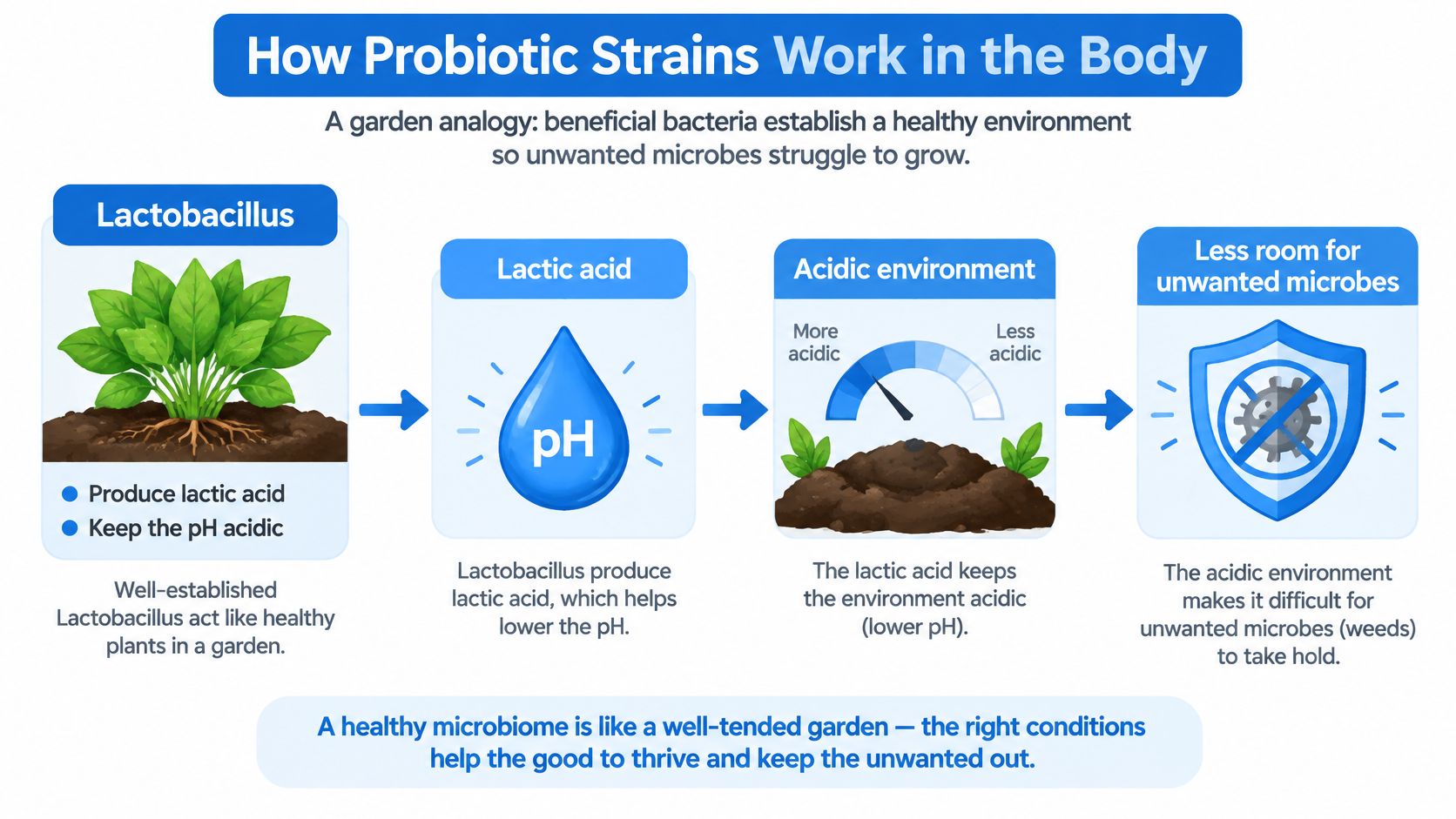
The Health Research Authority's Freya materials describe how Lactobacillus can produce lactic acid, lower vaginal pH, compete for attachment sites and influence local immune responses; some strains may also produce hydrogen peroxide or bacteriocins that inhibit other microbes. These are plausible biological mechanisms, not a guarantee of clinical benefit.
Different organisms, different jobs
Attachment sites are places on epithelial cells, the cells lining body surfaces, where microbes may adhere. If a beneficial organism competes successfully for those sites, an unwanted organism may have fewer opportunities to establish itself.
Reduced Lactobacillus abundance is associated with BV, candidiasis and urinary-infection risk. Oestrogen, vaginal acidity and Lactobacillus colonisation also interact, but an association doesn't establish that adding a supplement will correct the problem.
That distinction matters when you swallow a capsule. An oral product shouldn't be assumed to establish itself in the vagina, and detecting a microbial change wouldn't, by itself, prove symptom relief.
A convincing explanation of how something might work is the starting point for a clinical trial, not the result of one.
Turn the mechanism into a shopping question
Ask which strain was tested for your concern and how it was administered. A large colony count can't answer either question.
For a product-comparison example, XO's discussion of Bio Kult strains and clinical evidence offers a place to practise distinguishing ingredient descriptions from condition-specific findings. Our guide to probiotics for gut health can also help you keep digestive goals separate from vaginal claims.
For an additional visual explanation of the topic, you can watch the following video.
Reading Labels and Health Claims
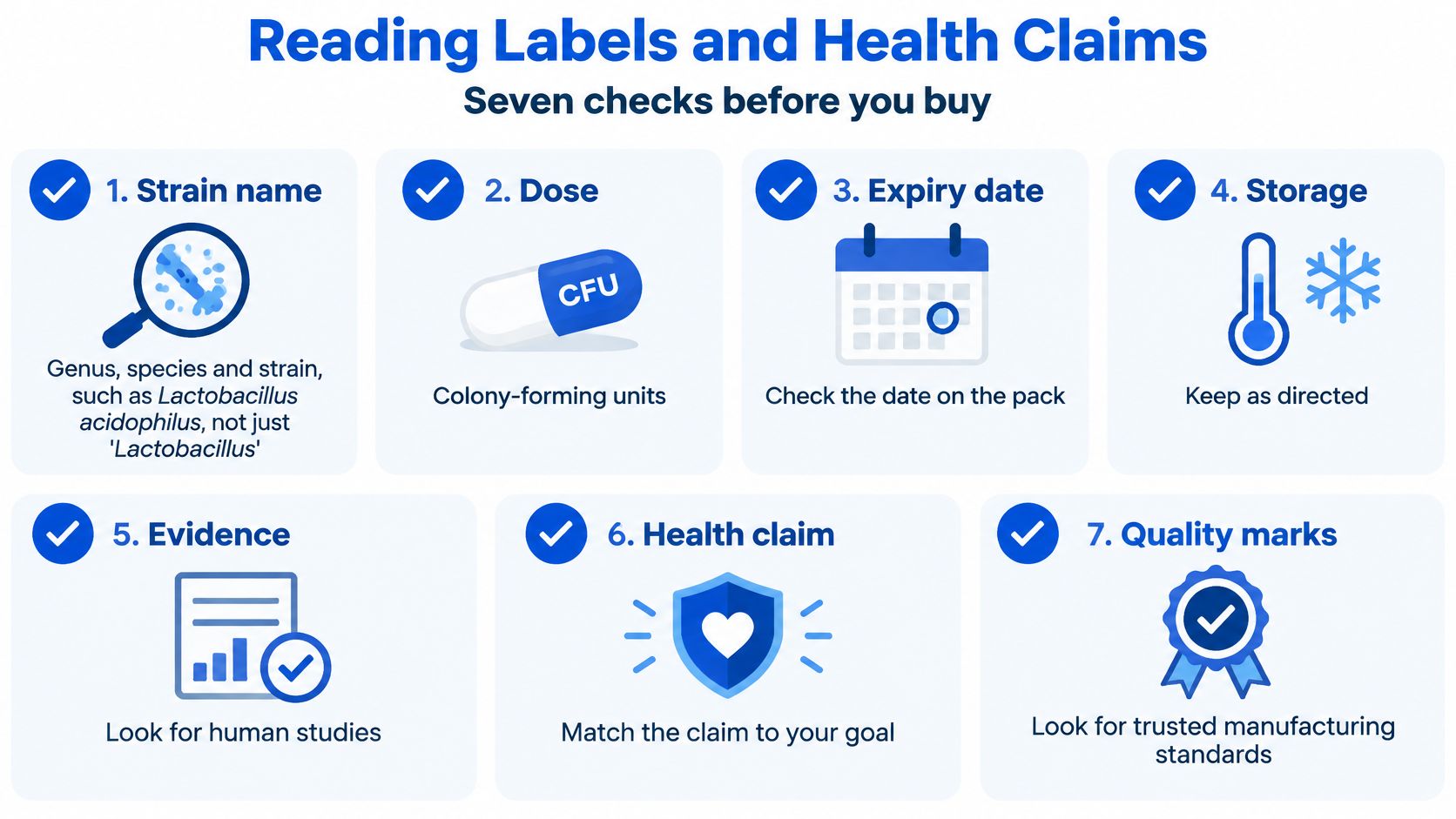
Use these seven label checks while comparing packs or online listings. The aim isn't to find the longest ingredient list. It's to find enough detail to judge what you're buying.
- Strain identity. Look for genus, species and the strain identifier. Lactobacillus is a genus; Lactobacillus acidophilus identifies a species, but still isn't a complete strain name. If the pack stops there, ask for the full identification.
- Dose. Find the colony-forming units, usually shortened to CFU, for the recommended daily serving. Prefer clear information about the viable count guaranteed at the end of shelf life, rather than only at manufacture.
- Route. Establish whether it's an oral capsule or a vaginal product. These aren't interchangeable, and an oral capsule shouldn't be inserted vaginally.
- Clinical target. Identify the concern studied with those strains. Evidence about bowel symptoms doesn't validate a vaginal-health promise.
- Duration and routine. Check how often the product is used and whether that schedule resembles the relevant clinical study. Don't invent a higher dose to try to speed up results.
- Ingredients. Read the full list for allergens, dairy, gluten and other ingredients relevant to you. A live culture description doesn't tell you whether the finished capsule suits your dietary requirements.
- Medical cautions. Check the warnings alongside your health conditions and medicines. If suitability is unclear, resolve it before starting.
This checklist graphic adds useful pack-handling reminders, including expiry and storage.
Compare information, not attractive wording
Suppose a pack describes a blend for women's wellbeing but doesn't identify its strains or the outcome tested. It hasn't given you enough information to assess strain identity or clinical relevance.
A different pack names its strains, states the dose and explains daily use. That's more useful, but it still needs evidence that matches your goal. Transparent labelling makes assessment possible; it doesn't automatically demonstrate effectiveness.
Keep expiry and storage in the decision too. Check the date before buying, and make sure you can follow the storage instructions at home.
Test the promise against the rules
The Advertising Standards Authority's guidance on probiotic claims explains that food and supplement health claims must be authorised on the Great Britain Nutrition and Health Claims Register; disease-prevention, treatment or cure claims aren't acceptable for foods unless appropriately licensed as medicines. The ASA also treats the word probiotic as potentially a general health claim, depending on context.
Common promises deserve different questions:
- Balancing hormones. Which hormone was measured, in whom, and was any meaningful symptom change demonstrated? A vague reference to balance doesn't answer that.
- Preventing thrush. This is a disease-prevention claim, not a description of a supplement's contents.
- Improving vaginal pH. Was pH measured with this strain and route? Even a measured change wouldn't automatically establish fewer infections.
- Supporting immunity. What exact authorised claim is being made, and which ingredient supports it? Don't assume the statement demonstrates a benefit from the live cultures.
Treat wording such as curing thrush or resetting hormones as a reason to pause. A responsible evidence description identifies the population, strain, route and measured outcome, without promising more.
Your quickest filter is simple: Which strain? Which studied condition? Which route?
When to See a Clinician First
Recurrent or persistent discharge, odour, itching, pain or urinary symptoms need assessment by a pharmacist, GP or sexual-health service. Book that assessment before trying any supplement for these symptoms. Similar symptoms can lead people to different self-diagnoses, so describe what you are experiencing rather than asking only for a particular product.
If a clinician prescribes metronidazole or clindamycin for bacterial vaginosis, use it as directed. A probiotic is optional and should not replace prescribed treatment.
Choose the appropriate next step
- An existing health condition or weakened immune system. Speak to a doctor before taking probiotic supplements. Bring your medicine list and the proposed product label so the conversation is specific.
- A mild general wellbeing goal without concerning symptoms. A defined supplement trial may be suitable, provided there is a relevant goal and a plan to review it.
- Pregnancy or breastfeeding. Include this in any discussion about vaginal or urinary symptoms and supplement use. Our guide to folic acid and pregnancy addresses a separate nutritional decision; it does not authorise probiotic use.
Make the consultation useful
Write down when symptoms began, whether they recur, any recent antibiotic treatment and what you have already tried. Include whether a previous episode was clinically diagnosed, rather than assuming the current symptoms have the same cause. A clinician can distinguish a recurrence from a new problem, and that distinction changes the treatment. Ask whether the strain and route you are considering have been studied for your specific symptoms. That question matters more than a women's health badge on the label.
Safety first: No product should delay assessment of persistent or worsening symptoms.
A supplement is optional. You can follow prescribed treatment without buying a probiotic.
How to Trial a Probiotic for Four Weeks
A useful trial needs a clear question: does this product improve the symptom I'm tracking? Without that question, it's easy to keep buying because you're unsure whether anything changed.
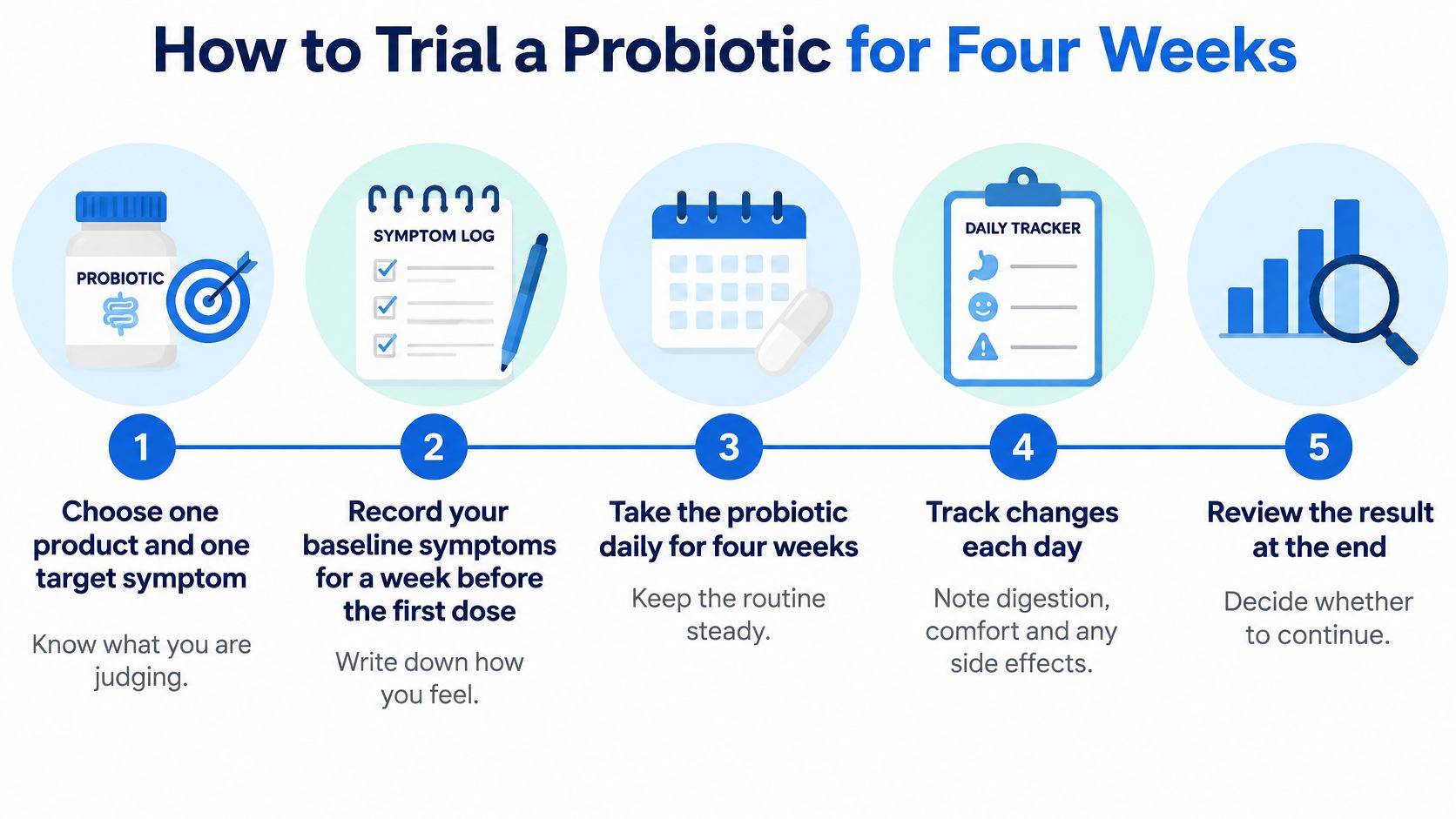
The NHS guide to foods that help digestion recommends taking a probiotic every day for at least four weeks before deciding whether it helps. That's an assessment period, not a guarantee of benefit, and it isn't a reason to postpone medical care.
Keep the experiment interpretable
- Choose one product and one target symptom. For a suitable digestive trial, that might be overall abdominal comfort. Avoid trying to assess digestion, vaginal wellbeing, energy and skin together.
- Record a baseline before the first dose. A practical option is to keep notes during the preceding week. Describe the symptom in ordinary language so you can recognise a meaningful change.
- Take it consistently. Follow the product's dosing instructions and use the same daily cue, such as breakfast, if compatible with those instructions. The minimum trial period allows a fairer assessment than judging after occasional doses.
- Keep a short daily log. Note the product taken, your target symptom and any new discomfort. A paper notebook or phone note is enough.
- Change one thing at a time. Starting another supplement or making a major dietary change at the same time makes interpretation harder.
- Review at the planned endpoint. Classify the result as clearly better, unchanged or worse. Look for a difference that matters to you, not a change so small you have to persuade yourself it happened.
- Act on the result. Stop and seek clinical advice if symptoms worsen. If nothing changes, don't continue indefinitely without reconsidering the choice.
Use the timeline as a reminder to record the outcome, not just take the capsule.
Decide what deserves a separate trial
If fibre is another option you're considering, our guide to psyllium benefits for gut health can help you explore that separately. Don't add it to rescue an inconclusive probiotic experiment.
Persistent vaginal or urinary symptoms don't belong in this routine. Likewise, anyone with an existing condition or weakened immune system should get medical advice before starting, not after completing the log.
Confirm the Right Choice Before You Buy
A good purchase is one you can explain in plain language. You should be able to name the symptom or goal you want to address, point to the strain and study that make the product relevant, and say what result would make you stop. A product name is a street sign: it tells you roughly where you are, not whether the road reaches your destination.
Make the decision in order
- Name the concern. Choose the relevant evidence category rather than a broad ambition to improve women's health.
- Resolve clinical questions. If symptoms need assessment, make that appointment before buying.
- Check the product details. Confirm strain identity, studied condition, dose, route, duration, ingredients and cautions.
- Reject unsupported promises. Don't choose a food supplement because it promises disease prevention, treatment or a hormone reset.
- Plan the review. Write down the target symptom and decide how you'll distinguish improvement from no change or worsening.
For another consumer perspective, Momotaro Apotheca's evidence-based guidance on women's probiotics can give you questions to bring to a product comparison. Apply the same strain, route and condition checks to any recommendation, including one that sounds reassuring.
A practical option to compare
Pumpernickel Health Foods helps customers start with how they want to feel, using categories such as women's health, digestive health, brain and focus, better sleep and joint support. That gives you a starting point for browsing. It does not replace checking clinical relevance.
One product to assess is For Women from Optibac Probiotics, a capsule supplement. Check the pack size on the product page, along with its current strain information, dose and oral route against your goal before adding it to your basket. The product name alone doesn't establish a benefit.
If the label cannot tell you which strain was studied for your concern, at what dose and by which route, the product is not ready for a trial.
Pumpernickel Health Foods offers free one-to-one consultations with supplement experts for personalised guidance. Bring the label you're considering and a clear description of your goal, so the consultation can focus on the information you need to compare and the questions that belong with your clinician.
A considered choice leaves you with a simpler routine and a clear way to judge whether the product earned a place in it.
You can browse the probiotic range at Pumpernickel Health Foods or arrange personalised guidance before choosing a women's probiotic.