
If B vitamins help your body release energy, does taking more automatically make you feel more energetic? That's the gap between what these nutrients do and what a supplement can realistically offer. Correcting a nutritional shortfall and boosting an already adequate intake aren't the same thing.
A B vitamins complex can be a convenient way to support intake when your diet leaves several gaps. But some people need a particular nutrient, a blood test or pregnancy-specific advice instead. Understanding the difference helps you choose a product for a clear reason, rather than buying the strongest-looking bottle.
Table of Contents
- The Eight B Vitamins at a Glance
- Who Is Most Likely to Fall Short
- Does Tiredness Mean You Need a B Complex?
- Folate, Folic Acid and Pregnancy Guidance
- How B Vitamins Are Handled and Where Doses Go Wrong
- How to Check a B Complex Label and Use It Safely
- Confirm Your Need Before You Buy a B Complex
The Eight B Vitamins at a Glance
A B complex is a group of eight water-soluble vitamins that your body uses to release energy from food, make red blood cells and keep the nervous system working. A B-complex supplement combines these nutrients, although the amounts and forms differ between products.
Think of a workbench with eight tools. Each tool has a different job, and having plenty of one doesn't replace a missing one. Likewise, B12 can't do folate's entire job, and niacin can't stand in for thiamin.
B vitamin roles, food sources and UK label reference per day
The daily amounts below are the adult food-labelling reference values set out in the food information regulation's nutrient reference table. They describe each nutrient separately, not a combined daily requirement for a B complex.
| Vitamin | Main role | Common food sources | UK label reference per day |
|---|---|---|---|
| B1 thiamin | Energy release from carbohydrate and nerve function | Wholegrains, pulses, pork, fortified cereals | 1.1 mg |
| B2 riboflavin | Energy release and healthy skin and red blood cells | Milk, eggs, lean meat, mushrooms, fortified cereals | 1.4 mg |
| B3 niacin | Energy metabolism; also made from tryptophan in protein | Meat, fish, peanuts, fortified cereals | 16 mg |
| B5 pantothenic acid | Formation of coenzyme A for fat and energy metabolism | Eggs, meat, mushrooms, avocado, wholegrains | 6 mg |
| B6 pyridoxine | Protein metabolism, nervous system function and red blood cells | Chicken, fish, potatoes, bananas, pulses | 1.4 mg |
| B7 biotin | Fat and carbohydrate metabolism | Eggs, nuts, seeds, dairy | 50 µg |
| B9 folate and folic acid | DNA synthesis, cell division and red blood cells | Green leafy vegetables, pulses; folic acid in supplements and fortified foods | 200 µg |
| B12 cobalamin | Nerve function, red blood cell formation and DNA synthesis | Meat, fish, eggs, dairy; fortified foods and supplements for vegans | 2.5 µg |
µg means micrograms; mg means milligrams. Check the unit as carefully as the number when comparing bottles.
What the table tells you
These reference amounts help you judge nutritional coverage, not how much extra energy a supplement will produce. A large percentage on a label doesn't establish that the product will improve concentration or make an adequately nourished person feel better.
B12 and folate often attract the most attention, but their food sources are quite different. A meal rich in lentils and leafy vegetables may contribute useful folate without providing a reliable source of B12.
Look at your usual meals rather than an unusually healthy day. Do you regularly eat pulses, wholegrains, vegetables and appropriate protein foods? If you avoid a food group, identify which nutrients it normally provides before deciding that you need the whole complex.
The practical benefit of a balanced B complex is convenience: it can bring several nutrients into one routine when several dietary gaps are plausible. Its value comes from matching those gaps, not including every vitamin in impressive-looking amounts.
Who Is Most Likely to Fall Short
In the UK National Diet and Nutrition Survey for 2019–2023, red-blood-cell folate below 305 nmol/L, the threshold associated with risk of megaloblastic anaemia, occurred in 12% of 11–18-year-olds, 4% of adults aged 19–64, 2% of adults aged 65 and over, and 7% of women aged 16–49.
Those findings make folate a genuine nutritional concern, particularly for adolescents. They don't mean that everyone in those groups needs a B complex, or that low folate proves low levels of every B vitamin.
Intake, blood status and deficiency aren't interchangeable
Dietary intake describes what you eat and drink. Biochemical status describes measurements such as vitamin concentrations in blood. Clinical deficiency requires interpretation alongside symptoms, health history and appropriate investigations.
Someone can report a varied diet yet have an absorption problem. Another person may have a limited diet without currently showing symptoms. That's why a risk assessment is more useful than guessing from how healthy your meals appear.
| Risk group | Why intake or absorption may fall short | What to raise with a professional |
|---|---|---|
| Vegans and strict vegetarians | Unfortified plant foods aren't reliable B12 sources; vegetarian intake also needs checking | Whether B12 intake is reliable and status needs checking |
| Adults aged 65 and over | Age-related stomach changes can reduce B12 absorption from food | Whether symptoms or history warrant a B12 test |
| Women who are or may become pregnant | Folic acid advice is dose- and time-specific | The appropriate pre-conception folic acid dose |
| People who drink heavily | Poor intake and impaired absorption can affect thiamin and folate | Thiamin and folate assessment and suitable treatment |
| Restricted or low-calorie diets | Less food or fewer food groups can reduce several B-vitamin intakes | A diet review and whether supplementation is appropriate |
| People taking certain medicines | Metformin and acid-reducing medicines can affect B12 levels | Medicine-related monitoring before starting a complex |
| People with gut disease or bariatric surgery | Digestive disease or altered anatomy can reduce absorption | A monitoring plan and suitable formulation or dosing |
Make the advice fit your circumstances
For a closer look at dietary exclusions, Yuve's resource on B vitamin gaps on plant-based diets provides a useful starting point for questions about fortified foods and supplements. Use it to prepare for a discussion, not to diagnose yourself.
If you're comparing a complex with broader nutritional support, our guide to multivitamins for women can help you frame that choice. Neither a women's label nor a plant-based label replaces checking the actual formulation.
Note which risk factors apply to you. An intake problem, an absorption problem and a pregnancy requirement may need very different solutions.
Does Tiredness Mean You Need a B Complex?
Does feeling tired mean you're short of B vitamins? No. UK Government healthy-eating guidance says the vitamins and minerals needed can be obtained from a healthy, balanced diet, with supplements recommended in particular circumstances rather than routinely.
Persistent fatigue can have many causes. These include anaemia associated with low iron, B12 or folate, poor sleep, thyroid disorders, low mood or stress, infection and side effects from medicines. Buying a supplement without considering these possibilities can delay finding the underlying problem.
Use this checklist to organise your next steps.
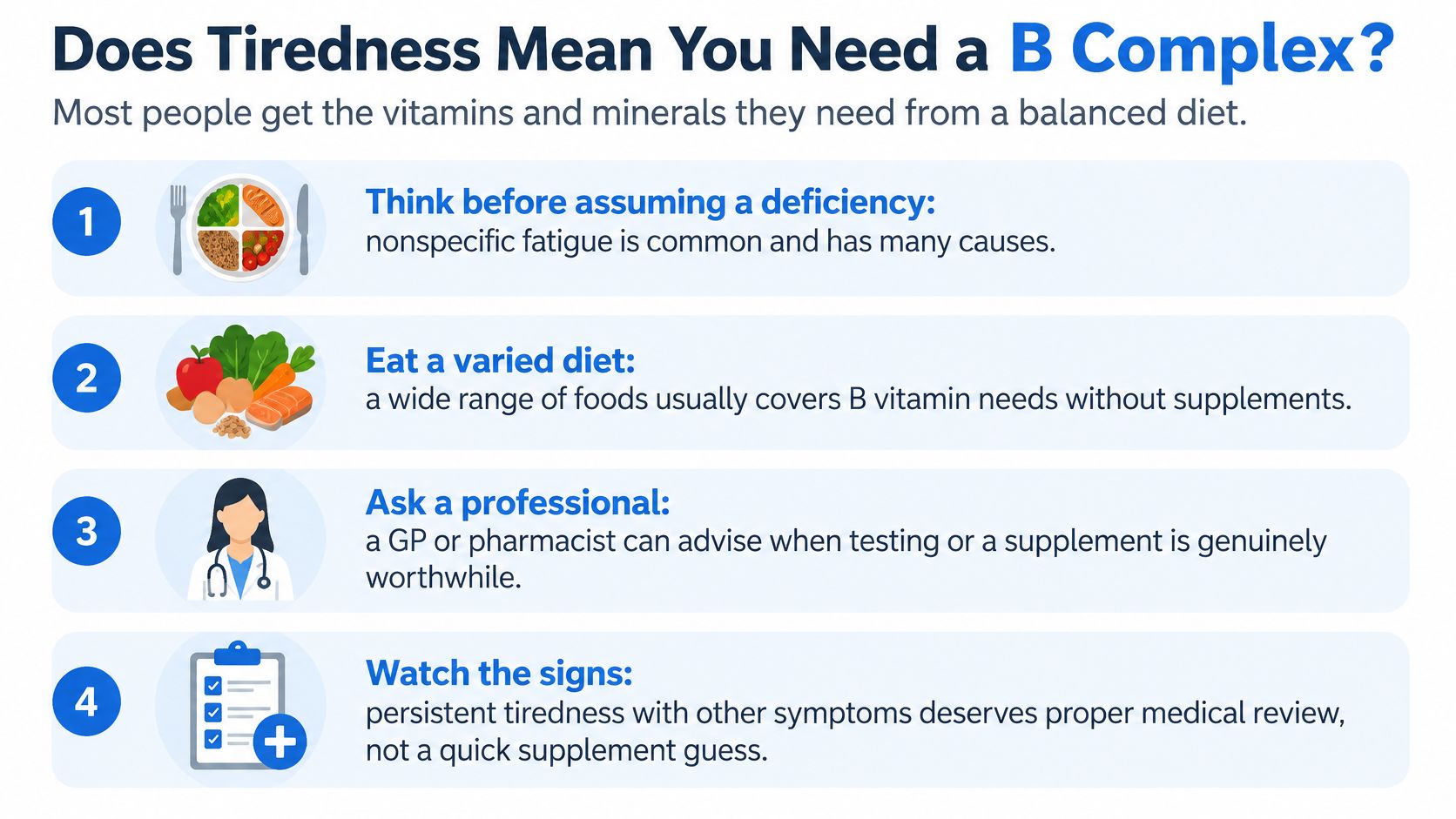
Symptoms that deserve assessment
The NHS guide to B12 or folate deficiency anaemia lists extreme tiredness, weakness, breathlessness, headaches, palpitations and a sore or red tongue among possible symptoms. B12 deficiency can also cause numbness, pins and needles, balance problems, memory difficulties and confusion.
Symptoms can occur without anaemia. Some people have symptoms despite apparently normal vitamin levels, while others have low levels without symptoms, so a clinician needs to interpret the whole picture.
Don't use a supplement trial to investigate new neurological symptoms. Seek medical assessment rather than waiting to see whether a bottle helps.
Keep a useful fatigue diary
A four-week diary can help you spot patterns and give your GP a clearer account. Don't postpone an appointment to finish it, especially if symptoms are worsening.
- Record the timing: Note when tiredness starts, whether it follows meals or activity, and what it stops you doing.
- Describe your meals: Include skipped meals, fortified foods, alcohol and supplements, not just your main evening meal.
- Track sleep: Record bedtime, waking, interrupted sleep and whether you feel refreshed.
- List medicines and changes: Include prescribed medicines, over-the-counter products and any new symptoms.
Our explanation of vitamin B12 and fatigue can help you distinguish nutritional support from an energy-boosting promise. For persistent unexplained tiredness, book a GP appointment before buying a B complex, and bring whatever diary notes you've already made.
Folate, Folic Acid and Pregnancy Guidance
Folate is the term commonly used for the forms found naturally in food. Folic acid is the manufactured form used in supplements and fortified foods. They're related to vitamin B9, but recognising the wording matters when you're following pregnancy advice.
B12 is a separate vitamin. Although B12 and folate both support normal blood formation, a product containing one isn't a substitute for the other.
| Term on food or supplement information | What it means for your decision |
|---|---|
| Folate | Often describes naturally occurring vitamin B9 in foods such as leafy vegetables and pulses |
| Folic acid | The form specified in standard UK pregnancy supplementation advice |
| Methylfolate | Another supplemental folate form; its presence doesn't establish that a product matches your pregnancy advice |
| B complex | A mixture of B vitamins, not automatically a pregnancy-specific supplement |
The dose and timing have a purpose
UK Government folic acid guidance advises women trying to conceive or who could become pregnant to take 400 micrograms of folic acid daily before conception and through the first 12 weeks of pregnancy. This targeted recommendation helps protect early development against neural tube defects.
The timing matters because early development happens before some people realise they're pregnant. Waiting until a routine appointment to consider folic acid can miss part of the intended supplementation period.
A general B complex isn't automatically interchangeable with this advice. It might contain a different amount or form of folate, alongside doses of other nutrients that you don't need.
Healthy meals remain valuable alongside appropriate supplementation.

Why fortified food doesn't settle the question
UK requirements for non-wholemeal wheat flour include fortification with calcium, iron, niacin and thiamin. Population-level fortification and individual pregnancy supplementation serve different purposes, so eating fortified foods doesn't remove the need to follow targeted folic acid advice.
Food choices also differ from day to day. A supplement with an appropriate declared amount makes the recommended intake more predictable than trying to calculate protection from vegetables, bread and cereal alone.
Feed Mom & Me's folate guidance for expecting mothers can help you prepare questions about terminology. For the product decision itself, follow UK guidance and your maternity team's advice rather than assuming a methylated form is necessarily preferable.
A previous pregnancy affected by a neural tube defect can change medical recommendations. Breastfeeding, existing health conditions and prescribed medicines also warrant individual advice.
Speak to a GP, midwife or pharmacist before conception where possible. Bring the label of any supplement you already take so they can check its folic acid content and avoid unnecessary overlap.
How B Vitamins Are Handled and Where Doses Go Wrong
Your body handles many B vitamins in a straightforward way: it absorbs what it can use and sends much of the surplus out through urine. That is what water-soluble means in practice. The description can still mislead, because a large supplemental dose may cause problems even when your body clears the excess.
B12 works differently. The liver acts like a pantry for B12, holding reserves that can carry you through a missed dose without an immediate drop. Those stores have limits, and a diet that excludes the usual sources still needs reliable intake from somewhere.
Keep regular nutritional support separate from high-dose treatment. A complex can help close likely dietary gaps; it supplies no calories and cannot guarantee greater stamina. A B complex suits some readers far more than others. If your meals are varied and your need is unclear, the product may add little. If your diet is restricted, the same product may be a practical form of support.
Different vitamins have different excess risks
Long-term high intakes of vitamin B6 can damage nerves. At an appropriate intake, B6 supports normal nervous-system function, yet larger doses do not offer increasing protection. High-dose niacin can produce skin flushing, warmth and itching. That reaction is a known effect of nicotinic acid, and it says nothing about whether the supplement is working well.
Folate and folic acid need clear label wording. High-dose folic acid also carries a separate B12 masking risk, which the label check should address.
Where accidental excess starts
Overlap is the usual route to accidental excess. Someone may take a multivitamin, a B complex and an energy product without noticing that all three contain B6 or niacin.
- Choose one main B complex: Do not combine several formulations because they use different marketing terms.
- Treat targeted nutrients separately: A prescribed or clinician-recommended nutrient needs its own dosing instructions.
- Do not double up after forgetting: Follow the product directions rather than trying to compensate with extra servings.
- Check the reason for continuing: An ongoing purchase should have an ongoing nutritional purpose.
Say you start a complex during a period of restricted eating. Once your meals become more varied, reassess whether the same product still suits you instead of automatically moving to a stronger formula. If a deficiency is confirmed, follow the treatment plan ahead of a general retail complex. Your need can change with your diet, and the product should change with it.
How to Check a B Complex Label and Use It Safely
Start with the nutrient panel and directions. You need to know what a daily serving contains, beyond which vitamins appear in the ingredient list. The front label can tell you the product name and the marketing story; the back tells you what a daily serving supplies.
Use this visual prompt while comparing products.
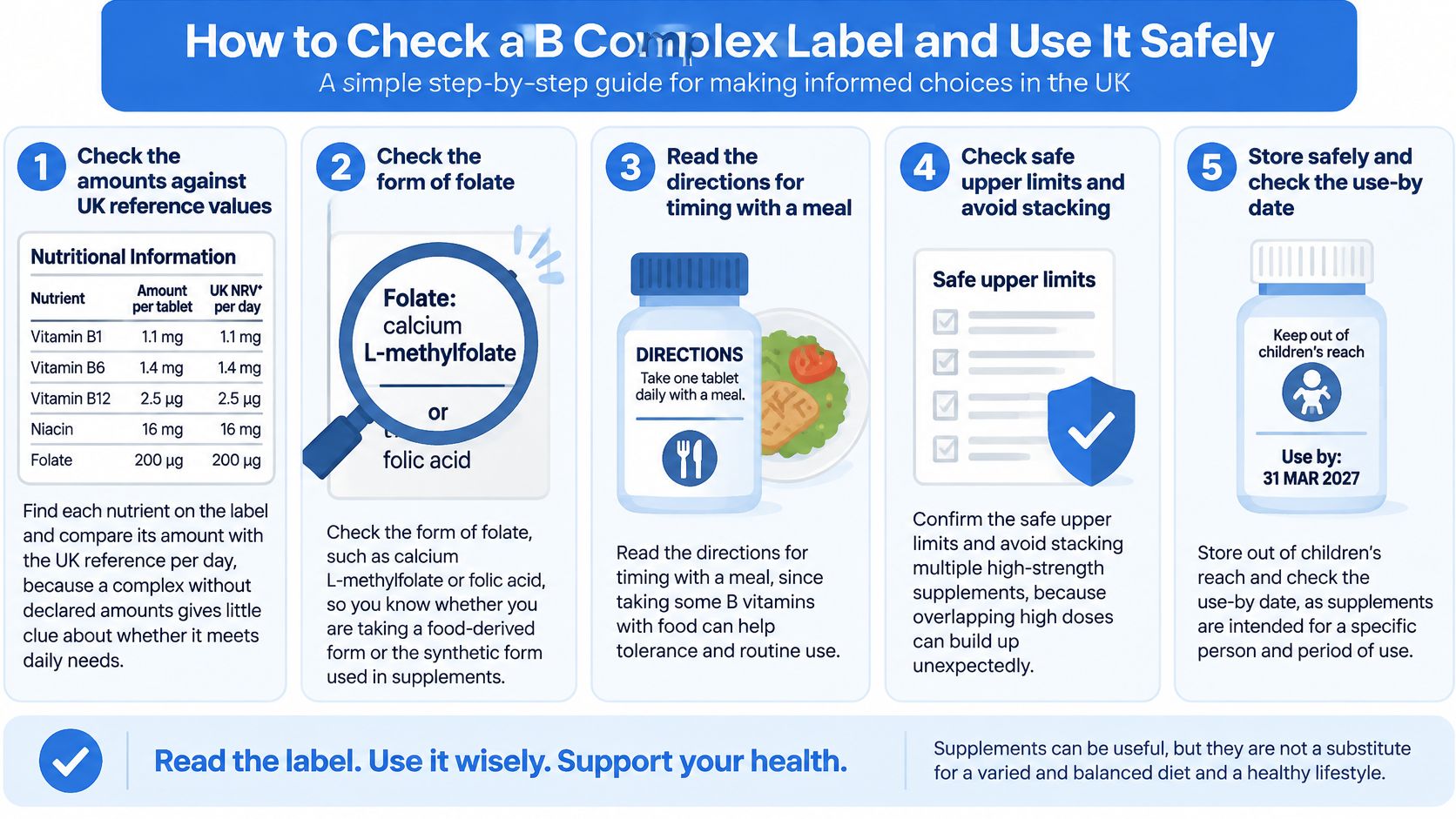
A practical label-checking routine
Find every declared nutrient amount. Compare the daily serving with the UK label references, and check whether the panel describes a capsule, a measured liquid serving or the complete daily dose. A complex without clear amounts gives you little basis for judging nutritional coverage.
Add your other sources. Include multivitamins, fortified cereals, energy drinks and separate nutrient supplements. Put their labels side by side so you can identify duplication rather than relying on memory.
Check folic acid carefully. Identify whether the label lists folic acid or another folate form, and check the amount against the guidance in step 4 before exceeding it.
Separate label references from dietary advice. The 2.5 µg B12 label reference is a food-labelling benchmark, whereas NHS Wales vitamins and minerals guidance gives the adult daily advice for people aged 19 to 64 as about 1.5 micrograms and flags more than 1 milligram of folic acid as a level to discuss with a professional. These figures answer different questions. Neither tells you the appropriate treatment dose for diagnosed deficiency or impaired absorption.
Start with suitability, not strength. Unless a GP or healthcare specialist recommends otherwise, avoid choosing a high-dose formula because it looks more substantial. Follow its directions, including whether to take it with food, and use the supplied measuring device for liquids.
Set a review point. For example, you could agree an eight-to-twelve-week review with your adviser to discuss your diet, tolerance and whether there's still a reason to continue. This is an organisational example, not a promise about when symptoms should improve or a substitute for clinical monitoring.
Respond to new symptoms and changing circumstances. Stop a non-prescribed supplement and seek advice if you develop new symptoms. Check before starting if you're pregnant, breastfeeding, have kidney or liver disease, or take regular medicines. Keep products out of children's reach and check their use-by dates.
Compare the whole formulation
Read our guide to whether you can take too many vitamins if your routine includes several products. Bring the actual packaging to a pharmacist when checking combinations, because similar product names can hide different formulations.
The video below presents supplement-label information in a visual, step-by-step format.
A liquid may be more convenient if you dislike tablets, while a capsule may fit your routine better. Judge the product by its declared daily amounts, the form of each nutrient and whether the directions fit your routine.
Confirm Your Need Before You Buy a B Complex
A B complex is worth buying when you can name the gap it fills. Before choosing, ask yourself:
- Does my usual diet regularly omit whole food groups? Look for patterns across a week, not a single busy day.
- Do medicines, life stage or absorption problems change my needs? Mention them when you ask for advice.
- Have persistent symptoms been assessed? Let a clinician check fatigue or other symptoms rather than treating them by guesswork.
A likely dietary gap can make a balanced complex worth discussing. An absorption disorder or confirmed deficiency may need a more specific approach, while an adequate diet without another indication may leave little reason to add one.
Choose for your routine, not a promised transformation
At Pumpernickel Health Foods, we sell B-complex supplements including High Six B-Complex, priced from £9.35 to £22.10, and Vitamin B Complex – Liposomal Liquid High Absorption. The latter provides essential B vitamins in a convenient liquid format for daily nutritional support; compare its declared amounts and directions with your needs rather than choosing from its name alone.
The liquid format is shown below.

If labels mention coenzyme forms, NexiHerb LLC's coenzyme B complex dosing guidance can help you prepare questions about the terminology. Don't treat a particular form as permission to increase the dose.
Our Bedford store offers free, pre-booked one-to-one consultations with supplement specialists, alongside advice by phone and WhatsApp. Bring your current labels, medicines list and fatigue diary so the discussion starts with your circumstances.
Pumpernickel Health Foods offers B-complex supplements and practical help comparing formulations with your diet and existing routine. Visit Pumpernickel Health Foods to explore the options or arrange a pre-booked consultation.