
You're standing in the aisle, phone in one hand and two very similar bottles in the other. Both promise daily support for women, both list impressive rows of vitamins, and neither explains whether it's right for your periods, your diet, or your plans for the next year. That uncertainty is normal, and it's exactly why choosing well starts with you, not with the longest label.
Table of Contents
- Why the Right Multivitamin Depends on You
- Understanding What a Women's Multivitamin Can Do
- Match Key Nutrients to Life Stage
- Compare Formulas for Different Needs
- Read a Women's Multivitamin Label Without Guesswork
- See How Four Women Would Compare Products
- Use Your Multivitamin Safely and Responsibly
- Make a Confident Final Choice
Why the Right Multivitamin Depends on You
One shopper picks up a multivitamin for women because her periods are heavy, she rarely eats red meat, and she's wondering about iron. Another eats a varied diet, isn't menstruating heavily, and mainly wants simple everyday coverage through winter. The bottle that helps the first woman feel confident she's covering a likely gap may add iron the second woman doesn't need. Same shelf, different answer.
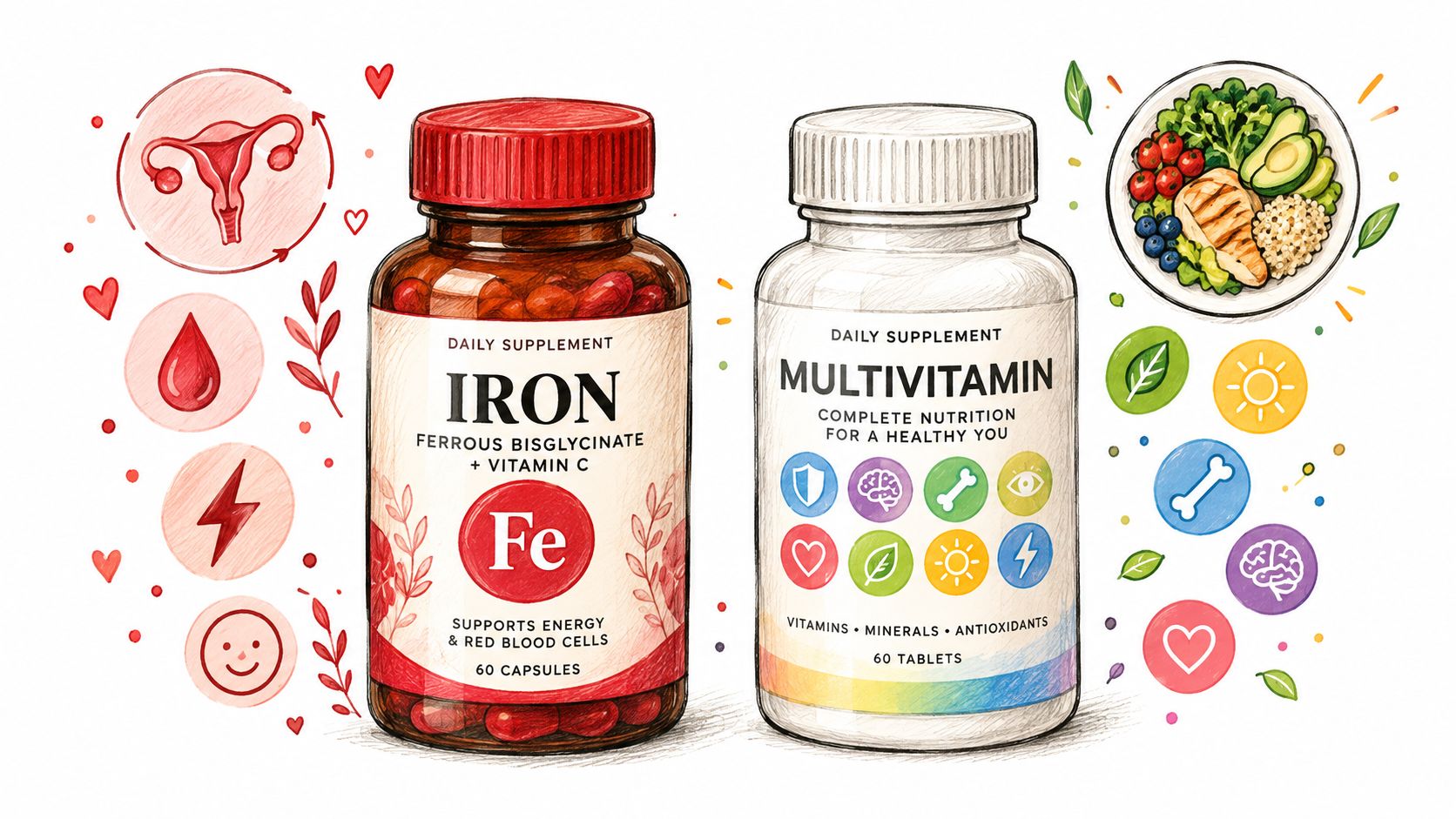
That's the trap in judging by ingredient count. More nutrients can sound like better value, yet a long list doesn't tell you whether the doses are meaningful, whether the form suits pregnancy planning, or whether you're duplicating something you already take. A shorter formula that matches your circumstances can be the smarter, calmer purchase.
The questions that change the answer
Your age and life stage, menstrual blood loss, pregnancy status or plans, diet pattern, allergies, medicines, and existing health conditions all shift what deserves attention. A vegan shopper, for example, will read a label differently from someone who eats fish and dairy most days. Someone taking prescribed medicine needs an extra check before adding anything new, however ordinary it looks.
If you're building a shortlist, a practical supplement checklist from Lila can help you organise those questions before you compare brands. Use it to note your goal, your current products, and anything you'd rather ask a pharmacist or GP about first.
Think of a multivitamin as a convenient nutritional tool that supports the meals you're already eating. It isn't a cure-all, and it doesn't replace food, sleep, or medical care. When you match it to your real life, you gain the benefit that matters most at the shelf, confidence that you're buying for a reason you can explain.
Understanding What a Women's Multivitamin Can Do
A useful way to picture a multivitamin is as a toolbox. Inside are selected building materials, perhaps iron, vitamin D, folate, and vitamin B12, each included for a particular job. Food is the larger basket beside it, supplying the wider set your body uses every day, including energy, fibre, protein, and many compounds a tablet can't reproduce.
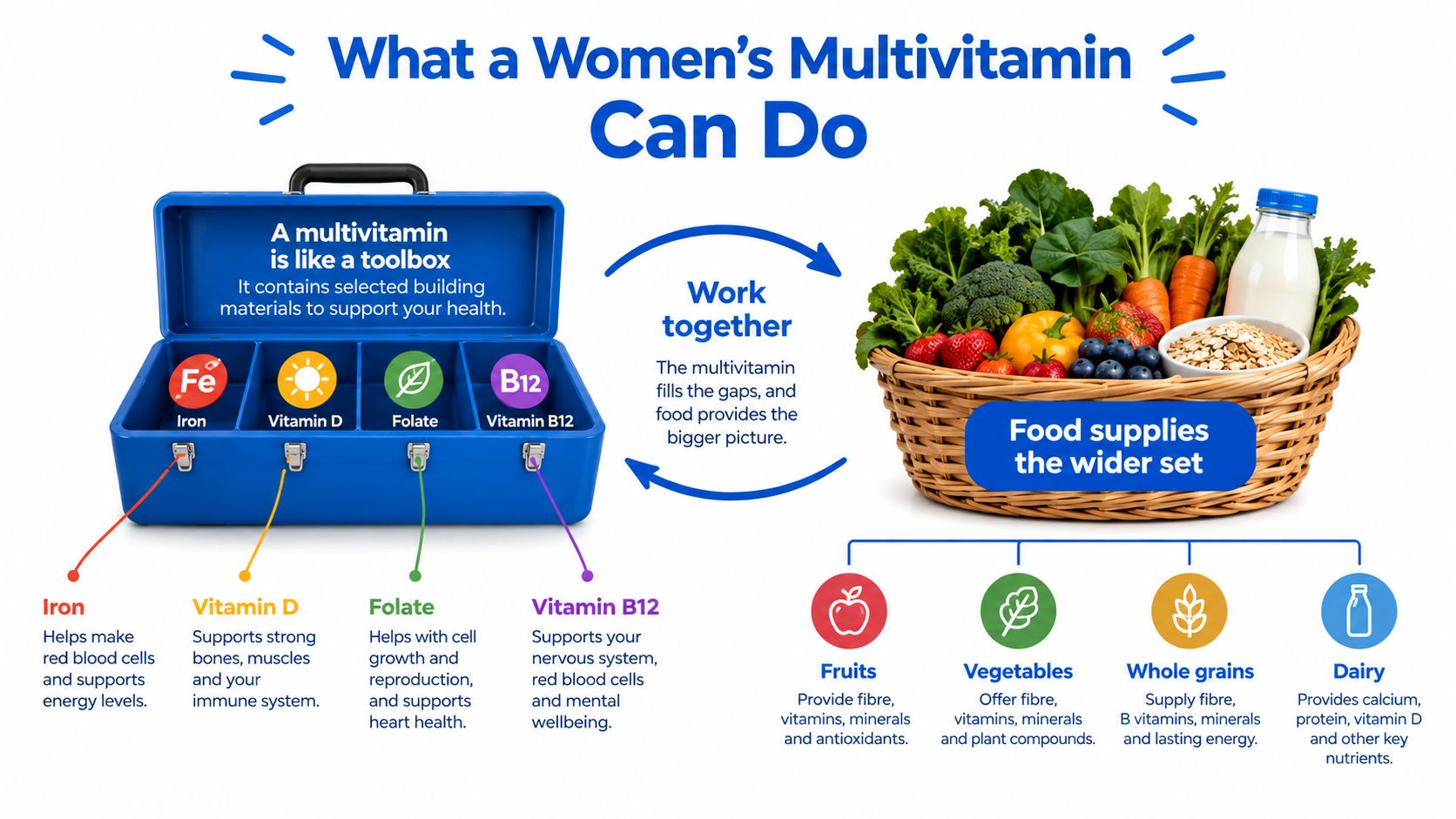
Used that way, a well-chosen formula can help bridge a specific dietary or seasonal gap. It can't reliably correct every deficiency, replace a balanced diet, or guarantee more energy and stronger immunity for everyone. Those broader promises are where shoppers often feel disappointed, because the product was asked to do a job it was never designed to do.
Key concept: Nutritional support helps you cover likely shortfalls. Clinical treatment addresses a diagnosed deficiency or condition, and that needs qualified advice, not a stronger-looking bottle.
The gap idea isn't theoretical. UK dietary analysis of micronutrient intakes in women and men found women aged 20 to 59 had lower intakes than men for nine micronutrients, including iron, calcium, iodine, folate, vitamin B12, magnesium, and potassium, and 25.3% of women had iron intakes below the Lower Reference Nutrient Intake. That doesn't mean every woman is deficient. It means some nutrients are harder to obtain consistently, so targeted label checking beats blanket reassurance.
Two shoppers, two different gaps
A woman eating varied meals with dairy, eggs, vegetables, and whole grains may only want modest everyday coverage. A woman on a restrictive or low-appetite diet faces a different risk, because several nutrients may fall short at once, and some, such as calcium and potassium, are difficult to supply in meaningful amounts from one small tablet.
That's why useful doses matter more than ingredient count. A formula earns its place in your routine when it supplies sensible amounts of the nutrients your diet plausibly misses, fits alongside your other products, and is easy to take consistently. The benefit to you is practical, fewer nagging doubts about what's missing, without pretending a tablet can do the work of your whole diet.
Match Key Nutrients to Life Stage
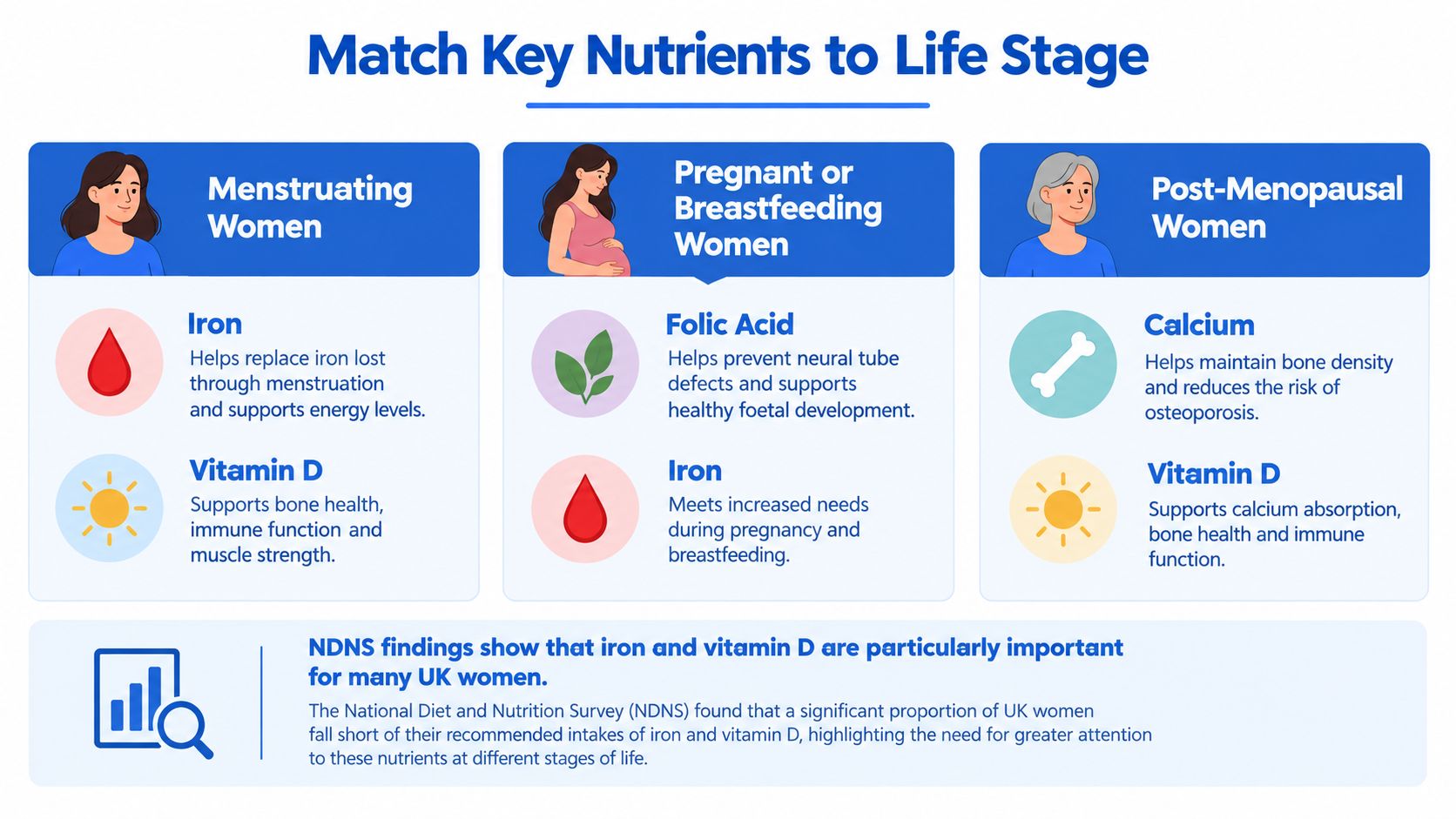
Nutrients don't stay equally relevant across your whole life. Menstruating years, pregnancy planning, and later adulthood each push different items to the top of the label, which is why a generic lecture on every vitamin rarely helps you choose.
UK population data explains why iron and vitamin D get so much attention. In NDNS results for 2016 to 2019, women aged 19 to 64 consumed an average of 76% of the UK Reference Nutrient Intake for iron, 25% had intakes below the Lower Reference Nutrient Intake, and 17% of adults aged 19 to 64 had low vitamin D status across the year. These are population patterns, not a diagnosis for you personally, but they show which gaps are common enough to check first.
Menstruating years
Regular blood loss makes iron the headline question for many women in this stage, especially if meat intake is low or periods are heavy. An iron-containing multivitamin can be a sensible part of a broader nutrition strategy when dietary intake is inconsistent. It shouldn't replace testing where anaemia is suspected, because symptoms, diet, blood loss, and ideally blood results determine whether a standard multivitamin amount is appropriate or insufficient.
Later adulthood
After periods stop, the iron conversation changes. Routine high iron is no longer an automatic advantage just because a product says women on the front, and taking extra iron without a reason isn't a harmless bonus. Attention tends to shift towards nutrients linked to bone health and to dietary changes that come with reduced appetite or a narrower range of foods.
Pregnancy planning
This is the stage where a general formula needs the closest scrutiny. Folate becomes time sensitive around conception, and the form of vitamin A matters because products containing vitamin A as retinol should be avoided during pregnancy. If pregnancy is possible or planned, read guidance on folic acid in pregnancy and what to check first before assuming any women's formula is suitable.
Dietary restrictions cut across every stage. A vegan diet, food allergies, gastrointestinal conditions, or consistently eating very little can all change which nutrients deserve priority, regardless of age.
If you have heavy periods, ongoing symptoms, a diagnosed condition, or you're taking medicine, treat that as your cue to seek medical advice before treating a shopping decision as a health solution.
Matching nutrients to life stage gives you a clear benefit, you stop paying for ingredients chosen for somebody else's body. You also spot sooner when the right next step isn't a different product, but a conversation and possibly a blood test.
Compare Formulas for Different Needs
Comparing side by side works better than comparing brand claims. Start by finding the profile closest to your situation, then use it to decide what to examine on the label and what should prompt advice first.
One figure shows why age belongs in that comparison. NHS guidance on iron requirements recommends 14.8 mg of iron daily for women aged 19 to 49 and 8.7 mg for women aged 50 and over, and women with heavy periods have a greater risk of iron-deficiency anaemia and may need professional advice about supplementation. A formula designed around menstruating years therefore won't automatically suit later life.
Women's multivitamin needs by context
| Reader profile | Nutrients to examine | Formula or dietary focus | Check before use |
|---|---|---|---|
| Everyday wellness | Vitamin D, B vitamins, folate | Balanced daily formula alongside varied meals | Duplication with other supplements |
| Menstruating, heavy periods | Iron, folate, vitamin B12 | Iron-containing option only if appropriate | Testing and advice where anaemia is possible |
| Later adulthood | Vitamin D, calcium from food, vitamin B12 | Formula without assumed high iron | Whether iron is needed at all |
| Vegan or restrictive eating | Vitamin B12, iodine, iron, calcium | Diet-first plan plus targeted coverage | Whether one tablet supplies meaningful amounts |
| Preconception or pregnancy | Folic acid, vitamin D, vitamin A form, iodine | Pregnancy specific formula | Pharmacist, GP, or midwife review |
No row declares a universal winner, and nothing in the table is a personalised dose recommendation. It's a filter. It helps you reject products quickly when they include something you don't want, omit something central to your profile, or raise a question you can't answer from the label alone.
For the heavy periods profile, for example, the useful question isn't whether iron appears on the packet. Before buying, read background on iron for women and when to seek advice and consider whether testing would tell you more than guessing. For pregnancy planning, the useful move is checking folic acid amount and vitamin A form, then confirming suitability with a professional.
By identifying your closest use case, you can write targeted questions, shortlist only formulas built for that context, and compare them on equal terms. That's a more satisfying benefit than a bigger capsule, because every product still on your list has earned its place.
Read a Women's Multivitamin Label Without Guesswork
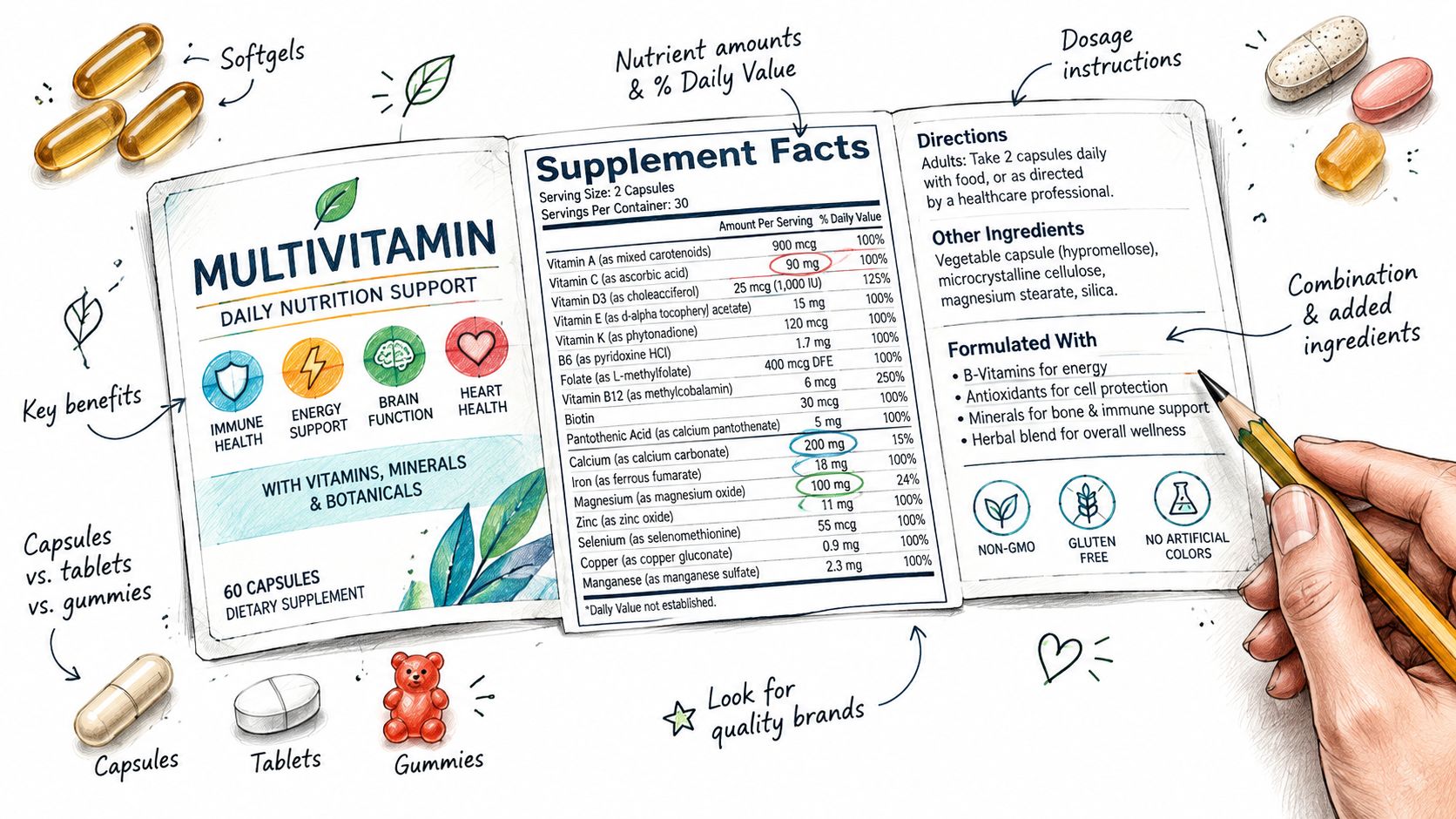
Turn the bottle around and work in a set order, purpose, dose, form, combination, then format. That sequence stops front-of-pack words such as complete or advanced from doing your thinking for you.
A repeatable label check
- State the purpose: Name the one or two gaps you're trying to cover before you read anything else.
- Check the dose: Look for meaningful amounts of those nutrients, not token traces added so a name can appear on the list.
- Check the form: Note the exact form where it matters, especially vitamin A and folate around pregnancy.
- Check combinations: Compare the label with every other supplement you take, because duplicate doses hide easily across products.
- Check the format: Choose tablets, capsules, liquids, or gummies you'll take as directed, and check serving size carefully.
Pregnancy planning shows why dose and form can't be skipped. NHS pregnancy guidance on vitamins and supplements advises 400 micrograms of folic acid daily before conception through the first 12 weeks for women who are pregnant, trying to conceive, or able to become pregnant, while some higher-risk women may instead need a medically advised 5 mg dose. A general women's product shouldn't be assumed equivalent to that advice, and a higher-risk dose is a medical decision, not an upgrade you select yourself.
Watch for proprietary blend language that groups ingredients without making individual amounts clear. Unclear serving directions deserve the same caution, because a price that looks generous can change once you realise the daily serving is several capsules. Decorative botanicals may suit some shoppers' preferences, but they don't compensate for weak amounts of the nutrient you came for.
What builds trust at shelf level is simpler. You want a readable ingredient list, transparent amounts, clear allergen information, and staff who'll explain trade-offs rather than push the largest bottle. Access to a consultation helps when two labels look similar but your medicines, diet, or pregnancy plans make them different in practice.
Reading labels this way benefits you every time you shop. You become harder to mislead, quicker to compare, and clearer about when a product is good enough, which is often the point where buying feels calm instead of pressured.
See How Four Women Would Compare Products
These are illustrative shopping scenarios, not customer cases. Each woman starts with the same shelf, yet asks different questions, which is why one product can be sensible for one person and a poor fit for another.
Four starting points
Maya has heavy periods. She notices an iron-containing formula and feels tempted to buy it immediately because she's often tired. Her better questions are whether her symptoms and blood loss warrant testing, whether a multivitamin amount would be sufficient if she were low, and whether her GP should be involved before she treats the problem herself.
Ruth is postmenopausal. She reads the word women on a bottle and almost assumes the iron inside must be appropriate. On closer inspection, she prioritises vitamin D and asks why she'd take routine iron now that her periods have stopped, unless a clinician had advised it. Her shortlist changes once she stops shopping by gender label and starts shopping by current physiology.
Vitamin D still needs context rather than assumption. The National Diet and Nutrition Survey 2019 to 2023 report found 7% of women aged 16 to 49 had vitamin D concentrations below 25 nanomoles per litre, the UK deficiency threshold used for bone health. Ruth's age group differs, so she uses the finding as a prompt to ask about her own status, not as proof of it.
Priya eats a vegan diet. A long ingredient list doesn't impress her until she checks vitamin B12, iodine, iron, and calcium. She asks whether the amounts are meaningful, whether calcium is better handled through fortified foods, and whether a separate targeted product would be more honest than expecting one tablet to cover everything.
Elena is planning pregnancy. She compares products on folic acid dose, vitamin D, and vitamin A form, not on capsule count. Her final question is who should review the choice with her, because a pregnancy-specific decision deserves input from a pharmacist, GP, or midwife.
Each scenario ends in a different, better question. That's the practical benefit for you, you leave with a shortlist shaped by your circumstances and a clear sense of what to verify, instead of hoping the word women on the packaging has done that work.
Use Your Multivitamin Safely and Responsibly
Choosing carefully is only half the job. A safe routine begins with following the label directions exactly and keeping a simple record of everything you already take, including single nutrients, fortified drinks, and products bought for unrelated reasons.
A calm safety routine
- List your current products: Write down each supplement and dose so duplication is visible before you add another.
- Start as directed: Take the stated serving with food if the label advises it, and don't increase the amount to speed up results.
- Review tolerance: Note nausea, stomach upset, constipation, or other persistent discomfort and seek advice rather than pushing through.
- Review the reason: Revisit whether the original gap, season, or life stage still applies before reordering automatically.
- Stop and ask: Pause and get qualified advice if you become pregnant, start new medicine, or develop symptoms you're trying to self-treat.
Season matters particularly for vitamin D in the UK. UK dietary guidance on healthy eating advises everyone aged five and over, including pregnant and breastfeeding women, to consider 10 micrograms of vitamin D daily between October and March, while diagnosed deficiency or specific clinical risks may require separately advised treatment. A standard multivitamin can provide a convenient seasonal baseline, but it shouldn't stand in for treatment that a clinician has prescribed.
Duplication is the most ordinary risk. A multivitamin plus a separate hair, skin, immunity, or energy product can repeat the same nutrients, so read advice on whether you can take too many vitamins before stacking products. Excess iron and vitamin A deserve particular respect in the wrong circumstances, which is why more isn't a sensible default.
Ask a GP, pharmacist, or midwife when there's a diagnosed deficiency, medication use, pregnancy, or simple uncertainty you can't resolve from the label. Poor tolerance is also information, not a challenge to overcome with another online review.
Used this way, your multivitamin becomes a reviewable habit rather than a permanent assumption. You benefit from consistency while it's relevant, and you keep a clear exit route when your diet, season, or health needs change.
Make a Confident Final Choice
Bring the decision down to five steps. Define your goal, identify the nutrients your diet most plausibly misses, check exact doses and forms, rule out duplication, and escalate special situations to a qualified professional. If a product fails one step, a longer ingredient list won't rescue it.
The strongest purchase is therefore the formula that fits your life stage, diet, and routine, in a format you'll take consistently. As starting points for comparison, shoppers exploring different formats can look at Source of Life Gold and Viridian High Five, then judge each by the same label checks rather than by reputation alone. Neither should be treated as a universal winner, and neither removes the need to check iron, folate, or vitamin A against your circumstances.
At Pumpernickel Health Foods, those comparisons can be made more personal through free pre-booked one-to-one consultations, telephone support, and a curated range organised by nutrient and health goal. Staff can help you compare labels, spot duplication, and recognise when a GP or pharmacist should answer the question instead.
You can visit the Bedford store for in-person advice and collection, or order for UK delivery if you already know what you're comparing. Either way, you'll buy with a reason you can state in one sentence, and that's the clearest sign the choice fits you.
Ready to compare a multivitamin for women against your diet, life stage, and current supplements with trained help instead of guesswork? Visit Pumpernickel Health Foods to browse the curated women's range, book a free one-to-one consultation, or arrange UK delivery and in-store collection from Bedford.
Composed with the Outrank tool