
Glucosamine and chondroitin are food supplements people take together for joints, but NICE advises against offering glucosamine for osteoarthritis and the NHS does not routinely prescribe either because evidence of meaningful benefit is weak.
If a stiff knee after the park, or a hip that complains on the stairs, could be rebuilt from a bottle, GPs across England would be handing these capsules out. They aren't.
People still reach for them, and that curiosity is easy to understand. Both substances already sit in joint tissue, the packs are on every high street, and the wording sounds calm. The gap is between that cartilage story and what UK guidance will stand behind. A combined capsule can be a time-limited personal experiment for some shoppers. It isn't an NHS treatment, and it isn't a repair kit.
Table of Contents
- What Glucosamine and Chondroitin Can and Cannot Promise
- How These Two Cartilage Ingredients Fit Together
- What the Studies and UK Guidance Actually Found
- Claims on the Label That Do Not Mean a Treatment
- Safety Checks Before You Buy a Joint Formula
- A Three-Month Trial You Can Actually Judge
- Decide Whether a Combined Capsule Is Worth a Trial
What Glucosamine and Chondroitin Can and Cannot Promise
You finish a walk, the knee feels wooden, and the bottle on the shelf reads as if it could lay new cushion back into the joint. Glucosamine and chondroitin are substances the body already uses in cartilage. A bottle in a UK health shop is still a food supplement, not a medicine the NHS has adopted for osteoarthritis.
NICE's osteoarthritis guideline NG226, first issued in 2014 and updated in 2022, tells clinicians not to offer glucosamine, and it says there isn't strong evidence of benefit. NHS guidance says GPs no longer prescribe glucosamine or chondroitin, because the evidence that they treat osteoarthritis isn't strong enough for routine care. That isn't the same as proving every person feels nothing. The trials were judged too weak and too inconsistent to justify NHS treatment.
Retail shelves and NHS policy are different things. A pack you can buy isn't an endorsement, and it shouldn't be sold in your head as a disease-modifying fix. A readable companion on joint supplement dosing and safety helps when you're comparing what a label contains with what a trial tested.
How the options compare
| Option | Typical studied use | What trials looked for | UK clinical position |
|---|---|---|---|
| Glucosamine sulphate | 1,500 mg daily for about 26 weeks | Mild or modest knee pain in some people, not disease progression | Most discussed form, but evidence too weak for routine NHS prescribing |
| Glucosamine hydrochloride | Various oral doses in trials | Pain and function | Evidence described as poor |
| Chondroitin | Oral nutraceutical doses in mixed trials | Pain and joint structure | Mechanism not understood; evidence of effectiveness limited |
| Combination | Both ingredients together in randomised trials | Extra pain relief beyond either alone | No good evidence of a clear additional effect overall |
| Either or both for osteoarthritis | Retail food supplements, not licensed NHS treatments | Pain versus placebo and radiographic joint-space narrowing | NICE advises not to offer glucosamine; NHS does not routinely prescribe either |
The sulphate form is the one people quote, at 1,500 mg a day for roughly half a year, with only a limited hint of milder knee pain in some people. The hydrochloride form has a poorer record. Chondroitin is a cartilage-related molecule, and UK sources treat its mechanism as unclear. Taking both together hasn't shown a clear extra effect on osteoarthritis pain.
A UK prescribing review of a 2010 BMJ meta-analysis of randomised trials found no clinically meaningful drop in joint pain versus placebo, and no benefit on radiographic joint-space narrowing in hip or knee osteoarthritis. That's the shared row in the table, and it's why these products shouldn't be described as cartilage repair. If you still want to try one, the useful questions are what the ingredients are, how long to give them, and who should leave them alone.
How These Two Cartilage Ingredients Fit Together
Think of the cartilage in a knee as a firm, water-holding cushion, not as another piece of bone. It sits between hard surfaces so they don't grind. Glucosamine is a building-block sugar the body uses when it makes larger molecules in that cushion. Chondroitin is one of those larger, chain-like molecules. It helps the tissue hold water and resist being squashed.
Once that picture is clear, the pairing in a capsule is easy to follow. One ingredient is framed as a raw material. The other is framed as part of the finished cushion. Marine formulas are common because these constituents turn up in animal connective tissue, and many glucosamine products start from shellfish.
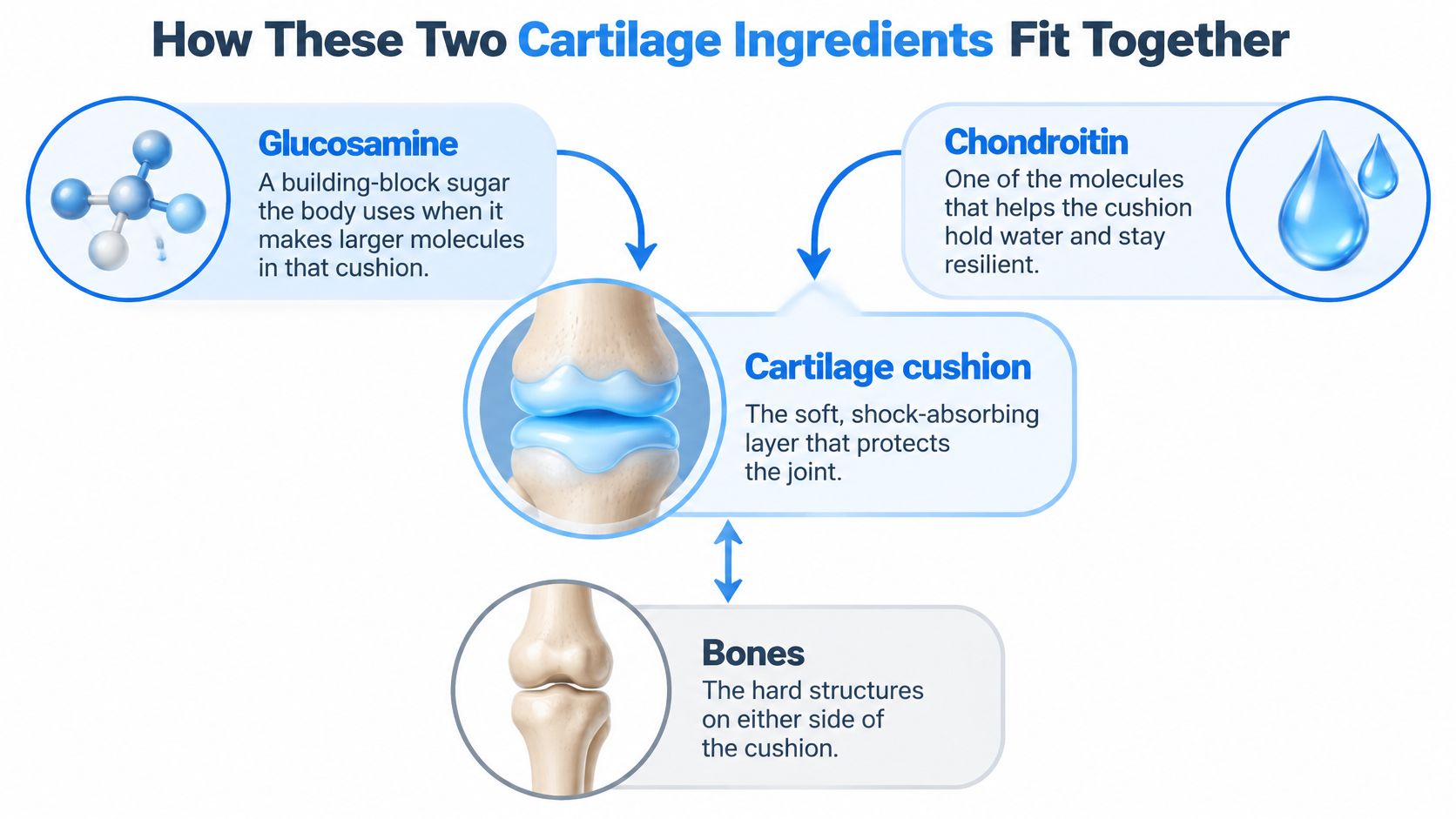
Swallowing the pair doesn't deliver an intact capsule into a worn knee. Digestion breaks supplements into smaller pieces. UK summaries are frank that the mechanism of oral glucosamine and chondroitin isn't understood. You can't point to a step that says "this tablet arrives and patches the cushion."
Association with cartilage molecules isn't the same as proof that a tablet repairs cartilage.
Why the two share a label
Shoppers usually want one joint product, not two half-stories. Manufacturers follow that habit, and some trials tested the combination rather than each ingredient on its own. That's a packaging choice and a study design. It isn't evidence that the pair works better in your knee.
Say you tip two capsules into your palm after a long day on your feet. The story on the tub is tidy: sugar building block plus water-holding chain. What your gut does next is messier, and what your knee does after that is the part no label can promise. This biology explains why the ingredients are grouped. It doesn't decide whether that story changes pain or the visible structure of a joint.
What the Studies and UK Guidance Actually Found
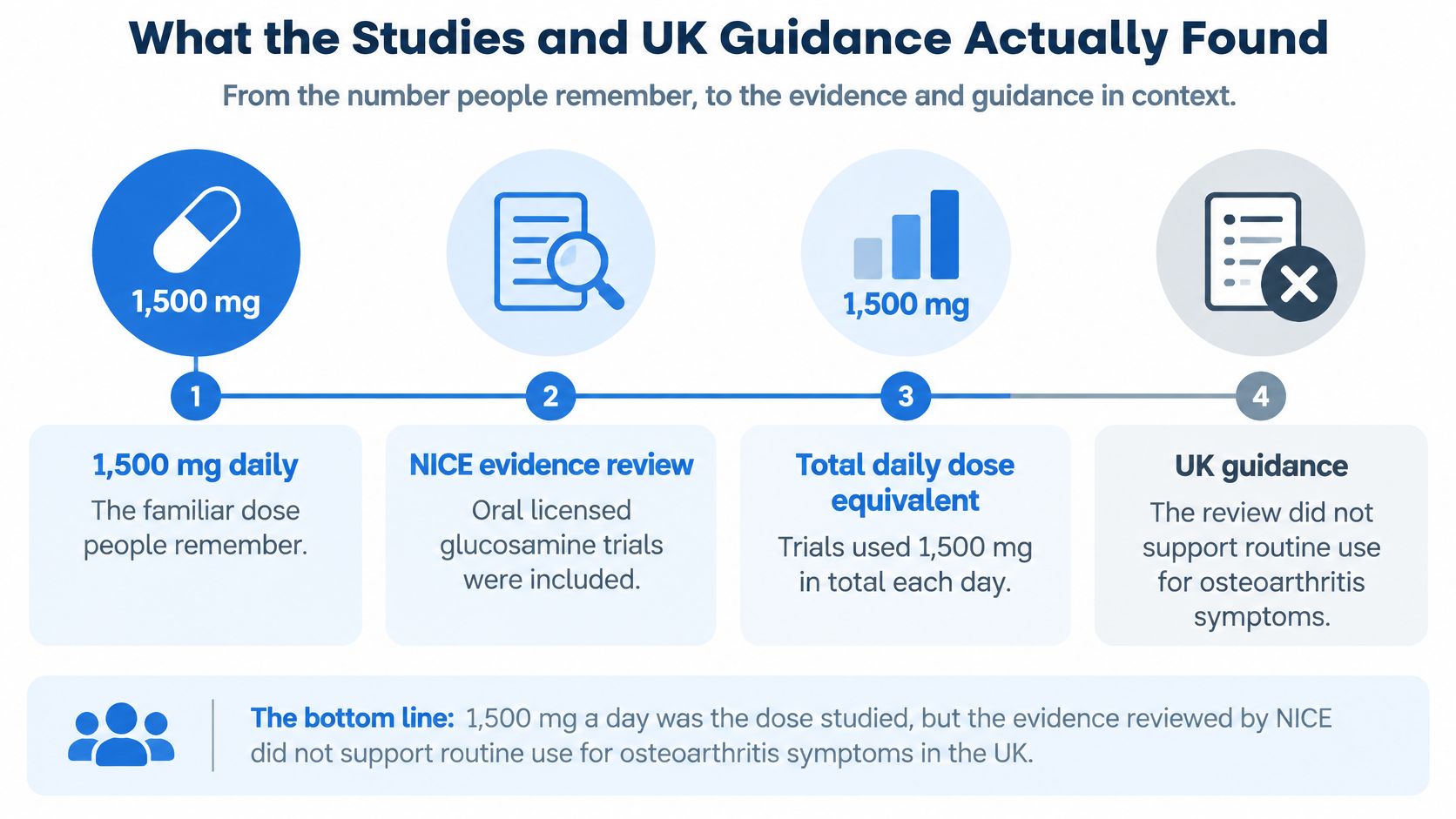
The number people remember is 1,500 mg of glucosamine a day. It needs a home, or it turns into a slogan.
What the familiar dose actually was
NICE's evidence review includes oral licensed glucosamine trials using a total daily dose equivalent to 1,500 milligrams over 26 weeks. One listed intervention used 500-milligram tablets at that daily total, with 71 participants in the intervention group. Earlier UK prescribing notes said the most favourable, still limited, evidence concerned glucosamine sulphate at 1,500 milligrams daily, mainly for possible mild or modest pain reduction in some people with knee osteoarthritis, not for stopping the condition progressing.
Glucosamine hydrochloride fared worse. The same UK guidance calls that evidence poor, and it says non-licensed glucosamine sulphate wasn't strong enough for NHS prescribing. Chondroitin didn't earn a stronger recommendation. NHS England's prescribing policy describes both ingredients as nutraceuticals and cites the British National Formulary view that the mechanism isn't understood and evidence of effectiveness is limited.
Formulation, dose, licensing, what was measured, and how long the trial ran all have to stay separate. A shop capsule that doesn't match the licensed sulphate product in those trials isn't the same experiment.
Pain scores and X-rays are different questions
A pain score asks whether mornings feel easier. A radiograph asks whether the visible gap in the hip or knee narrowed more slowly. Readers mix those up, then treat a vague sense of "support" as if it were both. The trials behind UK guidance didn't give clinicians a result strong enough to offer these products for either job.
A wider 2023 review of glucosamine for joint pain, reported by Natu.Care, covered 15 studies and 2,859 participants. Those studies weren't UK-specific, so they don't overturn NG226. Weak, inconsistent results also failed a cost test. They weren't enough to justify routine NHS treatment. That isn't proof that no individual ever notices a change.
Physiotherapy teams often put supplements in that wider frame. These supplement insights from Lake City Physical Therapy are a useful check on what a capsule can and can't carry. Food choices such as omega-3 for joint pain sit in a different conversation. They don't turn a glucosamine trial into a structural treatment.
Claims on the Label That Do Not Mean a Treatment
"Maintains healthy joints." "Supports flexibility." "Good for knees." Those lines feel reassuring because they describe the life you want, not a disease. Under UK food law they aren't a treatment claim, and they aren't proof.
GOV.UK food supplements guidance says supplements are regulated as food. They must not be sold with claims that they prevent, treat, or cure a medical condition. Making that kind of medicinal claim for a food supplement is an offence. The UK nutrition-and-health-claims register classes proposed claims that glucosamine or chondroitin helps maintain healthy joints, or supports healthy knees, as non-authorised, because the evidence submitted didn't substantiate them. Flexibility and mobility wording sits in the same non-authorised group.
The NHS osteoarthritis guidebook puts it in plainer words. There's no evidence that either substance changes joint structure or relieves pain.
Practical rule: "Supports healthy joints" on a label isn't proof that the product treats osteoarthritis.
How a careful shop should talk
An evidence-aware conversation can say what the ingredients are, whether they're marine-derived, how much is in a daily serving, and who should ask before taking them. It shouldn't promise cartilage repair, slower joint-space loss, or guaranteed easier movement. Interest in these bottles is large, which is exactly why the wording has to stay inside the law.
Three checks before you pay:
- Source on the label: Look for the full ingredient origin, including whether glucosamine comes from shellfish.
- A clear daily amount: You should be able to see how many milligrams one day's capsules provide, without adding a second product to "make up the dose."
- No disease claim: Osteoarthritis treatment, pain cure, or cartilage rebuilding doesn't belong on a food supplement.
If a page or a pack crosses that third line, treat it as a red flag, not as extra confidence.
Safety Checks Before You Buy a Joint Formula
"Natural" doesn't mean suitable for everyone. That's especially true for older adults, who are the people most likely to have osteoarthritis and to take several medicines already.
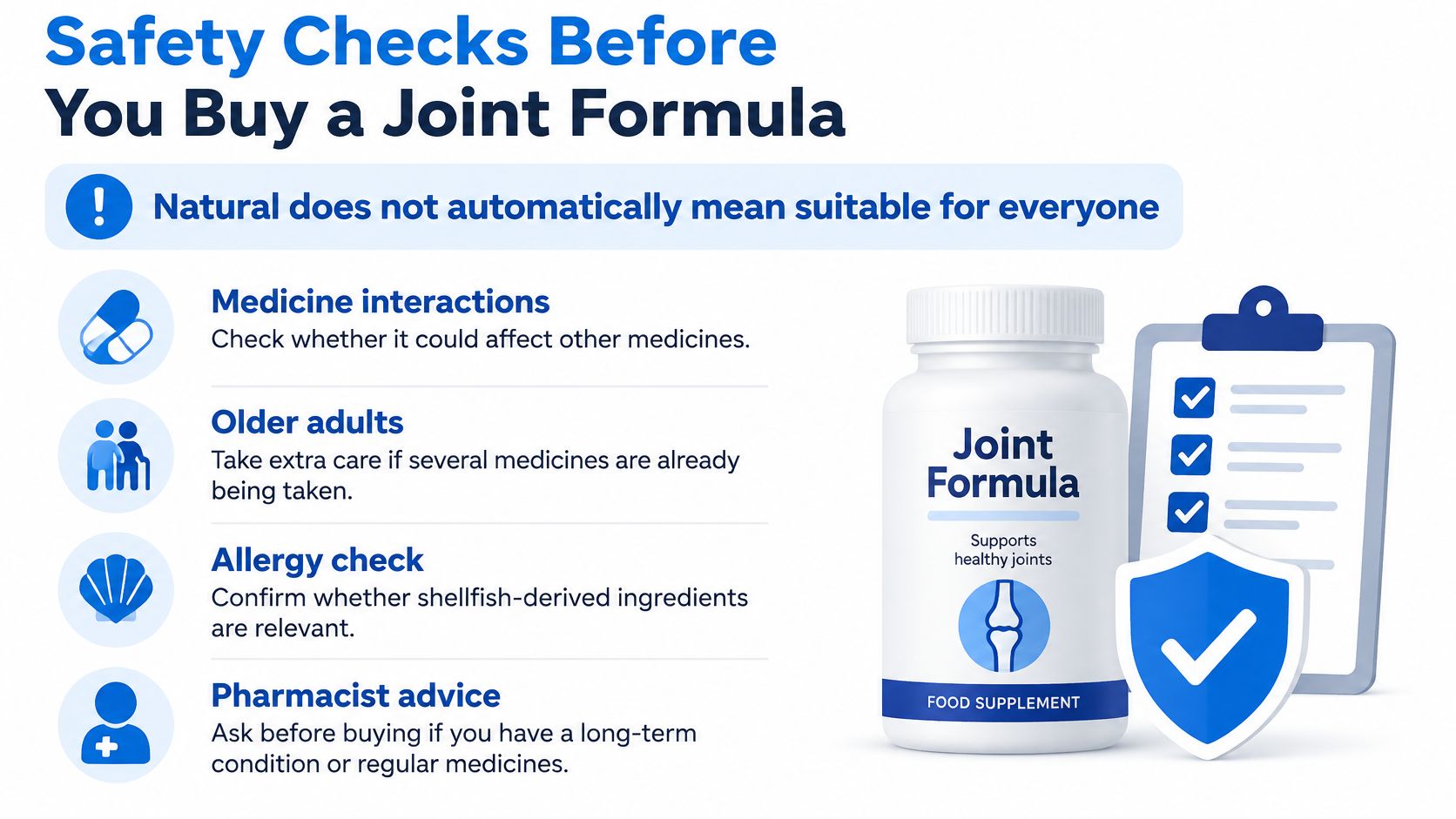
Two warnings should change a purchase today. NHS England's knee osteoarthritis decision aid warns against glucosamine if you have a seafood allergy, and it advises caution if you take warfarin, because glucosamine may affect clotting control. Many glucosamine products are marine-derived, so a shellfish allergy isn't a footnote. Chondroitin may also raise bleeding risk with anticoagulants, including aspirin. UK summaries also report no good evidence that the combination improves osteoarthritis pain, and Arthritis UK describes the results as mixed, with no clear additional effect overall.
A stop-and-ask screen
| Situation | Why it matters | Sensible next step |
|---|---|---|
| Shellfish or seafood allergy | Many glucosamine products are marine-derived | Don't take a shellfish-sourced product; ask about the source |
| Warfarin or another anticoagulant | Glucosamine needs caution and chondroitin may add bleeding risk | Speak to the clinician who manages the anticoagulant first |
| Aspirin or other antiplatelet medicine | Possible added bleeding risk with chondroitin | Ask a pharmacist before combining |
| Asthma | Some people are advised to be cautious with glucosamine | Check with a clinician before starting |
| Pregnancy or breastfeeding | Supplement safety isn't established for this use | Avoid unless a clinician advises otherwise |
| Planned surgery | Bleeding-risk ingredients may matter around an operation | Tell the surgical team and stop only on their advice |
| Diabetes or blood-sugar concerns | Glucosamine is sometimes queried in this group | Ask a GP or pharmacist rather than self-experimenting |
| Worsening swelling, instability or undiagnosed pain | A supplement trial can delay assessment | See a GP or pharmacist before buying |
The same habit of checking interactions applies when you already take several products, including supplements and vitamins for kidney health. A sensible shop conversation also asks whether osteoarthritis has been diagnosed, which other joint bottles are already in the cupboard, and whether pain is getting worse. Lack of benefit isn't a reason to keep raising the intake.
NHS non-prescribing reflects weak evidence and cost, not a verdict that nobody ever notices a change. Even a careful trial is optional support around movement, weight management where that's relevant, and clinical care. It isn't a substitute. Swelling, giving way, or pain you can't explain belongs with a GP or pharmacist before you experiment.
A Three-Month Trial You Can Actually Judge
Picture someone with familiar knee stiffness. They've already spoken to a pharmacist, nothing on the safety screen rules the ingredients out, and they want to know whether a combined capsule changes ordinary life. Not a scan. Ordinary life.
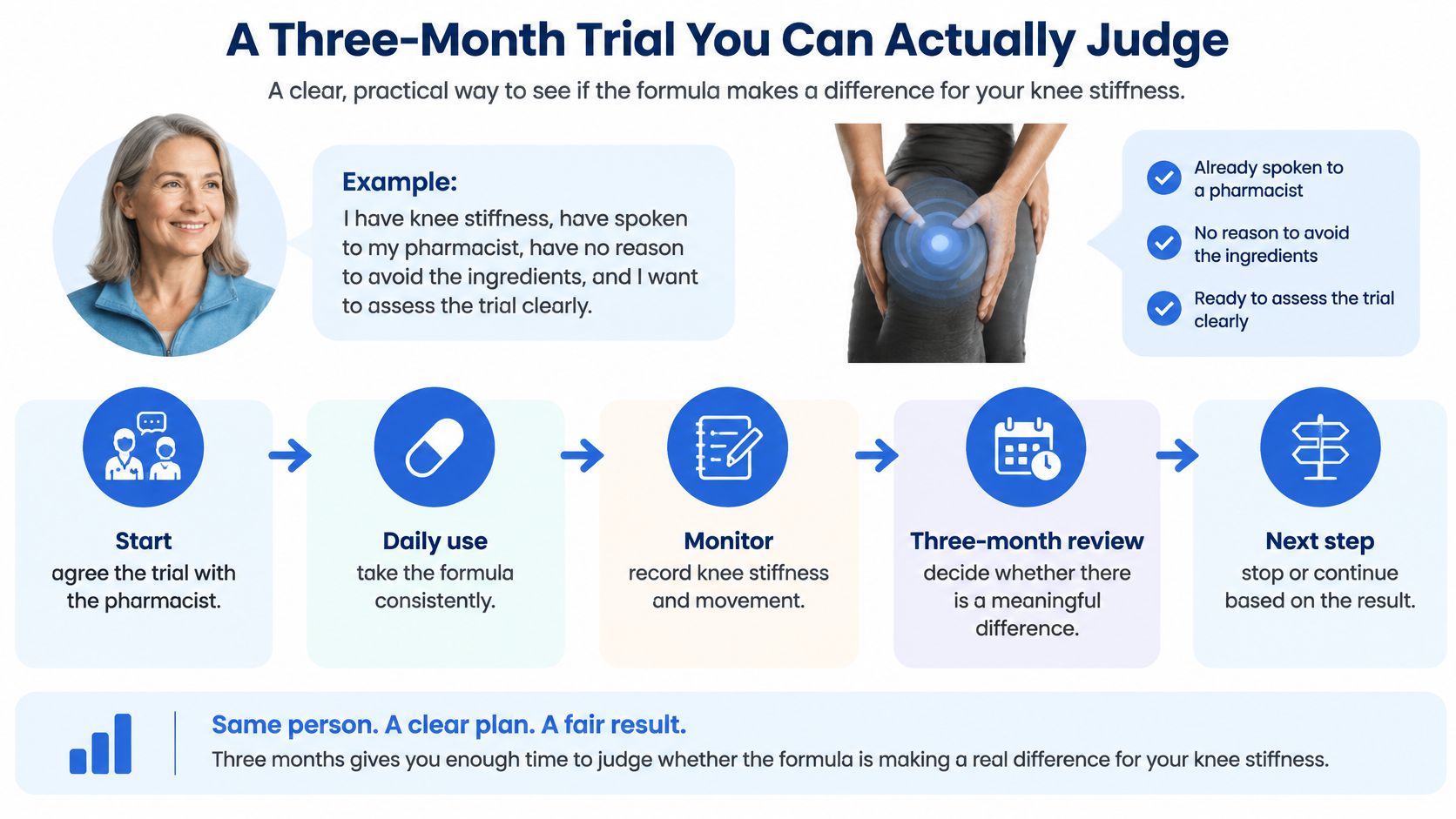
NHS patient information on glucosamine and chondroitin uses a practical threshold of 1,500 mg glucosamine daily, with a clear stop rule. If there's no improvement after three months, discontinue it. Any benefit that shows up isn't instant, so judging the bottle after a few days is too soon. Carrying on into a fourth month with notes that look the same isn't recommended, and it isn't a reason to double the dose or add a second joint product.
One person's twelve-week check
- Before the first capsule, note three real markers. Morning stiffness in minutes, comfort on a usual walk, and how often pain wakes them.
- Take the labelled daily amount. Don't stack a sulphate tub with a combination tub to chase a bigger number.
- Keep the same walking or strengthening habit, so the capsule isn't credited for exercise they started in the same week.
- Review the same three markers at four weeks and again at twelve.
- Stop at three months if the notes look the same.
Arthritis UK's mixed picture means a personal no is a useful answer, not a failed experiment. Worsening pain, new swelling, a knee that gives way, or a fresh diagnosis belongs with a GP, not with a longer supplement run.
A short explainer can make that twelve-week shape easier to picture before you start writing anything down.
The point of the notes is comparison, not optimism. If week twelve matches week one, you've learned something solid, and you can spend the money elsewhere.
Decide Whether a Combined Capsule Is Worth a Trial
The decision sits with you, not with the ingredient name.
Try a glucosamine and chondroitin combination only if you want a time-limited personal experiment, you've already checked the allergy and medicine cautions, and you have a plan for movement plus a clinician if pain is persistent or changing. Skip it if you want a proven osteoarthritis treatment, something the NHS endorses, or you have a shellfish allergy or an unresolved clotting-medicine question. Skip it too if you've already taken a similar product for three months and your own notes didn't change.
Some people still want one marine-derived combination for that bounded trial. Bionature (Kordels) Glucosamine and Chondroitin pairs the two naturally occurring, marine-derived constituents found in healthy tissue. We'd describe it as a formula you might choose for a structured twelve-week check, not as a product that repairs cartilage or replaces care. It's on sale from £27.95 to £16.99. Read the label on that page before you buy, including the source and the amount per day.
Other food traditions people ask about, including turmeric for joint health, are a separate choice with their own limits. If you'd like help matching a bottle to allergies, medicines and a three-month stop rule, talk to us free in store at 7 The Arcade, or call 01234 348179. UK delivery and in-store collection are there once you already know a product suits you.
Pumpernickel Health Foods is an independent Bedford health shop where we help you match joint supplements to your medicines, allergies and a clear stop rule, rather than to a repair promise. If you're weighing glucosamine and chondroitin, our team can walk through the label with you in store, by phone or online. Visit Pumpernickel Health Foods when you want that conversation before you buy.