
Waking with stiff fingers or knees can make the day feel slow before it's even begun. Perhaps your joints loosen after you walk around the kitchen, and you're wondering whether omega 3 could help. The answer depends less on the supplement aisle and more on what's causing the pain.
Omega 3 is often discussed for joint comfort because its fatty acids, EPA and DHA, are associated with inflammatory processes in the body, and oily fish is a familiar source. But claims about omega 3 for joint pain can blur important differences between conditions. The useful questions are: what kind of joint problem might you have, what does the evidence show for that condition, and how can you consider a product and dose safely?
Table of Contents
- Why Omega 3 Gets Suggested for Joint Pain
- Why Inflammatory Arthritis and Osteoarthritis Differ
- What the Evidence Says for Each Joint Condition
- How to Choose an Omega 3 Product With Confidence
- Reading Doses and Medication Safety Checks
- When Joint Pain Needs Medical Attention
- Next Steps for Joint Care and Expert Support
Why Omega 3 Gets Suggested for Joint Pain
It's easy to see why omega 3 comes up in conversations about stiff joints. People know it from oily fish and fish-oil supplements, and they may have heard that it has anti-inflammatory properties. That can sound like a straightforward match for pain and stiffness, but it doesn't mean every sore knee or stiff hand has the same cause, or that omega 3 has been shown to help each one.
Think of the supplement as a possible part of a wider plan, not a repair kit that works for every joint. A person with rheumatoid arthritis may be asking about inflammatory symptoms, while someone with knee osteoarthritis may be looking for help with pain during walking. Those experiences can feel similar, but they aren't interchangeable when weighing the research.
Start with the reason for the pain
If you're exploring self-care, it can help to consider the basics alongside supplements: the way you move, your diet and whether symptoms are changing. This guide to natural remedies for joint pain offers another perspective on everyday approaches. None of those options should delay an assessment if pain persists or you notice swelling or prolonged morning stiffness.
The most useful way to approach omega 3 is to separate three questions:
- Which condition is involved? Inflammatory arthritis and osteoarthritis call for different expectations.
- What does the evidence say? Research for rheumatoid arthritis is more encouraging than evidence for osteoarthritis, but it doesn't promise a result for every person.
- What's on the label, and is it safe for you? The amount of EPA and DHA matters, as does your medical history and any medicine you take.
That distinction can turn a confusing shelf of products into a more manageable decision. First, work out which evidence is relevant to the symptoms you're trying to address.
Why Inflammatory Arthritis and Osteoarthritis Differ
Joint pain isn't one diagnosis. A useful analogy is a house with two different problems: one has a leak in the roof, while another has cracks in its foundations. Both houses may have water damage, but the same repair won't solve both. Likewise, a supplement that may affect inflammatory symptoms shouldn't automatically be expected to improve pain from osteoarthritis.

Different conditions, different questions
Inflammatory arthritis includes conditions such as rheumatoid arthritis, psoriatic arthritis and axial spondyloarthritis. These involve inflammation and immune-system activity. UK guidance distinguishes these conditions when discussing omega 3: Arthritis UK says EPA and DHA may help some people with inflammatory arthritis, while the British Dietetic Association describes findings from high-dose fish-oil studies in rheumatoid arthritis that include reductions in morning stiffness, swollen and tender joint counts, and pain. The British Dietetic Association also cautions that evidence for routine supplementation in the general UK population is inconclusive (British Dietetic Association guidance on omega 3).
Osteoarthritis is different. It's commonly associated with changes in the joint and mechanical stresses on it, rather than being the same immune-driven process as inflammatory arthritis. That difference matters when reading headlines: evidence involving rheumatoid arthritis doesn't establish that a supplement will help someone with age-related knee osteoarthritis.
Nor can a product label diagnose what's happening. Swelling, persistent pain or prolonged morning stiffness are reasons to speak with a healthcare professional, particularly if inflammatory arthritis is possible. A clinician can assess your symptoms and advise whether you need treatment beyond self-care.
Practical rule: Don't choose a supplement based only on where it hurts. The likely condition matters more than whether the joint is a knee, hand or shoulder.
Once you know why the distinction matters, the evidence is easier to interpret. The question isn't whether omega 3 is “good for joints” in general. It's what research says about a specific condition, and how much confidence that research supports.
What the Evidence Says for Each Joint Condition
The evidence doesn't support a universal promise. Results differ between osteoarthritis and rheumatoid arthritis, and even a promising research finding describes what happened in a group, not what will definitely happen to you.
Osteoarthritis findings are uncertain
A UK Biobank analysis used genetic information from 114,999 participants to examine whether omega 3 levels had a causal relationship with osteoarthritis risk. The analysis found no statistically significant causal effect. That finding is about risk or disease association, though; it doesn't by itself prove that omega 3 can't affect short-term symptoms in someone who already has osteoarthritis. NHS Dorset guidance also describes human osteoarthritis trials as limited, inconsistent and poor quality (NHS Dorset omega-3 bulletin).
There is a more favourable result from a knee osteoarthritis trial involving a daily intake of approximately 450 mg of combined EPA and DHA, which reported improvements in pain and function. However, the resource describing that trial says more evidence is needed before clear benefits can be established. One positive result is a reason for further research, not proof that the same approach will work for everyone.
Rheumatoid arthritis has a more encouraging signal
A systematic review of 23 studies found a modest group-level pattern of benefit from marine omega 3 in rheumatoid arthritis. Earlier meta-analysis figures reported reductions of 26% in patient-assessed joint pain, 57% in morning-stiffness duration and 60% in NSAID consumption (systematic review of marine omega-3 and rheumatoid arthritis outcomes). These are averages from studies, not a forecast for any one person, and the review found no clear effect on some measures of disease activity.
The practical difference is that omega 3 may be discussed as complementary support for rheumatoid-arthritis symptoms, particularly stiffness and tenderness. It isn't a replacement for prescribed medication, including disease-modifying treatment. If you're comparing other joint-support options, you can also read about glucosamine, chondroitin and Celadrin for muscles and joints, while keeping in mind that each ingredient has its own evidence and suitability.
For readers weighing broader approaches to painful joints, it may also be useful to explore regenerative medicine for painful joints. Whatever options you consider, the central step is still matching the approach to the condition and discussing persistent symptoms with a clinician.
How to Choose an Omega 3 Product With Confidence
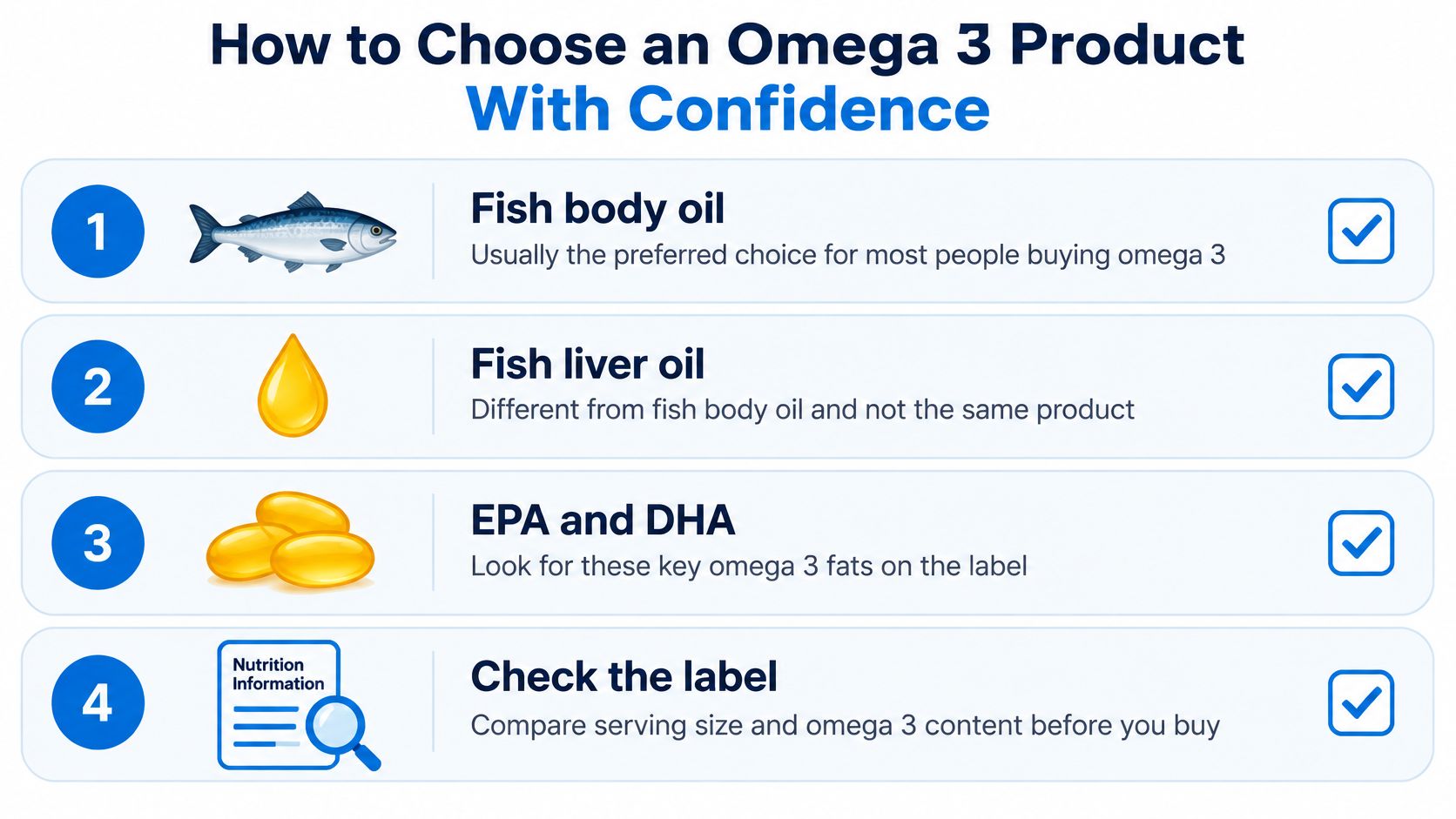
Two bottles can both say “fish oil” on the front and still contain different oils. The first check is whether the product uses fish-body oil or fish-liver oil, because those aren't interchangeable descriptions and the evidence isn't identical.
Arthritis UK describes fish-body oil as potentially helpful for rheumatoid-arthritis symptoms, including pain, morning stiffness, fatigue, and tender or swollen joints. It characterises the benefit as modest. By contrast, a 24-week trial involving 86 people found that 10 ml daily of cod-liver oil or olive oil didn't significantly reduce osteoarthritis pain or disability compared with the other treatment (Arthritis UK information about fish oils). That doesn't establish that every fish-liver oil product is ineffective for everyone; it does show why “fish oil” is too broad a label for judging evidence.
Compare what the label actually tells you
Look beyond a large total-fish-oil number. The key quantities to check are EPA and DHA, the long-chain omega-3 fats most often discussed in the joint-health evidence. Also check the serving size: a label may list the amount per capsule, per teaspoon or per suggested daily serving. Those are different ways of presenting the information, so compare like with like.
If you'd like another plain-language perspective on serving sizes, you can find guidance on choosing an omega-3 serving. That can help you make sense of a label, but it doesn't establish a therapeutic dose for your particular condition.
This video offers additional context on omega 3:
At Pumpernickel Health Foods, shoppers can browse fish oils and omega products separately from joint and bone health products, and can ask a supplement specialist to help compare labels. The Bedford shop and website offer free, pre-booked one-to-one consultations by phone, WhatsApp or in person at 7 The Arcade, Bedford. The aim is to make it easier to compare what a product contains and whether it fits your goals, not to treat a supplement as a guaranteed fix. You can also learn about omega 3 and heart health for another example of why product choice and personal suitability matter.
Reading Doses and Medication Safety Checks
Numbers on omega 3 labels can be hard to compare because they refer to different things. A nutritional benchmark, a dose used in some concentrated products for inflammatory conditions, and an amount in an osteoarthritis trial are not automatically equivalent.
Arthritis Research UK notes that concentrated products sometimes provide about 3 g per day of combined EPA and DHA, and that effects may take around three months to judge. The British Dietetic Association's benchmark is about 450 mg per day, roughly the amount supplied by eating one to two portions of fish weekly. That benchmark is for dietary adequacy, not an established therapeutic dose for joint pain (Arthritis UK guidance on diet and nutritional supplements).
| Omega 3 Dose Reference Points for Joint Health | EPA and DHA per day | Context |
|---|---|---|
| General UK dietary benchmark | About 450 mg | A dietary adequacy target, not an established dose for treating joint pain |
| Concentrated products sometimes used for inflammatory conditions | About 3 g | A higher amount that calls for clinician or pharmacist review |
| Amount used in a knee osteoarthritis trial | Approximately 450 mg | A trial intake that reported improvement, but doesn't establish a proven treatment dose |
A simple label check
First, find the serving size. Then look for the combined EPA and DHA amount for that serving, rather than relying only on the total fish-oil quantity. If the label doesn't make the amount clear, ask a pharmacist or supplement specialist to help interpret it.
Higher-dose use needs a safety check, especially if you have cardiovascular disease or risk factors. NHS formulary guidance notes a dose-dependent increased risk of atrial fibrillation with omega-3-acid ethyl-esters in people with cardiovascular disease or cardiovascular risk factors. Before starting a therapeutic trial, discuss your medicines and health history with a clinician or pharmacist, particularly if you take anticoagulants or antiplatelet medicines, or have a cardiovascular history.
Before starting: Share the full list of your medicines and supplements. A dose that looks reasonable on a label still needs to fit your health history.
When Joint Pain Needs Medical Attention
Persistent joint pain deserves attention, especially when it comes with swelling or prolonged morning stiffness. These symptoms don't prove that you have inflammatory arthritis, but they do make it unwise to treat the problem as a simple shopping decision. A supplement can't tell you what's causing the pain or whether you need prescribed treatment.
Seek medical advice if symptoms persist, keep returning, or interfere with everyday activities. That's particularly important when inflammation may be involved, because rheumatoid and other inflammatory conditions can require treatment that an omega 3 product cannot provide. Don't stop or replace prescribed medication in favour of a supplement without discussing it with the clinician who manages your care.
A GP or pharmacist can also help you weigh potential benefits against risks before you try a product. Make the conversation specific:
- Describe the symptoms: Explain which joints hurt, whether they swell and how long morning stiffness lasts.
- Bring your medicine list: Include prescribed medicines, over-the-counter products and supplements.
- Mention relevant health history: Include cardiovascular conditions, risk factors and any history relevant to blood clotting or bleeding.
This is a normal part of responsible self-care, not a reason to feel that supplements are off limits. The aim is to choose an approach that doesn't delay a diagnosis or conflict with treatment. If symptoms are persistent or changing, speak to a healthcare professional before deciding whether to try omega 3.
Next Steps for Joint Care and Expert Support
A sensible decision about omega 3 for joint pain starts with the condition, not the product. Consider whether your symptoms need medical assessment, look for evidence that applies to that condition, and check the labelled EPA and DHA amount alongside your medicines and health history.
If you're considering other dietary options, you can also read about turmeric for joint health. As with omega 3, it's worth discussing supplements with a healthcare professional if you have persistent symptoms or take prescribed medicines.
For help comparing products, Pumpernickel Health Foods offers free, pre-booked one-to-one consultations with supplement specialists by phone, WhatsApp or in person at 7 The Arcade, Bedford. The shop is open Monday to Saturday from 9:30 to 17:15; you can call 01234 348179, arrange in-store collection or use the website's UK delivery service. If your pain, swelling or morning stiffness keeps coming back, speak with your GP or pharmacist before starting a supplement.
If you'd like help comparing EPA and DHA labels or choosing an omega 3 product that fits your needs, visit Pumpernickel Health Foods to explore its fish oils and joint-health range. You can also arrange a free, pre-booked one-to-one consultation with a supplement specialist, and contact your GP or pharmacist first if your symptoms persist or you take prescribed medicines.