
You're standing in a health shop, looking at a wall of multivitamins for men. One bottle promises energy, another immunity, and a third seems to offer everything from sharper focus to stronger bones. The labels are crowded, the formulas look similar, and it's hard to tell whether the one with the longest ingredient list is the right choice.
The useful question isn't which multivitamin looks most impressive. It's whether you have a reason to take one, what your diet and lifestyle might be missing, and how to choose a product that fills a gap without adding nutrients you don't need.
Table of Contents
- Standing in the Supplement Aisle
- What a Men's Multivitamin Should Contain
- Why Vitamin D Is the Priority Nutrient
- How to Read a Multivitamin Label
- Regulation, Safety, and Common Mistakes
- When a Multivitamin Is Worth It
Standing in the Supplement Aisle
A customer might come in after a few tiring weeks and ask for a multivitamin to get his energy back. Another might eat a limited range of foods, rarely get outdoors during winter, or want a straightforward way to cover possible gaps in his diet. Those situations aren't the same, even if both men are browsing the same shelf.
A multivitamin can be dietary insurance, a practical way to top up some nutrients when someone's usual food intake doesn't cover their needs. It isn't a treatment for unexplained tiredness, low mood or poor concentration, and it can't make up for a diet that routinely lacks variety. If a symptom persists, it's better to ask a GP or pharmacist about it than to assume a supplement is the answer.
That distinction helps cut through the marketing. A large number of ingredients doesn't automatically make a formula more suitable. A high-dose product may add little value if you already get those nutrients from food or other supplements, and it can make it harder to keep track of your total intake.
Start with your circumstances, not the bottle. Think about the foods you regularly eat, whether you follow a restrictive diet, how much time you spend outdoors and whether you're taking any other supplements. If you have a diagnosed deficiency, a clinician may recommend a specific nutrient or treatment rather than a general multivitamin.
The aim is not to find a product that promises to fix everything. It's to identify a likely gap and decide whether a balanced, clearly labelled product is a sensible way to address it. For some men, that may be a standard multivitamin. For others, it may be a specific supplement, a change to their diet, or professional advice instead.
What a Men's Multivitamin Should Contain
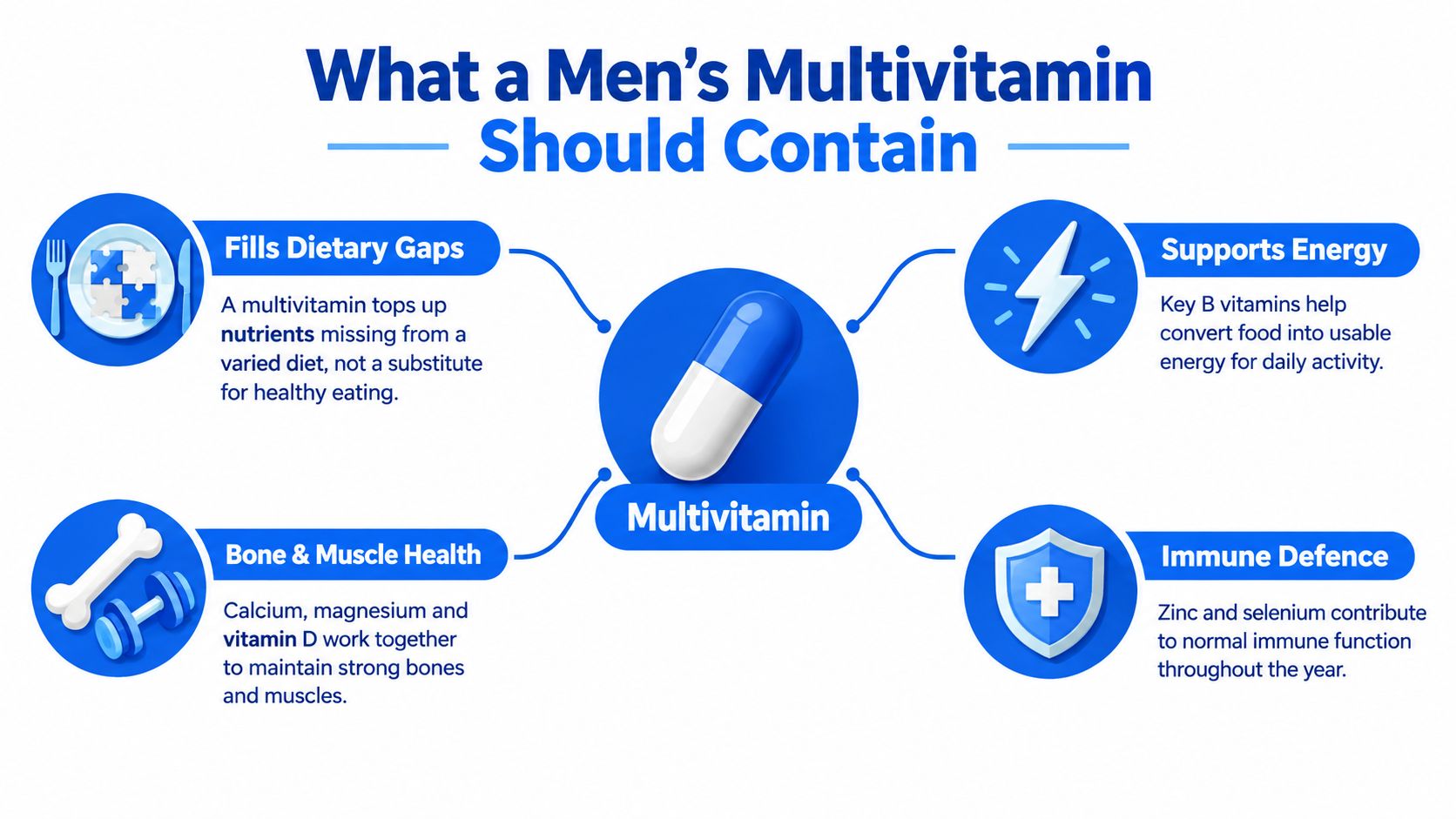
A multivitamin works best as a complement to food. Think of a balanced meal as the main course and a multivitamin as a safety net for nutrients that might be missing from your usual routine. A tablet can supply selected vitamins and minerals, but it can't replace the variety of foods that make up a balanced diet.
That's why a longer ingredient list isn't the same as a better formula. The practical question is whether the amounts suit your needs and fit with what you already eat and take. A product with a sensible selection and clear serving information may be more useful than one that pushes large doses of many nutrients.
Look for balance, not a headline dose
Vitamin D deserves particular attention for men in the UK, while zinc, B vitamins and magnesium may also appear in everyday formulas. Their presence doesn't mean every man needs a separate high-dose product. If you want to understand zinc's role and how it features in supplementation, see this guide to the benefits of zinc.
A balanced formula should make it easy to see what you'll get in a daily serving. Check the serving size carefully: the amount listed may apply to more than one tablet. Then consider whether you're already taking a separate vitamin D, mineral or other supplement that contains the same ingredients.
Standard dose or high dose?
A standard-dose multivitamin is intended to provide broad coverage, not to deliver a dramatic dose of every nutrient. High-dose formulas may seem attractive if you're hoping to feel a quick difference, but taking more isn't automatically more effective or more appropriate. The relevant dose depends on your diet, any identified need and other products you use.
A multivitamin can be a convenient choice when your eating habits are inconsistent or your options are limited. But if the core issue is a persistently restricted diet, or a symptom you can't explain, the useful next step may be dietary or clinical advice rather than a stronger formula.
Keep the role modest: a multivitamin may help cover dietary gaps. It isn't a magic pill, and it doesn't turn an unbalanced diet into a balanced one.
Why Vitamin D Is the Priority Nutrient
For men choosing a general multivitamin in the UK, vitamin D is a particularly practical nutrient to check. Between October and early March, UK sunlight can't reliably drive meaningful vitamin D production in the skin. That seasonal limitation makes the amount in a product worth checking rather than assuming that every multivitamin contains enough.
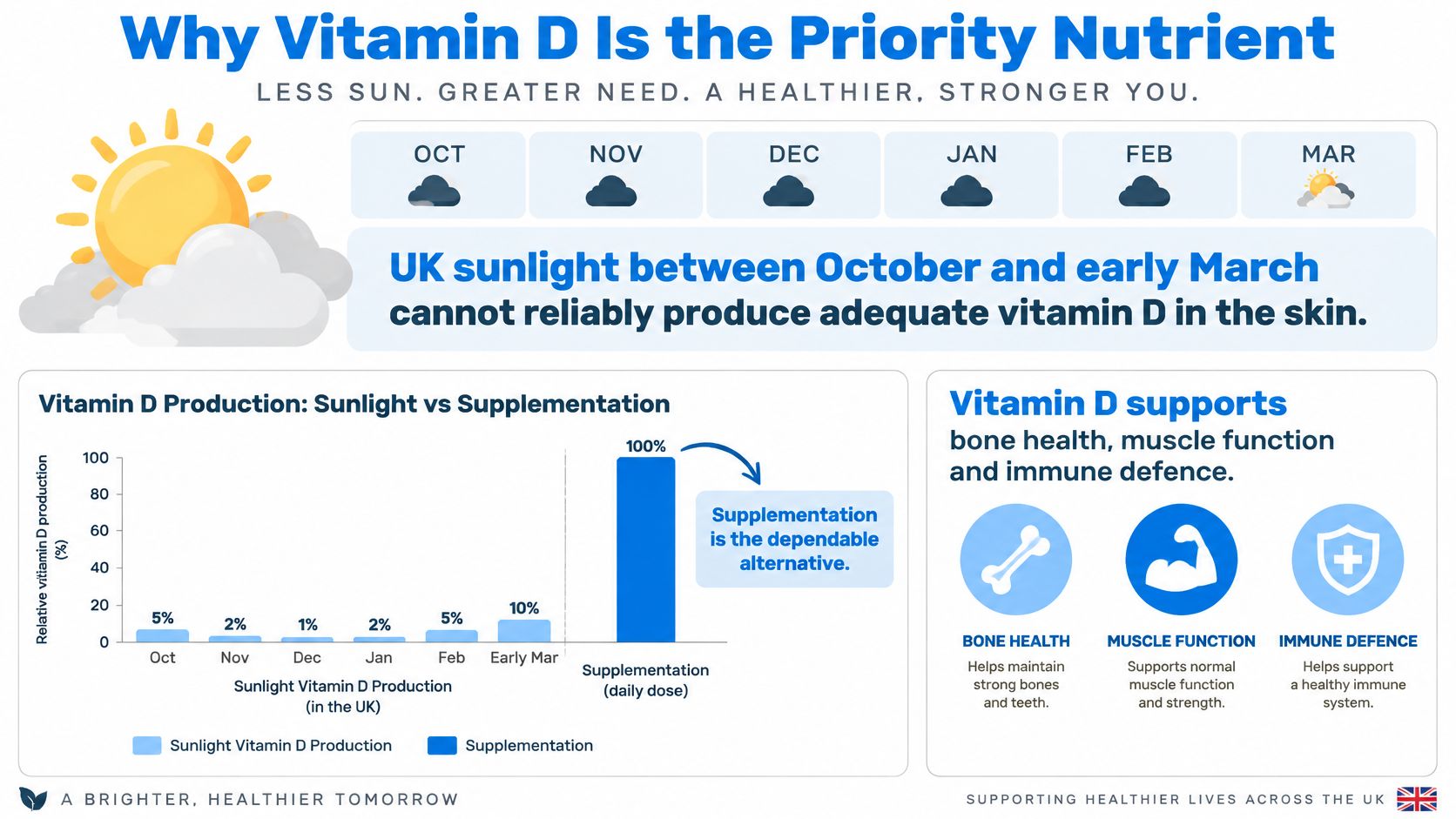
The UK Scientific Advisory Committee on Nutrition's reference nutrient intake is 10 micrograms (400 IU) daily for people aged four and over. The recommendation is designed to maintain serum 25-hydroxyvitamin D at or above 25 nmol/L when sunshine exposure is minimal, a threshold used for musculoskeletal protection. UK public-health guidance describes 10 micrograms daily as sufficient for routine winter supplementation, and says products up to 25 micrograms (1,000 IU) are suitable when a 10-microgram product isn't available. You can read the government's vitamin D and nutrient guidance.
Dietary intake helps explain why checking the label matters. In the National Diet and Nutrition Survey, men aged 19–64 had a median vitamin D intake of approximately 2.8 micrograms per day from food; men aged 65 and over had about 3.2 micrograms. Those figures are below the UK reference intake of 10 micrograms per day for adults during autumn and winter. The same survey reported median zinc intakes of about 9.8 milligrams per day for men aged 19–64 and 10.0 milligrams for men aged 65 and over, a reminder that nutrient intake varies by nutrient rather than calling for uniformly high-dose formulas. The National Diet and Nutrition Survey findings describe dietary intake before supplements are considered.
Check the serving, then check the rest
Look at the amount of vitamin D in the full daily serving, not just the amount per tablet. Men who are seldom outdoors, cover most of their skin, live in institutional care or have dark skin may need vitamin D year-round, so a pharmacist or GP can help them assess what's suitable.
More isn't automatically better. If you also take a separate vitamin D product, add the amounts together before choosing a multivitamin. If you'd like background on the different forms, this explanation of which vitamin D is superior can help you understand the comparison. For further detail on vitamin D's role, explore this guide to vitamin D beyond sunshine.
How to Read a Multivitamin Label
A label is more useful than a product name or a claim on the front of the bottle. Start by finding the daily serving size, then check the amount of each nutrient you'll get from that serving. If the directions say to take more than one tablet, the listed amount may refer to the complete serving rather than each tablet.
Next, look for amounts that don't fit your needs. Adult men generally don't have a sex-specific reason to seek high-dose iron: the adult reference value is approximately 6.9 mg per day, while requirements are substantially higher for menstruating women. Routine high-dose iron may be poorly targeted for men and can cause gastrointestinal side effects. A lower-dose or iron-free formula may be more rational unless a clinician has identified a need. See the UK government's dietary recommendations for context on reference values.
Multivitamin Label Checklist
| Label Element | What to Look For | What to Avoid |
|---|---|---|
| Daily serving | Clear directions and nutrient amounts for the full serving | Comparing products by tablet when the serving sizes differ |
| Vitamin D | A clearly stated amount that suits your needs, particularly for winter use | Assuming every multivitamin provides enough, or doubling up without checking |
| Iron | A dose that's appropriate for you, with clinical advice if deficiency is suspected | Choosing a high-iron product without a diagnosed need or professional advice |
| Zinc and vitamin B6 | Clear amounts that you can compare with other products you take | Overlapping doses from multivitamins and separate immune, energy or performance products |
| Warnings and claims | Straightforward ingredient details, directions and cautions | Relying on broad promises about energy, immunity or focus instead of checking the label |
Finally, review everything else you take. A multivitamin can overlap with a standalone vitamin D, magnesium or “immune support” product, so compare ingredient lists and total daily amounts. A label that makes those details easy to find is more useful than one that relies on an impressive-sounding name.
If you're buying online, apply the same checks. A product's description can help you narrow your options, but the ingredients panel, serving size and warnings are what tell you what you'll be taking. If anything is unclear, ask a pharmacist or the retailer's qualified staff before buying.
Regulation, Safety, and Common Mistakes
A common assumption is that a product with more nutrients must offer more benefit. That can lead to dose stacking: taking a multivitamin alongside separate vitamin D, vitamin A, vitamin B6 or combination products without adding up what each one contains. The total matters, especially when several bottles are being used for different goals.
UK food supplements are regulated as food, not as medicines. There's no general requirement to register them before sale, and UK authorities don't set national maximum levels for vitamins and minerals in supplements. The rules do cover areas including safety, composition, labelling and advertising. The UK guidance on food supplement legislation describes how the framework developed. This is why reading the ingredient amounts and warnings matters.
Avoid accidental excess
Vitamin D is one reason to check for overlap, but it isn't the only nutrient to consider. NHS guidance advises older men, who have greater osteoporosis risk, to avoid more than 1.5 mg of vitamin A daily from food and supplements. It also says men and women shouldn't exceed 10 mg of vitamin B6 daily from supplements unless a doctor advises them to. The NHS information on vitamins and minerals provides guidance on these limits.
Product quality is another reason not to treat supplements as risk-free. NHS Specialist Pharmacy Service guidance has reported that contents may differ from labels or include undeclared ingredients, and UK authorities recalled two supplements containing excessive vitamin D in 2025. Check current product information and notices rather than assuming the label alone settles every question.
A simple safeguard: before adding a product, put your supplements side by side and compare the ingredients and daily amounts. If you take medicines or have a medical condition, ask a pharmacist or GP to review the combination.
A high-potency formula also isn't a good shortcut for unexplained symptoms. Persistent tiredness, unexplained weight change, symptoms of anaemia, gastrointestinal disease or a restricted diet may need investigation. A multivitamin can't diagnose the cause or replace clinically indicated treatment. For more on the risks of excess intake, see this guide to taking too many vitamins.
When a Multivitamin Is Worth It
Most individuals can get the vitamins and minerals they need from a varied, balanced diet. Multivitamins may be useful if someone can't eat normally or has a clinically identified need; NHS England guidance says supplements are generally unnecessary except in situations such as a medically diagnosed deficiency. Read the NHS-linked guidance on vitamins and minerals for more detail.
That doesn't mean you need a perfect diet before considering a supplement. It means the decision should connect to your circumstances. If you regularly miss meals, eat a restricted range of foods or have a reason to suspect a nutrient gap, a standard-dose multivitamin may be worth discussing. Limited sun exposure can also make vitamin D a more relevant part of the conversation.
A practical decision check
Before choosing a product, ask yourself:
- What does my diet look like? Consider which food groups you regularly miss, and whether a change in routine has made your meals less varied.
- Do I follow a restrictive diet or have trouble eating normally? If so, ask whether your food choices or health circumstances point to a specific nutrient concern.
- Am I taking other supplements or medicines? Make a list and check for overlapping ingredients. A pharmacist can help assess whether a product is suitable alongside your medication.
- Do I have symptoms I'm trying to fix? Don't assume tiredness, low mood or poor concentration means you need a multivitamin. Persistent symptoms are a reason to seek advice, not simply to buy a higher-dose formula.
- Has a clinician identified a need? If testing or a clinician's assessment has found a deficiency, follow their advice on the appropriate product and dose rather than relying on a general formula.
The best choice might be no multivitamin, a standard-dose product to cover likely gaps, or a specific nutrient recommended by a healthcare professional. Keep the aim practical: match the product to your diet, season, lifestyle and other supplements, and review that choice if your circumstances change.
If you're unsure, speak to a GP or pharmacist before using supplements to treat symptoms. A thoughtful recommendation should help you understand whether you need anything at all, not just point you towards a bottle.
Pumpernickel Health Foods offers men's multivitamins alongside individual nutrients, with free pre-booked consultations from supplement specialists to help you compare options and check what fits your needs. Visit Pumpernickel Health Foods online, or speak with the team for guidance before choosing.