
If a mushroom helps someone complete a computer task faster, does that mean it will help you remember names, concentrate at work or protect your memory as you age? That gap between a measured test result and an everyday benefit is where many lion's mane claims become misleading.
Lion's mane is an interesting supplement, but interest isn't the same as certainty. You can take its potential seriously without accepting promises that the human trials haven't established.
Table of Contents
- Which Lion's Mane Benefits Have Real Evidence
- What Lion's Mane Is and How It Is Supposed to Work
- What Healthy-Adult Trials Measured for Memory and Focus
- Memory Concerns in Later Life and What One Anecdote Cannot Show
- How Much Lion's Mane Studies Used and How to Read Labels
- Side Effects and Who Should Avoid Lion's Mane
- Choosing a Lion's Mane Product and Deciding Your Next Step
Which Lion's Mane Benefits Have Real Evidence
Does lion's mane work? For healthy adults, no cognitive benefit is firmly established. The human evidence is small, short and preliminary, with encouraging findings for particular tasks and populations rather than dependable improvements across memory and focus.
Each claim below is read against the four details that decide how far a result can travel: who took part, what dose and preparation they used, how long the study ran and what outcome was measured. A finding only holds for people, products and timeframes that resemble the ones tested.
Lion's mane benefit claims compared with the evidence
| Claimed benefit | Best available evidence | Evidence strength | Verdict |
|---|---|---|---|
| Memory and focus in healthy adults | Single-dose trials of 1.8 g and 3 g with 18 to 41 participants | Low, acute and small | Early signal for processing speed only |
| Overall cognition in healthy adults | 2025 crossover, 18 adults aged 18 to 35, single 3 g dose | Low | Not demonstrated |
| Cognition with mild cognitive impairment | 30 adults aged 50 to 80, 3 g a day for 16 weeks | Low to moderate, small sample | Possible short-term benefit that faded after stopping |
| Mood and stress | 28-day trial, 41 adults, trend with p = 0.051 | Low, not statistically significant | Unproven |
| Nerve growth factor support | Cell and animal studies | Mechanistic only | Plausible, unconfirmed in people |
| Immunity and gut health | Lab and animal work with little human data | Very low | Unproven for consumers |
| Dementia prevention or reversal | No human trials with long-term dementia endpoints | None | Not supported, must not be claimed |
How to read these verdicts
Possible means a small trial gives researchers a reason to keep testing. It can't predict what you'll notice.
Not demonstrated means the relevant trial failed to establish an overall effect, so the claim isn't supported.
Unproven means the evidence is too thin to say whether a consumer benefit exists at all.
One principle worth keeping: a supplement can be biologically interesting while its human evidence remains thin.
Notice what the table's strongest rows share: each rests on one small trial, measured over days or weeks rather than years. The mechanistic rows sit lower precisely because cell and animal studies track compounds in a dish, not memory in a person.
If you meet a claim that isn't in this table, run it through the same four questions: who was studied, at what dose, for how long and what was measured. An answer that matches your situation is a reasonable basis for trying something; anything vaguer is a headline, not evidence.
What Lion's Mane Is and How It Is Supposed to Work
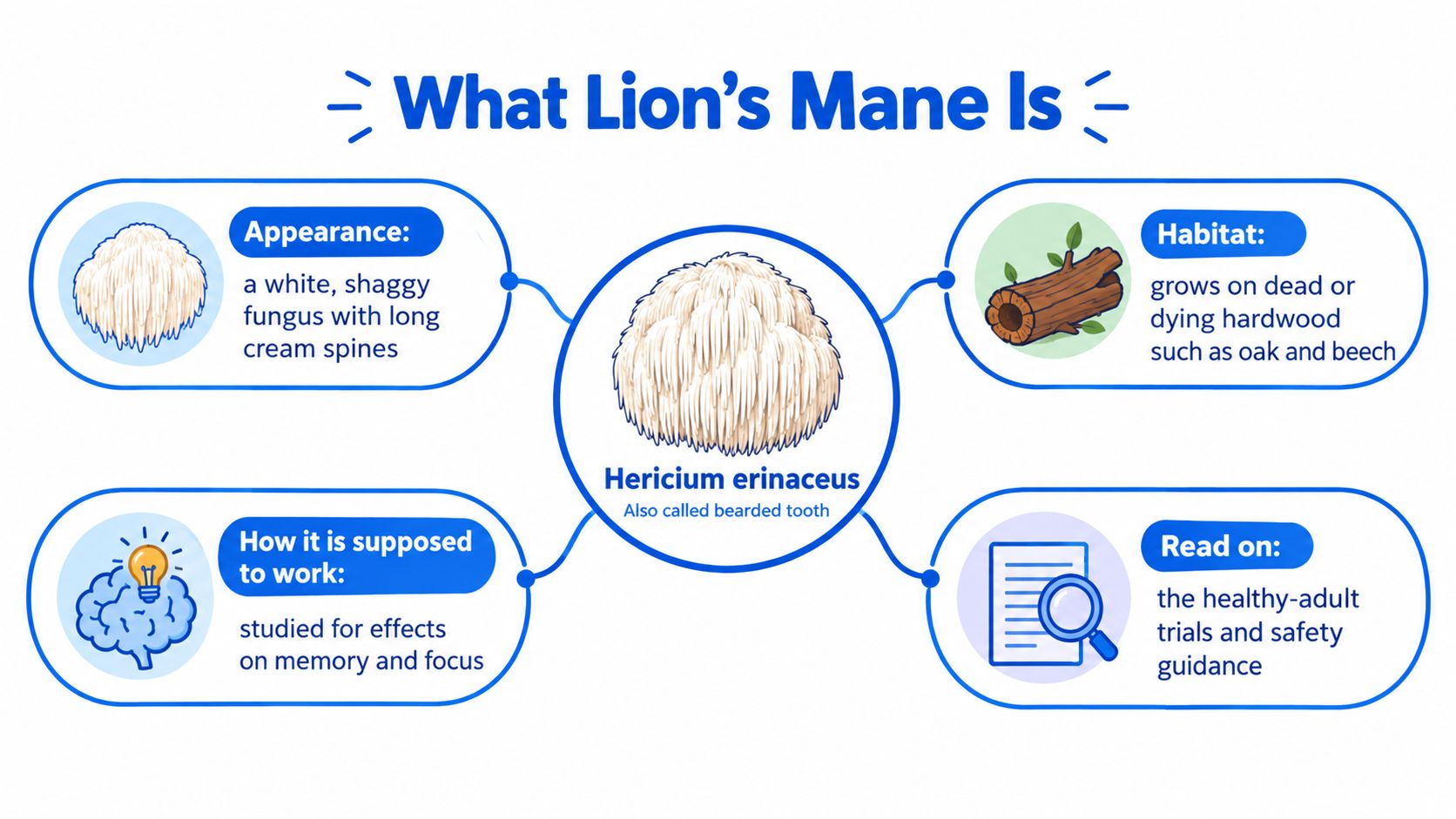
Lion's mane, Hericium erinaceus, is a white, shaggy fungus with long cream spines. Also called bearded tooth, it grows on dead or dying hardwood, including oak and beech.
The familiar spiky mushroom is only part of the organism. It works rather like an apple on a tree: the fruit you can see and pick is produced by a much larger structure you can't. For the fungus, that hidden structure is the mycelium, a network of fine threads spread through the wood. Because the two parts are biologically distinct, a product made from one isn't automatically interchangeable with a product made from the other.
The illustration identifies the mushroom and the questions that matter when considering a supplement.
Fruiting body and mycelium aren't identical
The fruiting body is the visible mushroom, used in many research powders. Mycelium can be cultivated on grain and appears in some lower-cost supplements, although price alone doesn't establish quality.
These parts contain different mixtures of compounds. A product labelled only as mushroom complex tells you little unless the manufacturer also identifies the mushroom part and preparation.
The proposed brain-related mechanism centres on hericenones, associated with the fruiting body, and erinacines, associated with mycelium. Laboratory and animal work suggests these compounds may influence nerve growth factor, a protein involved in maintaining nerve cells.
A mechanism isn't a result
Cell studies happen in a dish.
When cultured nerve cells respond to these compounds, researchers gain a reason to investigate further, but a dish has no stomach, no bloodstream and no barrier between blood and brain. Swallowing a capsule raises questions the laboratory can't answer, including digestion, absorption and how much of any relevant compound reaches the brain at all.
- What the mechanism offers: A plausible reason to run carefully controlled human trials.
- What it doesn't offer: Proof of new brain-cell growth, nerve repair or better memory in someone taking a retail supplement.
- What remains uncertain: Whether the compounds reach the right place, in useful amounts, to produce meaningful benefits in people.
Human outcomes, measured in controlled trials, are what lion's mane benefit claims stand or fall on.
What Healthy-Adult Trials Measured for Memory and Focus
The Northumbria University pilot is particularly relevant to healthy adults interested in concentration. It used random allocation, double blinding and a placebo, helping reduce the chance that expectations alone explained differences between groups.
The trial's basic design is summarised below.
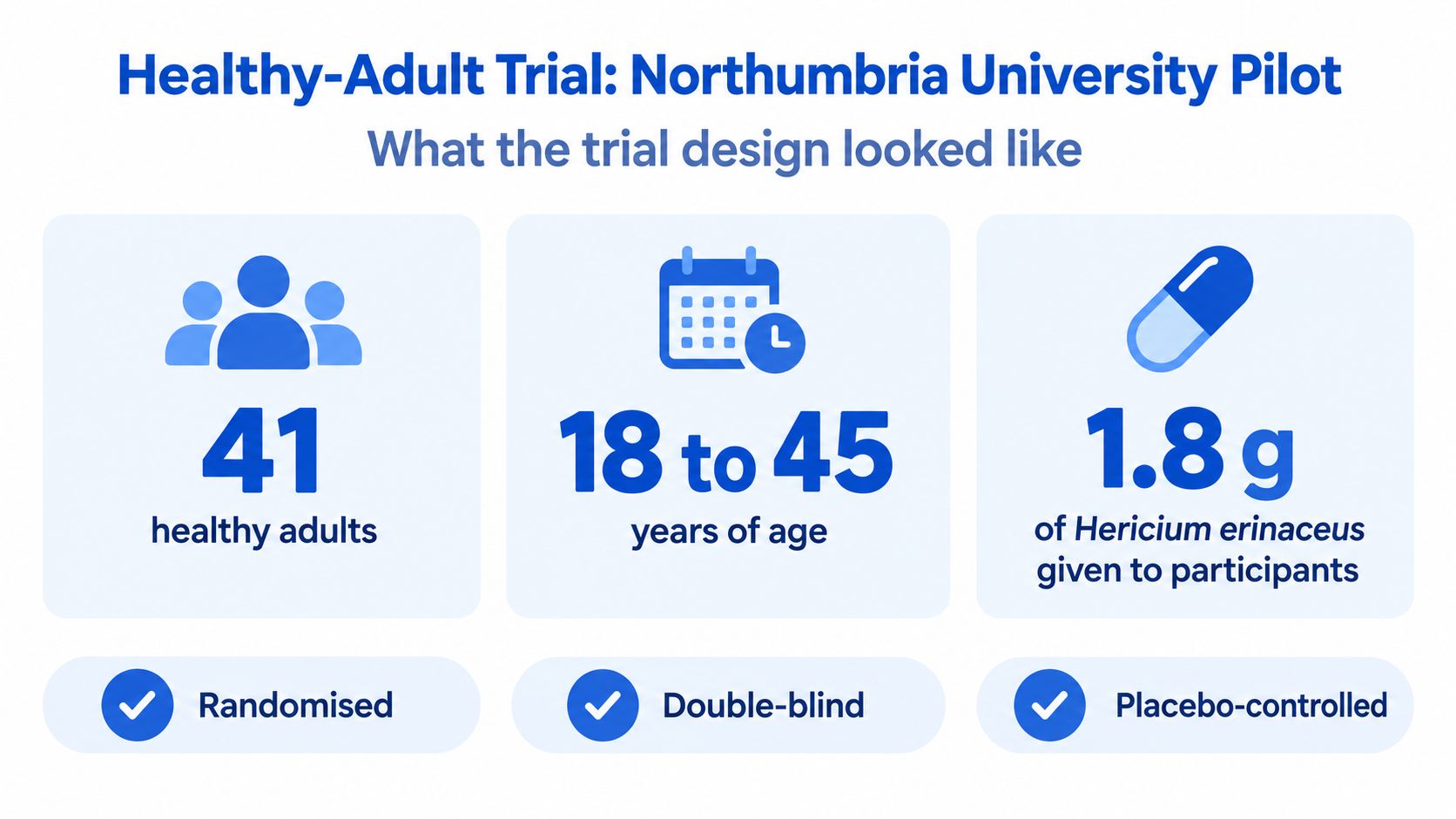
In the Northumbria University pilot study, 41 healthy adults aged 18 to 45 received 1.8 g of Hericium erinaceus powder or placebo; the lion's mane group completed a Stroop interference task faster 60 minutes after a single dose, with p = 0.005. After 28 days, lower subjective stress was a trend rather than a conventionally statistically significant finding, with p = 0.051.
What a faster Stroop result means
A Stroop task asks you to name the ink colour of a word while ignoring what the word says. For example, if the word red appears in blue ink, the correct response is blue.
That conflict tests your ability to suppress an automatic response. Faster performance can suggest a change in processing speed or attentional control, but it doesn't directly measure remembering appointments or following a complicated conversation.
The pilot also produced null or limited negative findings on other cognitive and mood measures. Selecting only the positive result would therefore give an incomplete picture of what participants experienced.
A p-value isn't a measure of how much sharper someone felt. Nor does the stress result establish a reliable stress-relieving effect merely because it was close to the conventional significance threshold.
What the crossover trial adds
The 2025 randomised, double-blind, placebo-controlled crossover study in Frontiers in Nutrition involved 18 healthy adults aged 18 to 35, testing a single 3 g dose of a 10:1 fruiting-body extract; it found no significant overall improvement in global cognition or mood, although a fine-motor task improved at 90 minutes.
In a crossover design, participants receive the different study conditions at separate visits. Comparing a participant's responses across conditions can be useful, but a small acute study still can't establish what happens during regular use.
A faster performance on a particular task is like recording a good sprint time. It doesn't establish that the runner can complete a better marathon.
For a visual introduction to the topic, the following video can accompany the trial explanations.
Keep these outcomes separate when reading a product claim:
- Short test speed: Completing a specific timed activity more quickly under controlled conditions.
- Sustained attention: Maintaining concentration throughout a longer task, such as checking a document.
- Everyday memory: Remembering information when you need it outside the testing room.
Our guide to enhancing brain health naturally offers a broader starting point for considering your routine. Lion's mane remains an experimental focus-support option, not a treatment for ADHD, dementia or cognitive impairment.
Memory Concerns in Later Life and What One Anecdote Cannot Show
The older-adult trial addressed a different question from the healthy-adult experiments. Its participants already had mild cognitive impairment, meaning memory or thinking changes beyond what would normally be expected with ageing, without the loss of everyday independence associated with dementia.
That distinction matters. A finding in people with existing impairment can't automatically be applied to a healthy person hoping to think more sharply at work.
What happened during supplementation
The Alzheimer's Drug Discovery Foundation's Cognitive Vitality assessment describes a randomised, placebo-controlled trial of 30 adults aged 50 to 80 who took 3 g daily for 16 weeks, delivered as four 250 mg tablets, three times daily. Cognitive-function scale scores were significantly higher than placebo at weeks 8, 12 and 16, and the scores fell back once supplementation stopped.
Read this trial the way its design allows. The placebo comparison rules out a simple expectation effect, which is the strongest thing the study has going for it. The limits sit in the numbers: 30 participants is small, 16 weeks is short for a condition that changes slowly, and a cognitive scale score isn't the same as managing a job, finances or medication. The trial supports a possible benefit during supplementation in this specific group. It can't say whether the same dose would help someone without impairment.
Putting a personal account in its proper place
Suppose a man in his sixties stops working because of memory problems, starts taking lion's mane and returns to work a couple of months later. His family would understandably credit the supplement. A researcher couldn't.
A single account can't separate the supplement from everything else happening at the same time: the natural ups and downs of early cognitive change, other medical care, better sleep, or just a good fortnight. The outcome also sits outside what the trials measured. Returning to a job is a life event shaped by employers, finances and confidence, not a cognitive scale score.
A person's encouraging experience deserves respectful listening. It doesn't establish what another person should expect.
For a wider wellbeing perspective, healthy aging advice from Velma can help you organise questions about later-life cognitive health. It shouldn't replace an assessment of new symptoms.
If you or someone close to you has persistent memory changes, ask a GP to assess the cause before trying a supplement. No supplement can responsibly be promised to reverse decline or return someone to work.
How Much Lion's Mane Studies Used and How to Read Labels
Lion's mane doses and durations used in research
| Study | Participants | Dose and duration | Outcome |
|---|---|---|---|
| Muffin study | Healthy adults | 10 g a day in muffins for four weeks | No cognitive improvement |
| Typical research range | Adults in published studies | 1.8 to 3.2 g a day of fruiting-body powder for up to 16 weeks | Long-term safety in healthy adults not well established |
A University of Reading-hosted review of mushroom intervention studies reports the four-week muffin trial at 10 g daily and places typical research doses at roughly 1.8 to 3.2 g of fruiting-body powder a day for up to 16 weeks. The muffin result is worth pausing on. If sheer quantity were the deciding factor, the largest dose in this table would have produced the clearest benefit. It produced none.
Read the preparation before the headline amount
None of these figures adds up to a recommended dose. The trials chose different preparations and quantities, and the results vary too much to point at a single target. Research quantities describe what scientists decided to test, not a universal dosing instruction.
Begin by finding out whether the stated amount refers to dried powder, extract or a claimed dried-mushroom equivalent. Those are different measurements, even when the front label displays similar numbers.
For example, a 12:1 extract nominally describes material produced from approximately 12 g of starting mushroom for each 1 g of extract. An extraction ratio works like a coffee-strength claim: it describes how much raw material went in, not how much active compound ends up in the cup. The ratio doesn't demonstrate that all compounds are retained, absorbed or concentrated equally.
A label stating 1800 mg of 12:1 extract therefore can't be read as equivalent to the 1.8 g powder used in a trial. Powder is milled mushroom, while an extract has had soluble compounds drawn out and the rest discarded, so the two can carry different proportions of the mushroom's components. The numbers may look familiar, but the preparations aren't chemically interchangeable.
Label-reading rule: An extraction ratio describes a manufacturing relationship, not a multiplier for proven benefits.
Make any trial of use easy to evaluate
If a pharmacist agrees that trying lion's mane is reasonable, begin with the product's suggested dose and don't exceed it. Record a specific goal, such as how often you lose your place during a familiar reading task, rather than relying on a general feeling of being sharper. A defined target gives your review point something to measure against.
- Keep the routine stable: Avoid starting several supplements together, which makes any change harder to interpret.
- Record tolerability: Note headaches, digestive symptoms and anything else that starts after use.
- Agree a review point: An eight-to-twelve-week review with a pharmacist is a practical checkpoint, not a scientifically established time to benefit.
The longer impairment trial doesn't justify continuing indefinitely. If you can't identify a worthwhile benefit, discuss stopping rather than increasing the dose.
Side Effects and Who Should Avoid Lion's Mane
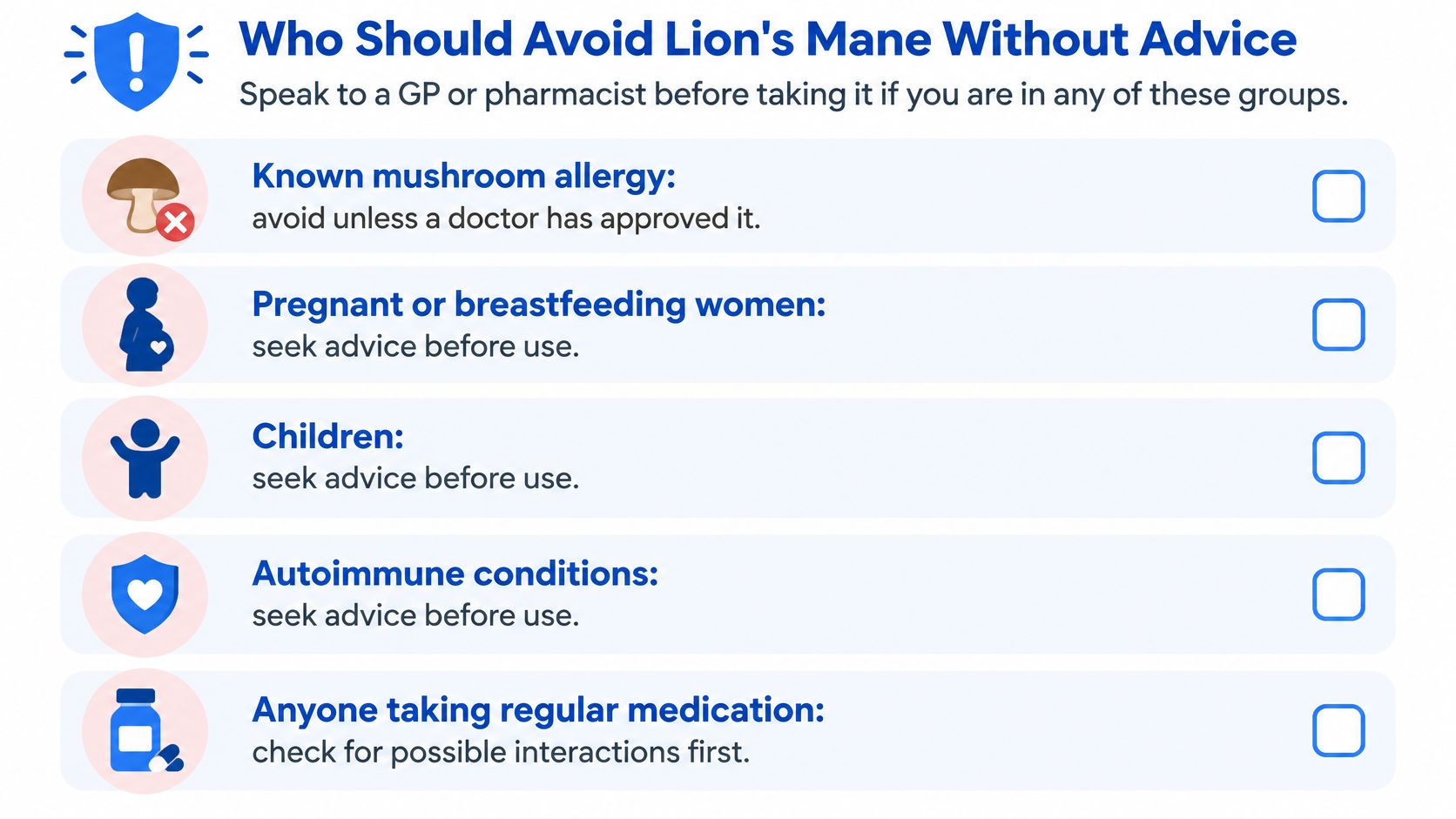
Don't take lion's mane without professional advice if you're pregnant or breastfeeding, considering it for a child, living with an autoimmune condition or taking regular medicines. If you have a known mushroom allergy, avoid self-experimenting with it.
Blood-thinning and blood-sugar medicines deserve particular attention when discussing possible interactions. These are precautionary checks because interactions aren't well studied, not proof that every combination causes harm.
The checklist below highlights the groups who should seek advice first.
Recognise symptoms and know when to stop
The Camden Medicals lion's mane explainer identifies digestive symptoms, headache and allergic reactions as reported issues, and describes studies lasting up to 16 weeks at approximately 1.8 to 3.2 g daily of fruiting-body powder while noting uncertainty about long-term safety.
Digestive symptoms might include bloating or loose stools. Don't assume discomfort is a necessary adjustment period or evidence that the product is working.
- Stop for suspected allergy: Itching, a rash, swelling of the lips or face, or wheezing warrants stopping the product and seeking medical advice.
- Seek emergency help for breathing difficulty: Don't wait to see whether symptoms settle after another dose.
- Pause for persistent discomfort: Stop and speak to a pharmacist if digestive upset or headache continues or is significant.
Concentrated extracts shouldn't be treated as equivalent to eating a mushroom in a meal. Their composition and exposure can differ, and a familiar food origin doesn't establish supplement safety.
Before-you-try checklist
The absence of serious problems in a small trial can't rule out uncommon reactions or harms from prolonged, high-dose use. Bring the actual bottle or a clear photograph of the full label when asking for advice.
- Allergies: Mention mushroom allergies and previous supplement reactions.
- Medicines: Include prescriptions, over-the-counter medicines and other supplements.
- Pregnancy and breastfeeding: Don't assume that a food-based ingredient is suitable in concentrated form.
- Existing conditions: Disclose neurological, autoimmune and other ongoing health problems.
- Planned surgery: Tell the surgical team what you're taking and follow their advice about stopping.
People managing kidney disease also need an individual review of supplement use. Our guide to supplements, vitamins and kidney health provides context for that conversation, rather than clearance to take lion's mane.
Choosing a Lion's Mane Product and Deciding Your Next Step
Lion's mane product forms and what to check on each
| Product form | What it is | Label to check | Evidence fit |
|---|---|---|---|
| Fruiting-body powder | Dried, ground mushroom | Grams of powder per dose | Closest to the 1.8 to 3.2 g research powders |
| Dual or hot-water extract | Compounds extracted from the fruiting body, often labelled with a ratio | Extract ratio, extraction method and amount per dose | Different chemistry from powder, so compare with care |
| Mycelium product | Fungus grown on grain, often labelled as mycelium | Whether the label says fruiting body or mycelium | Most trial evidence is for fruiting-body products |
| Standardised extract | Extract measured to a stated compound level | The standard and milligrams stated on the label | Check whether any human trial used this exact preparation |
The right product form depends on what the label discloses. A preparation you can identify by mushroom part, dose and method gives you something concrete to compare against trial conditions; a striking extract ratio on its own tells you little about evidence.
A standardised extract offers information about a measured constituent. It still needs relevant human evidence before that constituent level can be presented as delivering a cognitive benefit.
Check what the manufacturer actually discloses
Look beyond the front of the bottle. Our guide to buying natural supplements online can help you evaluate the practical details before purchasing.
- Mushroom part: Look for an explicit statement of fruiting body or mycelium.
- Daily serving: Check the amount in the full suggested serving, not just a prominent front-label figure.
- Preparation: Identify powder, extraction method, extract ratio and any standardisation.
- Testing: Ask for independent heavy-metal and contaminant testing relevant to the product or batch.
- Other ingredients: Review the whole formula, including additional botanicals and capsule ingredients.
Mushrooms can absorb metals from their growing environment, so contaminant documentation carries real weight here. A quality seal shouldn't be assumed to cover every possible contaminant unless the testing paperwork says so.
Certifications such as organic, vegan, Halal and Kosher tell you how a product was sourced and which dietary requirements it meets. They answer different questions from a clinical trial, so treat them as one part of the label check rather than evidence of a cognitive effect.
Multi-ingredient blends deserve the same scrutiny, ingredient by ingredient. An added botanical brings its own suitability questions, and the lion's mane evidence applies to the lion's mane component alone.
Recognise claims that go too far
The Oncology Nursing Society's evidence discussion provides context for cautious interpretation of lion's mane claims; UK advertising expectations require supported health claims that don't imply disease treatment or prevention.
Confirm that the particular preparation is lawfully sold, including compliance with any applicable novel-food authorisation requirements. Regulatory status can differ between preparations, so a lawful powder doesn't settle the question for every extract.
Promises to reverse cognitive decline or restore someone's ability to work go well beyond what small trials measured. An attractive customer story describes one person's experience. It can't show what a product will do for you.
Match the purchase to your situation
A healthy adult curious about focus can consider a cautious, label-directed trial after checking suitability. Persistent or worsening memory problems need a GP assessment first, and anyone in a risk group should resolve the safety questions with a clinician before buying.
Our Organic Lion's Mane Capsules by Pumpernickel Health Foods contain 1800 mg of 12:1 extract, enriched with Ginkgo Biloba and Black Pepper, in 120 high-strength capsules, described as a four-month supply. They're made in the UK and certified organic, vegan, Halal and Kosher, with a stated sale price of £17.49, reduced from £19.99; check the live price before buying. A 12:1 extract differs in composition from the powders used in trials, so the research findings shouldn't be read as predictions for this or any other extract.
We offer free, pre-booked one-to-one consultations with a supplement specialist, by phone or at our Bedford shop. Bring your medicines list so we can help identify suitability questions that need a pharmacist's or prescriber's assessment.
Before choosing, ask three questions: does the label state the form, does it state the dose, and does it explain the testing? Clear answers won't guarantee a benefit, but they give you a firmer basis for deciding whether a product is worth trying.
Pumpernickel Health Foods offers lion's mane supplements alongside free, pre-booked consultations to help you compare preparations and discuss suitability. Visit Pumpernickel Health Foods to explore the options or arrange a conversation by phone or in our Bedford shop, with your goals and medicines list to hand.