
You wake up with a scratchy throat, reach for a tissue and realise your week may be about to get less comfortable. If you're looking at echinacea for colds, you probably want a straight answer: is it worth buying, or is it another bottle that promises more than it delivers? My recommendation is to consider it for a clearly defined, short-term purpose, not as an all-winter insurance policy.
Table of Contents
- Why People Reach for Echinacea at the First Sniffle
- What Echinacea Actually Is and How It Is Prepared
- What the Research Says in Plain English
- Three Different Jobs Echinacea Is Asked to Do
- How to Read a UK Echinacea Label and Use It Well
- Who Should Be Cautious About Taking Echinacea
- Setting Realistic Expectations and Knowing When to Seek Help
- Choosing Echinacea With Confidence This Winter
Why People Reach for Echinacea at the First Sniffle
An autumn morning in Bedford, a busy diary and the beginnings of a runny nose. It's easy to understand why someone would walk into the shop looking for a herbal option before their cold gets properly underway. They don't want a lecture about research methods. They want to know what might help and what's worth their money.
The honest answer starts with a question: what do you want echinacea to do? Avoiding a cold, easing symptoms and reducing repeated respiratory infections aren't the same job. A product that has been investigated for one purpose shouldn't automatically be recommended for another.
My buying rule: Choose the purpose before you choose the bottle.
A useful option, not a promise
Echinacea has been investigated in controlled clinical research, including a registered study comparing Echinaforce with placebo and collecting daily symptom diaries. That makes it a subject of serious investigation, but the Health Research Authority study registration records the study's design and aims, not proof that the product prevents or cures colds.
Before recommending a purchase, I'd separate these expectations:
- Prevention: You're currently well and want to avoid becoming ill.
- Symptom relief: Your cold has started and you want it to feel more manageable.
- Reducing recurrence: You're concerned about respiratory infections coming back repeatedly.
That distinction protects you from spending money on the wrong assumption. It also makes a supplement consultation more useful: we can discuss an actual goal rather than the vague idea of boosting everything.
If you're reviewing your wider seasonal routine, our guide to vitamin D for immunity support is a separate starting point. Don't assume different immune-support products do the same thing or need to be taken together.
For echinacea, I'd balance the research with the UK label and your health history. A worthwhile purchase is one you understand, can use appropriately and don't expect to perform miracles.
What Echinacea Actually Is and How It Is Prepared
Echinacea is a group of flowering plants used in herbal medicine, not a single standard ingredient. The names you'll encounter include Echinacea purpurea, Echinacea angustifolia and Echinacea pallida. Those details matter because a finding about one preparation doesn't automatically apply to another.
Think of grape varieties and wine. Knowing that something is wine tells you the broad category, but not exactly what's in the bottle. Echinacea labels need the same closer attention.
The visual below offers a useful starting point for recognising the main label distinctions.
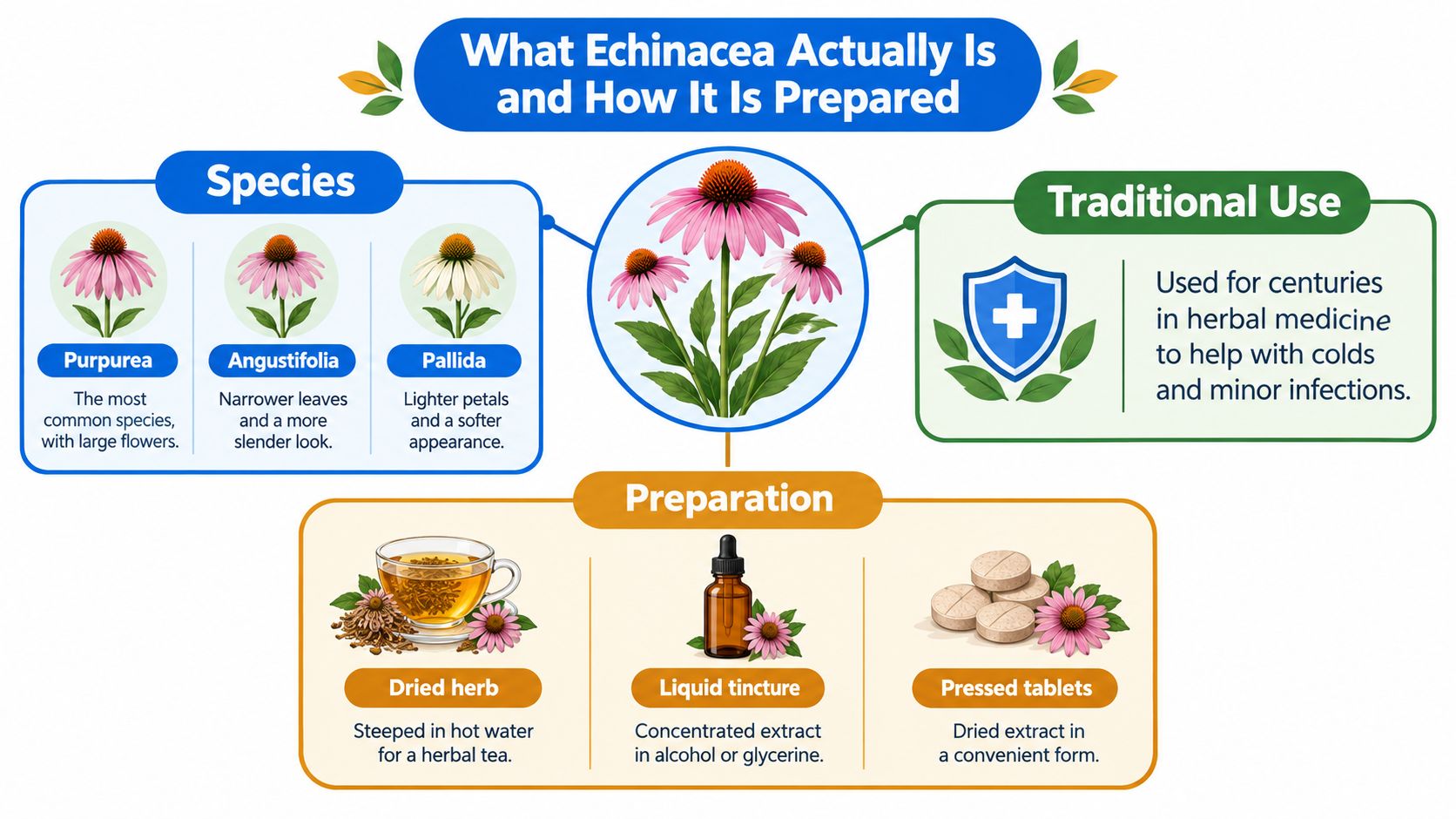
Read beyond the plant name
The plant part is another distinction. A product may use the aerial herb, meaning the parts above ground, or the root. It may also combine material from different parts of the plant.
Preparation adds another layer. Pressed juice, an alcoholic extract or tincture, and dried plant material aren't interchangeable descriptions. Nor should you assume that a tea, tablet and liquid necessarily contain comparable preparations because each carries the echinacea name.
When comparing bottles, look for:
- Species identification: The full plant name, rather than just echinacea on the front.
- Plant-part information: Whether the preparation uses herb, root or a combination.
- Preparation details: Whether it contains expressed juice, an extract or dried material.
- Finished-product directions: The intended use and instructions for that particular bottle.
Format is a practical choice, not proof of strength
A liquid may suit someone who dislikes swallowing tablets. A chewable may be more convenient for someone who wants a different format. Neither preference establishes that the product works better.
My advice is to choose the preparation first and the convenient format second. Don't pick a bottle because the front looks stronger, more concentrated or more natural.
This is why I wouldn't recommend substituting any echinacea product for one used in a clinical trial. The exact preparation is part of the evidence, not a minor packaging detail. If the label leaves you unsure what you're buying, ask before paying.
What the Research Says in Plain English
If you're weighing echinacea for a cold, separate three questions: can it prevent one, ease symptoms after they start, or reduce recurrence? The evidence does not support treating all three as the same job. A Cochrane review of echinacea for preventing and treating colds examined 24 controlled trials involving 4,631 participants. None of the 12 prevention comparisons reporting whether participants experienced at least one cold found a statistically significant difference.
The review's prevention analysis also described a post-hoc pooled result suggesting a relative risk reduction of approximately 10% to 20%, but judged the possible benefit weak and of questionable clinical importance. I would not buy echinacea expecting reliable protection.
Possible symptom relief, inconsistent results
The evidence is more encouraging for certain preparations taken soon after symptoms begin. Cochrane's common-cold treatment summary reported that alcoholic extracts or pressed juice from the aerial parts of Echinacea purpurea might improve symptoms, including a runny nose, in adults who start treatment early. Nine treatment comparisons reported a significant effect, one showed a trend, and six found no difference. The summary found no clear evidence of benefit in children.
That is a mixed result, not a dependable promise. A positive finding matters, but it does not erase the comparisons showing no difference. I'd consider a suitable preparation for possible symptom relief, while keeping expectations modest.
Cough and laboratory-infection findings need care
NICE's acute-cough evidence summary reported improvement versus placebo, with a standardised mean difference of −0.68 and a 95% confidence interval from −1.32 to −0.04. NICE rated the evidence low quality because the analysis included only 2 studies. Most studies in the wider review did not show significant cough reduction, and the committee made no recommendation for echinacea.
Separately, the UK Centre for Reviews and Dissemination's induced-rhinovirus review reported fewer symptomatic colds among echinacea users, with a pooled odds ratio of 1.55, a 95% confidence interval of 1.02 to 2.36 and p=0.043. Symptom severity showed no significant difference, with a weighted mean difference of −1.96 and a 95% confidence interval of −4.83 to 0.90.
These results measure different outcomes. They do not show that echinacea reliably makes an ordinary cold milder or prevents it from returning.
A possible benefit is a reason to consider a suitable product, not a reason to promise a result.
For a broader look at available options, Vitamin Planet's guide to cold and flu remedies offers another way to compare approaches. Judge each remedy by its own evidence.
Three Different Jobs Echinacea Is Asked to Do
Your reason for buying echinacea should determine how you judge it. Someone who wants relief from today's runny nose needs a different conversation from someone worried about repeated infections throughout the season.
Use this comparison to identify your situation without turning every positive research finding into the same claim.
| Your goal | What would count as a useful result | My recommendation |
|---|---|---|
| Prevention | Avoiding a cold before symptoms begin | Don't buy it expecting dependable protection. |
| Symptom relief | Making an established cold more manageable | Consider an appropriately labelled preparation with realistic expectations. |
| Reducing recurrence | Experiencing fewer repeated respiratory infections | Discuss the research and your health history before choosing a longer-term strategy. |
Prevention isn't the strongest buying argument
If you're feeling well and want a guarantee that you'll stay that way, I wouldn't steer you towards echinacea. The prevention findings discussed earlier don't justify that confidence.
There's also a practical mismatch between taking something throughout winter and choosing a product authorised for a short symptomatic course. A research question about prevention doesn't override the directions on a retail bottle.
Symptom relief is a more focused decision
For an otherwise suitable adult at the beginning of a cold, a licensed product intended for symptom relief is a more coherent purchase. You know what you're trying to achieve, and you can judge whether it feels worthwhile without expecting it to eliminate the illness.
The positive treatment findings concerned specific extracts and pressed-juice preparations. That's why I'd ask to see the exact bottle rather than recommend echinacea as a category.
Recurrence deserves its own conversation
The Committee on Toxicity's mechanism-of-action annex cites a meta-analysis of six randomised trials reporting reduced relative risk of recurrent respiratory infections, RR 0.649, with a 95% confidence interval of 0.545 to 0.774. That is evidence about recurrence, not equivalent evidence for treating a cold that's already underway.
The finding is worth discussing, but it isn't permission to keep restarting a short-course product indefinitely. Repeated infections also deserve attention beyond the supplement shelf.
Our guide to zinc for immune support can help you frame a separate discussion about nutritional products. Don't treat zinc and echinacea as substitutes, and don't assume combining them will produce a better result.
How to Read a UK Echinacea Label and Use It Well
Start with the Traditional Herbal Registration, usually abbreviated to THR, and the product's authorised indication. This is more useful than a large plant illustration or a broad immune-support slogan.
The Committee on Toxicity's summary of existing UK echinacea authorisations explains that THR products are authorised for relief of common-cold and influenza-type symptoms on the basis of traditional use. It also distinguishes specific preparations with supporting clinical evidence from the wider range of species, plant parts and extracts.
Check the medicine, not just the marketing
Traditional use isn't the same as strong clinical proof for every formulation. Treat the registration as a defined authorisation with boundaries, not an endorsement of every claim you might encounter online.
Before you buy, check the following:
- Intended use: Does the label describe relief of the symptoms you're trying to manage?
- Preparation: Can you identify the species, plant part and extract?
- Directions: Can you follow the dose and course without improvising?
- Warnings: Have you read the leaflet, including restrictions relevant to your medicines and health conditions?
Don't borrow dosing instructions from a different bottle. Drops, conventional tablets and chewables need their own directions.
The website screenshot below can help orient you when browsing, but it isn't a substitute for reading the chosen echinacea product's leaflet.
Start promptly and set a stopping point
The EMA monograph for the covered Echinacea pallida root preparation says treatment should begin at the first signs of a cold, advises consulting a doctor or qualified healthcare professional if symptoms continue for more than 10 days, and does not recommend that preparation for children under 12.
Apply your chosen UK product's own age wording and licensed duration. Don't extend the course because there's liquid left in the bottle, and don't assume the threshold means you should wait to seek help if you're becoming more unwell.
Pumpernickel's in-store A. Vogel Echinaforce range includes liquid and tablet options, including chewables. A free pre-booked consultation is a practical way to compare those formats, check the current label and decide whether buying one makes sense for you.
Before starting: Know the dose, know when you'll stop, and know what would make you seek medical advice sooner.
Who Should Be Cautious About Taking Echinacea
Natural doesn't mean suitable for everyone. The most important echinacea safety conversation concerns allergies and immune-related conditions, not whether a product is herbal.
UK Committee on Toxicity safety material describes oral echinacea as generally well tolerated, with mild, reversible gastrointestinal effects and allergic skin reactions commonly reported; pharmacovigilance reports also include potentially serious reactions, including anaphylaxis, particularly in people with atopic disease, and EMA recommends caution with asthma or a history of atopy.
Run the safety check before buying
A history of hay fever or eczema belongs in the conversation. It doesn't prove you'll react to echinacea, but it shouldn't be dismissed as unrelated information.
This checklist is a reminder to disclose allergy history, not a diagnosis or a prediction that asthma symptoms will necessarily worsen.
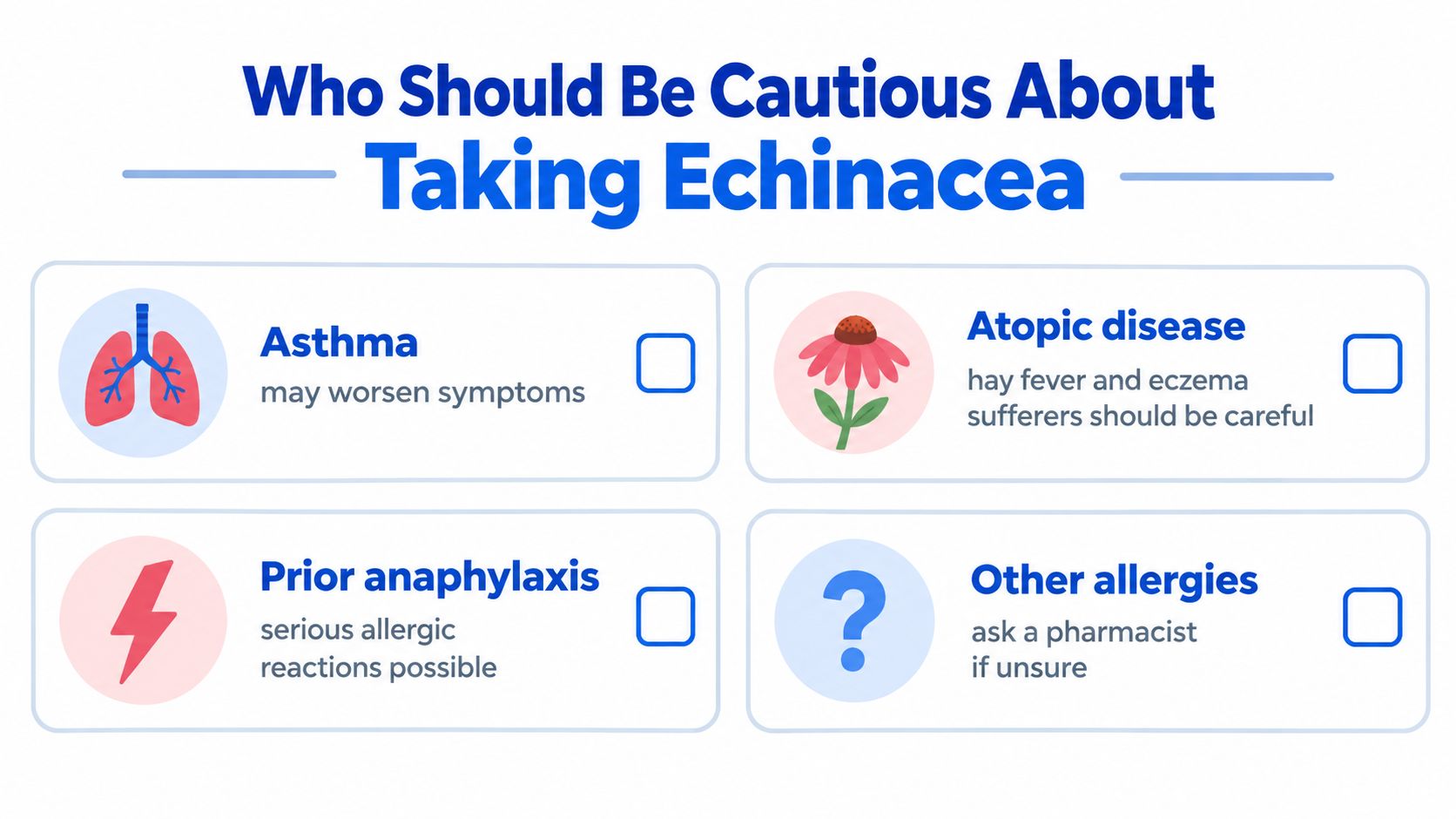
Before considering a purchase:
- Asthma or atopic disease: Ask a pharmacist or GP whether echinacea is appropriate.
- Previous anaphylaxis or a suspected echinacea allergy: Don't experiment with a trial dose. Seek professional advice.
- Autoimmune disease, immunodeficiency, immunosuppression or white-cell disorders: Echinacea isn't recommended. Speak to your treating clinician.
- Immune-modifying treatment: Have a pharmacist review your medicines before adding a herbal product.
- Pregnancy or breastfeeding: Avoid use because high-quality reproductive-safety data are insufficient.
Those pregnancy, breastfeeding and immune-condition restrictions are also covered in the Committee on Toxicity safety material. The issue isn't that every user will be harmed. It's that the available reassurance isn't adequate, or immune modulation could be inappropriate for the individual.
Bring your whole supplement routine
Tell the adviser what you already take, including prescribed medicines, non-prescription treatments and other herbal remedies. A useful recommendation depends on the complete picture.
Our guide to whether you can take too many vitamins addresses the broader habit of adding products without reviewing the routine. The same practical discipline applies here: more bottles don't automatically mean better care.
For children, follow the exact age restriction on the UK product rather than relying on adult experience. If any safety question remains unresolved, my recommendation is simple: leave the bottle on the shelf until you've checked.
Setting Realistic Expectations and Knowing When to Seek Help
Echinacea is an optional addition to sensible self-care, not a replacement for it. Prioritise rest and fluids, practise hand hygiene and avoid passing your infection to others. If you're eligible for flu vaccination, discuss that with your healthcare provider rather than treating a herbal remedy as an alternative.
The visual below summarises practical self-care, but don't take its suggested shortening of a cold as a promised benefit. The research discussed earlier doesn't justify a fixed claim about time saved.
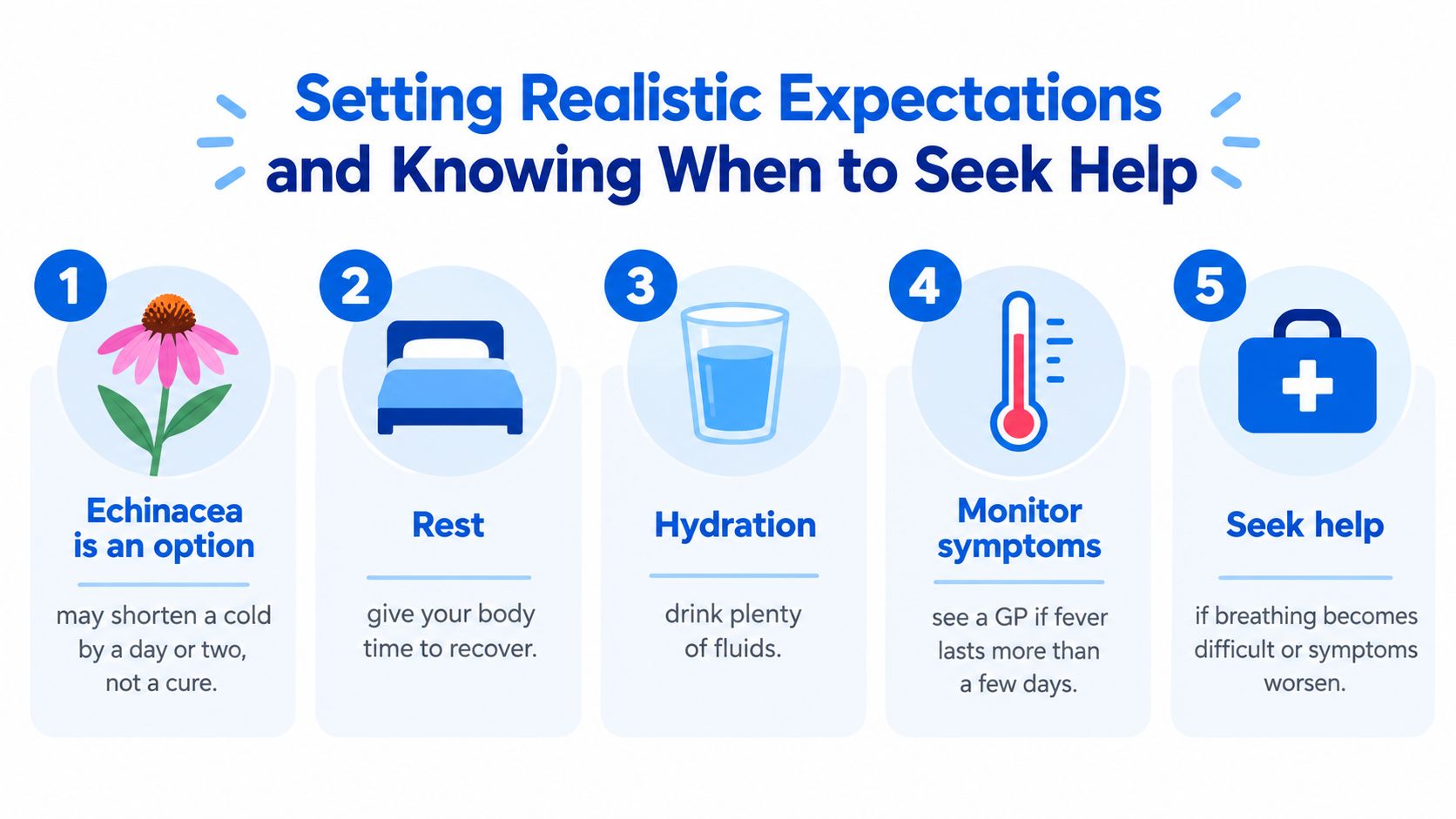
Symptoms matter more than finishing the course
Breathing difficulty, facial swelling or rapidly developing hives require immediate medical attention, especially after taking a product. Don't wait for a routine GP appointment if you suspect a serious allergic reaction.
- High or persistent fever: Seek medical advice rather than adding another supplement.
- Symptoms beyond the stated threshold: Arrange the professional assessment described in the label guidance.
- Repeated or worsening illness: Speak to your GP rather than repeatedly restarting echinacea.
For additional reading about symptom duration, the VirusFAQ.com cold symptom guide offers a resource to consult alongside professional advice. It shouldn't be used to explain away warning signs.
An additional video is available below; use media as background information, not personalised medical guidance.
My position is straightforward: a supplement should support responsible self-management, never delay necessary care.
Choosing Echinacea With Confidence This Winter
Decide whether your concern is prevention, symptom relief or recurrence before choosing echinacea. Then match your expectations to the evidence and the exact product, rather than treating the name as a universal answer.
For a suitable adult seeking short-term symptom relief, a clearly labelled THR option is worth considering. Check the safety list, follow the course directions and resist the temptation to keep taking it without review.
Pumpernickel offers Bedford shop advice, phone and WhatsApp support, and free one-to-one supplement consultations. Bring your questions and medication list so the decision is supported, not guessed.
Pumpernickel Health Foods offers a curated A. Vogel range, including Echinaforce, alongside free pre-booked consultations to help you assess preparation, format and suitability. Visit Pumpernickel Health Foods to explore the range or arrange advice before choosing echinacea for your next cold.
Created with the Outrank app