
A blood test comes back normal after six weeks, but you still feel tired. Has the vitamin worked? The answer depends on what is being measured: a blood level can change before symptoms ease, and improvement is more likely when a deficiency was present to begin with.
Absorption, correction of a deficiency and symptom relief are separate steps. A supplement may be absorbed without changing how you feel, especially if your nutrient levels were already adequate.
If symptoms persist, taking a higher dose or waiting longer may not be the right response. The useful next step is to review the treatment and consider whether another cause needs checking.
Table of Contents
- Realistic Timelines for Each Vitamin
- Why Vitamins Rarely Work Overnight
- Why Vitamin D Loading Courses Take Months
- Week-by-Week Milestones for B12 and Iron
- Vitamin C, Magnesium and B Complex Timelines
- When a Vitamin Still Does Nothing
- Dose, Consistency and Your Next Review
Realistic Timelines for Each Vitamin
Think in weeks to months, not overnight results. Treatment timelines are most useful when a deficiency has been confirmed and the treatment matches its cause. They aren't promises of extra energy for someone whose nutrient levels are already adequate.
The comparison below separates the first change from the fuller response. For vitamin D, “steady state” means blood levels have settled into a relatively stable pattern, not that every symptom has disappeared.
Expected timelines by vitamin and starting point
The vitamin D estimate comes from the Shropshire and Telford NHS vitamin D treatment guidance, which describes approximately 3 months to steady state after loading or maintenance treatment. For B12, South West London clinical guidance describes neurological improvement beginning within about 1 week, with complete resolution commonly taking 6 weeks to 3 months.
| Vitamin | Starting point | First change | Full effect |
|---|---|---|---|
| Vitamin D | Confirmed deficiency | Blood levels begin to rise over weeks | About 3 months to steady state |
| Vitamin B12 | Confirmed deficiency | Neurological improvement within about 1 week | 6 weeks to 3 months for complete resolution, although symptoms can persist |
| Iron | Iron-deficiency anaemia | Feel better after 3–4 weeks | 2–4 months, then rebuild stores |
| Vitamin C | Healthy adult, usual intake | Blood levels rise within hours to days | No established timeline for health benefit |
| Multivitamin | Healthy adult, no deficiency | Usually no noticeable change | No predictable felt effect |
| Magnesium | Low intake or deficiency | No supported fixed timeframe | Reassess against the identified deficiency and symptoms |
| Vitamin B complex | Confirmed deficiency | Follow the timeline for the deficient B vitamin | No single timeframe for the whole complex |
For the iron row, the NHS ferrous sulfate guidance gives 3–4 weeks before people commonly feel better and 2–4 months for the full therapeutic effect. Iron is a mineral rather than a vitamin, but it belongs in this comparison because it's often taken for similar concerns, particularly tiredness.
Use the right starting point
A fast change in circulating vitamin C doesn't establish a timetable for better health. Likewise, a multivitamin can help cover dietary gaps without producing a sensation you can identify.
For families, Daily Powers' explanation of how long kids' vitamins take to work offers a child-focused companion. Don't transfer adult treatment schedules to children.
Find your nutrient, record whether deficiency has been confirmed and write down your start date. Those details make the comparison useful rather than just reassuring.
Why Vitamins Rarely Work Overnight
Topping up a nearly empty bath takes time before there's enough water to use; adding a little to a full bath barely changes anything. Vitamins follow a similar principle: the benefit depends on what was missing, not on taking a tablet.

From swallowing to using a nutrient
Absorption comes first. A tablet must break down and its nutrients must pass through the gut. Food, digestive conditions and other medicines can affect that process, so swallowing the labelled amount doesn't guarantee that your body absorbs it all.
Conversion follows for some nutrients. Colecalciferol, a common vitamin D form, must be processed by the liver and kidneys into the active hormone calcitriol. The NHS vitamin D guidance explains why deficiency treatment is a course rather than an instant fix, and why excessive prolonged intake can cause harm.
Storage changes the pattern. Fat-soluble vitamins A, D, E and K can be held in the liver and fatty tissues. B12 is water-soluble but is an important exception to the idea that these vitamins aren't stored: the liver can retain supplies for years. Vitamin C is largely not stored, and surplus is excreted.
Your starting level determines the opportunity for benefit. Correcting a shortage and taking extra when you already have enough are different situations. Neither rapid absorption nor a large dose proves that you'll feel better quickly.
A vitamin shows its benefit when it fills a real gap, and correcting that gap takes time.
For anyone comparing delivery methods, Restore Osteopathic Medicine's discussion of deficiency treatment versus wellness drips provides context for that distinction. The practical question isn't which route gets nutrients into the bloodstream fastest, but whether you need treatment and which route suits the cause.
Why Vitamin D Loading Courses Take Months
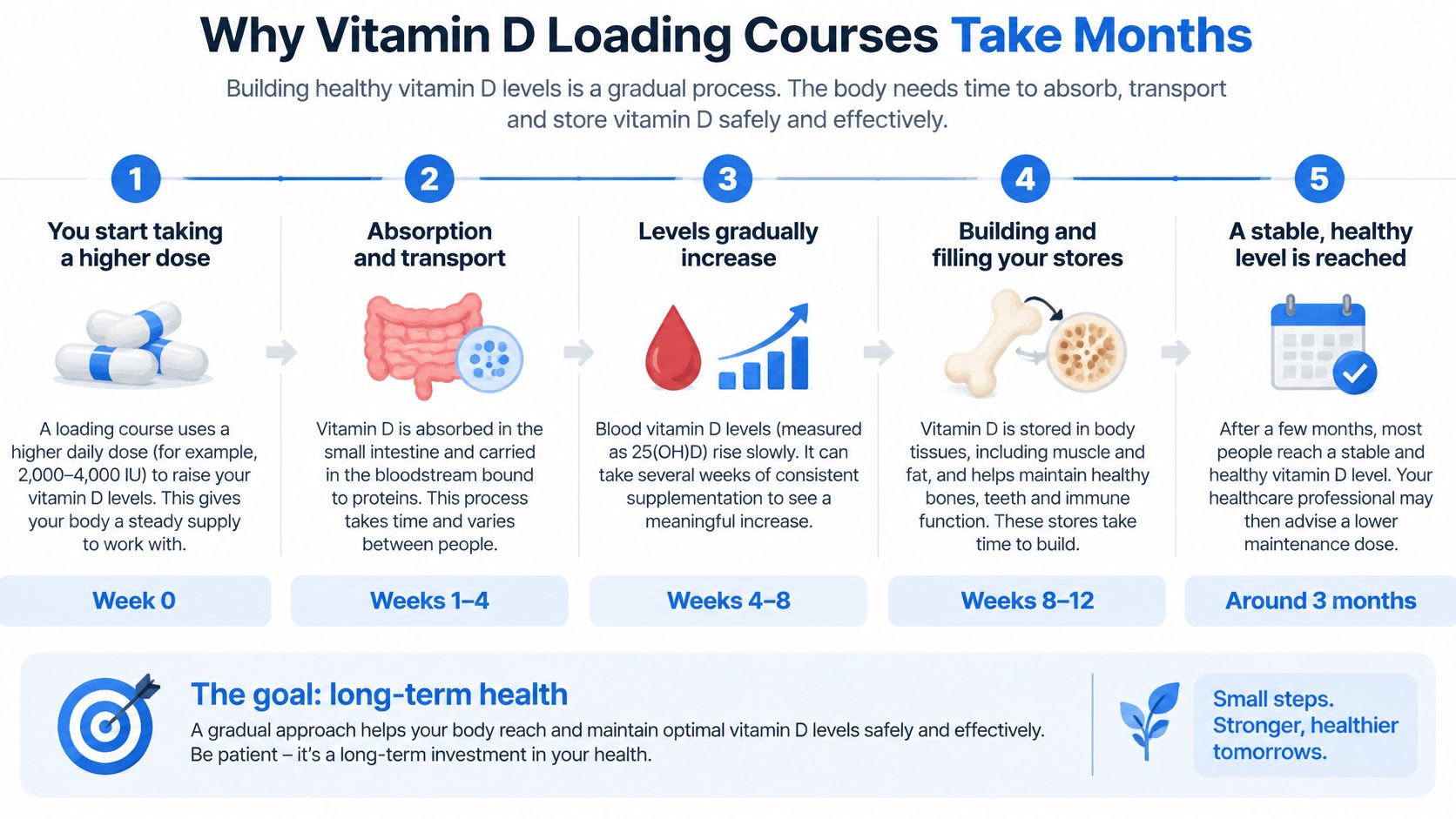
Vitamin D offers a clear example of phased treatment. A loading course raises low levels, while maintenance aims to keep them adequate afterwards. These aren't interchangeable jobs.
The Shropshire and Telford NHS adult treatment pathway describes treatment for serum 25-hydroxyvitamin D below 25 nmol/L, with an example of 40,000 IU weekly for 7 weeks and clinical symptom review around 3 months after starting. It also describes loading courses totalling approximately 300,000 IU over 6–10 weeks, followed by 800–2,000 IU daily, generally beginning about one month after loading.
Vitamin D phases and what to expect
| Phase | Duration | Typical dose | What to expect |
|---|---|---|---|
| Loading | 6–10 weeks | About 300,000 IU in divided doses | Levels rise faster than with maintenance |
| Between phases | About 1 month after loading ends | Follow the prescribed transition plan | Clinical review or monitoring as directed |
| Maintenance | Long term, as directed | 800–2,000 IU daily | Ongoing support to hold levels in range |
| Steady state | About 3 months after loading or maintenance begins | Continue the prescribed regimen | Symptoms may lag behind blood levels |
The timing of steady state is a biochemical expectation, not an instruction to repeat a loading course. Your prescriber should tell you when to move between phases and whether testing is needed.
What unchanged symptoms mean
Muscle or bone discomfort can improve later than the first blood-level changes. Treatment has to correct the shortage before deficiency-related symptoms can reliably ease, and the symptoms may also have another cause.
Say you're early in a prescribed course and still feel the same. Keep to the agreed dose rather than doubling it, and use the planned review to discuss your response. Taking more doesn't give you a dependable shortcut and can raise blood calcium, a condition called hypercalcaemia.
If you're comparing routine formulations, our guide to vitamin D3 and K2 offers background on product choices. It doesn't replace an individual deficiency-treatment plan.
If deficiency seems possible, arrange a GP assessment and discuss whether a blood test is appropriate before choosing a high-dose product.
Week-by-Week Milestones for B12 and Iron
A blood count can improve before symptoms do. For example, someone with iron-deficiency anaemia may have a rising haemoglobin by day 10 while numbness persists. The blood result shows that the body is responding; lingering symptoms still need attention, especially if they do not ease as expected.
For B12 deficiency-related anaemia, the Nottinghamshire vitamin B12 treatment guideline describes checking haemoglobin and reticulocytes around 7–10 days, with another test at approximately 8 weeks. Reticulocytes are young red blood cells. A rise in their number can show that the bone marrow is responding.
Symptoms may begin to improve within about 2 weeks, though improvement can take up to 3 months, according to the same guidance. Nerve symptoms and blood abnormalities can recover at different rates.
Match each checkpoint to its purpose
With iron, Royal Berkshire NHS guidance on taking iron supplements says some people begin feeling better after about a week. It recommends checking levels about 1 month after starting and, when treatment is working, checking again 2 months later. Feeling better does not by itself confirm that iron stores are replenished.
Review points for vitamin B12 and iron
| When | Vitamin B12 | Iron |
|---|---|---|
| Around 1 week | Symptoms may begin to improve | Some people begin feeling better |
| 7–10 days | Check haemoglobin and reticulocytes | Follow the agreed monitoring plan |
| 2–4 weeks | Track changes in symptoms | Review symptoms and follow any arranged blood tests |
| About 1 month | Discuss symptoms and treatment tolerance | Recheck iron levels |
| About 8 weeks | Check the response | Continue monitoring as directed |
| Following months | Nerve symptoms may recover more slowly | Continue treatment to replenish stores |
| Longer-term review | Establish whether ongoing replacement is needed | Confirm that the cause has been addressed |
These are clinical checkpoints, not deadlines you must meet. If haemoglobin rises but numbness persists, tell your clinician; if blood results show little response, discuss possible reasons and the next step.
Practical rule: Continue the agreed treatment plan even once you feel better.
For more context on injections, read do B12 shots really work. A clinician can help determine whether injections suit your treatment needs.
The iron guide for women can help you prepare questions about iron products. Compare elemental iron, the amount of iron supplied, rather than the tablet's total weight. Persistent symptoms, difficulty tolerating treatment or a poor response are reasons to ask for a clinical review.
Vitamin C, Magnesium and B Complex Timelines
How quickly should you expect vitamin C, magnesium or a B-complex supplement to make a difference? The answer depends on whether you have a shortfall and what you hope to improve. Changes in a blood level and changes in symptoms are separate milestones.
Vitamin C levels can change quickly, while a noticeable health benefit depends on whether you needed more in the first place. There is no set waiting period for a healthy adult to feel a vitamin C supplement working. Our guide to daily vitamin C dosage explains how to consider your intake.
Judge the purpose before the result
A multivitamin supports daily nutritional intake. If your diet already meets your needs, you may not notice a change.
Formula VM-2000 Multivitamin provides a blend of vitamins and minerals for daily nutritional intake.

With magnesium, the starting point is why you are considering it: low dietary intake, a measured deficiency or a symptom you think may be related. B-complex products contain several B vitamins, each with its own role. A blend therefore has no single timetable for improvement.
- Clarify the reason. Ask your GP or pharmacist whether testing is appropriate for your symptoms and circumstances.
- Agree what success means. If a deficiency is confirmed, follow the clinician's plan for reassessment.
- Avoid dose escalation. No noticeable effect alone does not show that you need a higher dose.
The full record checklist in the final section can help you prepare for a review. If there is no change within the expected timeframe, seek advice about the cause and next steps rather than increasing the dose yourself.
When a Vitamin Still Does Nothing
A supplement that hasn't helped isn't automatically too weak. The more useful question is whether the diagnosis, treatment route and ongoing cause have all been addressed.
The NHS overview of vitamin B12 and folate deficiency anaemia explains that B12 replacement may be lifelong when deficiency isn't caused by diet. When a temporary poor diet caused the deficiency, treatment may sometimes stop after levels recover and the diet improves.
Look beyond the tablet
An incomplete diagnosis can leave you treating a suspected nutrient problem while the actual cause of fatigue remains unrecognised. Continuing losses, including heavy menstrual bleeding or gut bleeding, can also prevent lasting correction.
Absorption deserves particular attention. Irreversible malabsorption causes, including autoimmune gastritis, total gastrectomy or terminal-ileal resection, may require B12 injections rather than relying on ordinary tablets. Missed doses and interacting medicines are other reasons a suitable prescription may not produce the expected response.
Use any general explanation alongside, not instead of, your own treatment advice.
A practical review should work through the problem in order:
- Confirm the diagnosis. Bring significant or persistent symptoms to a clinician rather than repeatedly trialling supplements.
- Check actual use. Take your bottle, medication list and dosing record to the appointment.
- Discuss absorption risks. Mention digestive disease, relevant surgery and medicines.
- Set the next checkpoint. Agree what will be assessed and when.
- Resist adding more products. Overlapping formulas can complicate the picture without addressing the cause.
Persistent or worsening numbness, tingling or balance problems need medical review, not a stronger supplement.
You don't need to wait until a bottle is empty to ask for help. A reassessment can change the diagnosis, route or treatment plan more usefully than another purchase.
Dose, Consistency and Your Next Review
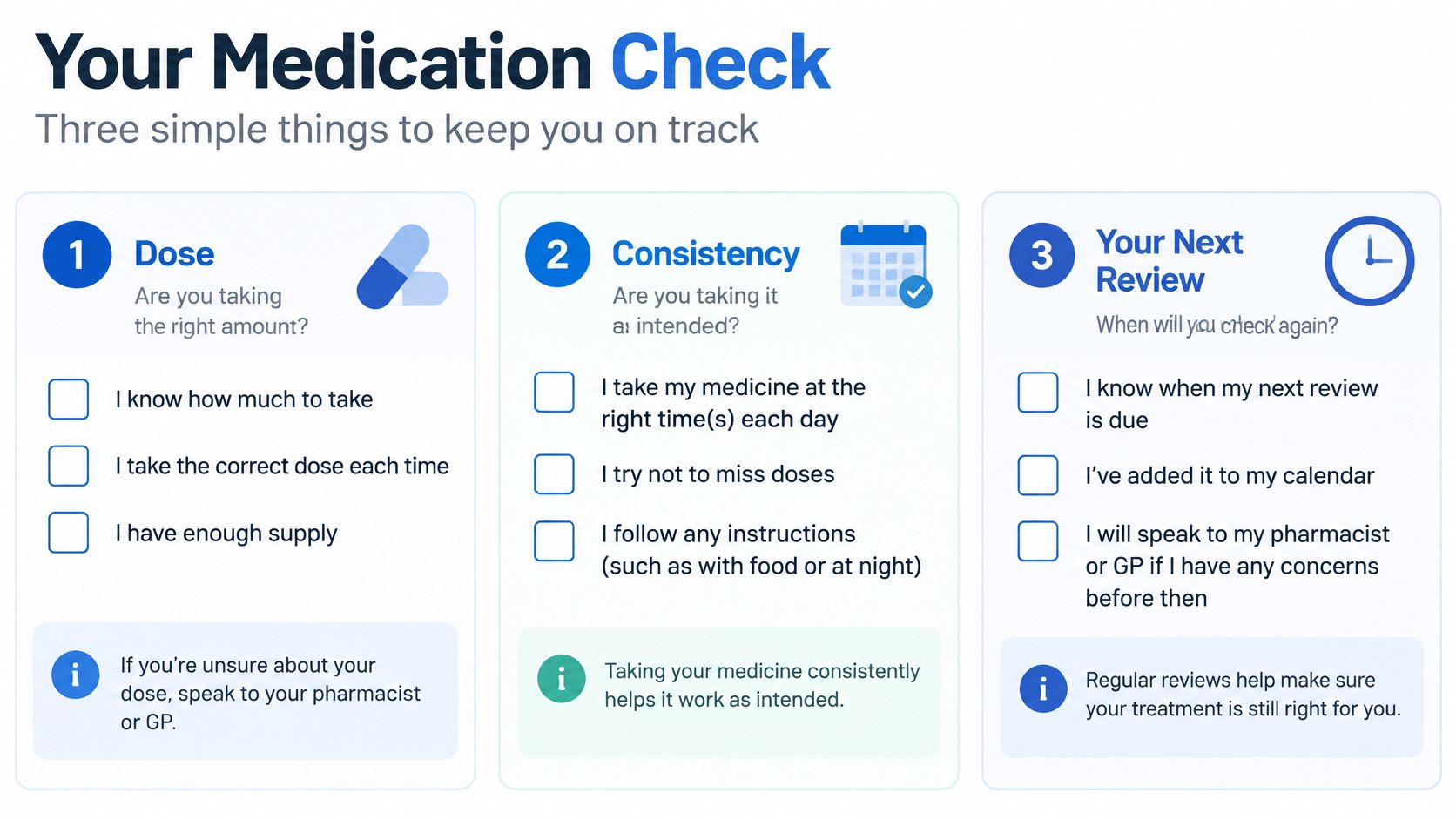
The right routine depends on why you are taking a supplement. A prescribed loading course, a maintenance dose and a multivitamin have different purposes, so follow the plan you have agreed with your clinician or pharmacist.
Consistency helps you judge whether that plan is working. Link a daily dose to a regular meal, or set a calendar reminder for a non-daily schedule. If you miss a dose, check the product leaflet or ask a pharmacist rather than doubling up.
Make administration part of the plan
Take vitamin D with a meal containing some fat. Tea and coffee can reduce iron absorption, so keep them away from an iron dose and ask a pharmacist how to space iron around other medicines.
If iron upsets your digestion, tell the prescriber. That gives them a chance to review how you take it or the product's suitability, rather than leaving you to stop or change the dose yourself.
Keep a simple record
A short record makes a review more useful. Note:
- Product and dose: Include the formulation and any other supplements containing the same nutrient.
- Start date: Record when you began taking it consistently.
- Reason: Note whether you are treating a confirmed deficiency, supporting your diet or investigating a symptom.
- Review date: Include the planned clinical check or blood test, if applicable.
- Changes: Track improvements, side effects and new symptoms.
For symptoms that need prompt attention, follow the guidance in the previous section. Pumpernickel Health Foods offers supplement consultations to help you compare labels and understand product timing. This support can complement clinical care, but persistent symptoms still need appropriate assessment.
Use your record to make the next review specific: what you take, how regularly you take it and what has changed. Agree how and when to judge the result, rather than waiting indefinitely.
Pumpernickel Health Foods sells multivitamins, vitamin D, vitamin C, B complex, magnesium, iron, zinc, calcium, fish oils and omega, and probiotics. Visit Pumpernickel Health Foods to explore the range or arrange a supplement consultation. Bring your current products and treatment plan to help compare suitable options and avoid unnecessary duplication.