
You're holding a bottle of vitamin D3 and K2, wondering whether it's better than the vitamin D already in your cupboard. Then you notice your multivitamin contains vitamin D too, and your calcium tablets might contain it as well. What looked like a simple purchase suddenly needs a calculator.
The sensible choice isn't necessarily the strongest formula or the one with the longest ingredient list. It's the product that supports your needs without duplicating what you already take, with a clear label and advice when medicines or medical conditions complicate the decision.
Table of Contents
- Do You Need Vitamin D3 and K2 Together?
- What Vitamin D3 and K2 Each Do in the Body
- How Much Vitamin D3 the UK Benchmarks Recommend
- Where Vitamin K2 Comes From and What the Evidence Shows
- How to Audit Your Vitamin D and K2 Intake Safely
- Three Shoppers and What Each Should Do
- Check Your Total Vitamin D Before You Buy
Do You Need Vitamin D3 and K2 Together?
For most healthy UK adults, vitamin D has a clear daily benchmark, while K2 isn't a routine required add-on. A combined product can be convenient, but you don't automatically need both in a supplement.
The UK government's nutrient guidance sets the vitamin D reference nutrient intake at 10 micrograms (400 IU) daily for everyone aged four and over, with seasonal supplementation and year-round advice for people at greater risk of low vitamin D.
Your circumstances matter more than a claim on the front of a bottle.
Do you need D3, K2 or both? By situation
| Situation | Vitamin D3 | Vitamin K2 | Talk to a clinician first? |
|---|---|---|---|
| Healthy adult, autumn to early March | 10 µg (400 IU) daily | From diet; no routine supplement | No |
| Child over 4 or adult with little sun or darker skin | 10 µg (400 IU) daily, year-round | From diet; no routine supplement | Ask if unsure |
| Diagnosed vitamin D deficiency | Dose set by a clinician | Only if a clinician advises | Yes |
| Taking warfarin | Keep to the advised dose | Vitamin K can reduce warfarin's effect; don't start without advice | Yes |
| Pregnant or breastfeeding | 10 µg (400 IU) daily in line with UK advice | From diet; no routine supplement | Yes, before higher strengths |
| Diagnosed bone disease or on bone medication | Set by prescriber | May be discussed with prescriber | Yes |
For a healthy adult, the practical action is to check whether an existing supplement already supplies the seasonal amount. For someone with limited sunlight exposure, the question is whether supplementation should continue throughout the year.
A diagnosed deficiency is a different situation. Don't choose treatment by copying a friend's dose or using the strongest product available. A clinician should determine the regimen and whether follow-up is needed.
If you take warfarin, don't add K2 independently or abruptly change an existing vitamin K supplement. Speak to your anticoagulant clinic, which can advise you alongside your usual monitoring.
Buying rule: A D3-and-K2 combination is a convenience, not a requirement. Choose it only when its ingredients, dose and suitability make sense for you.
What Vitamin D3 and K2 Each Do in the Body
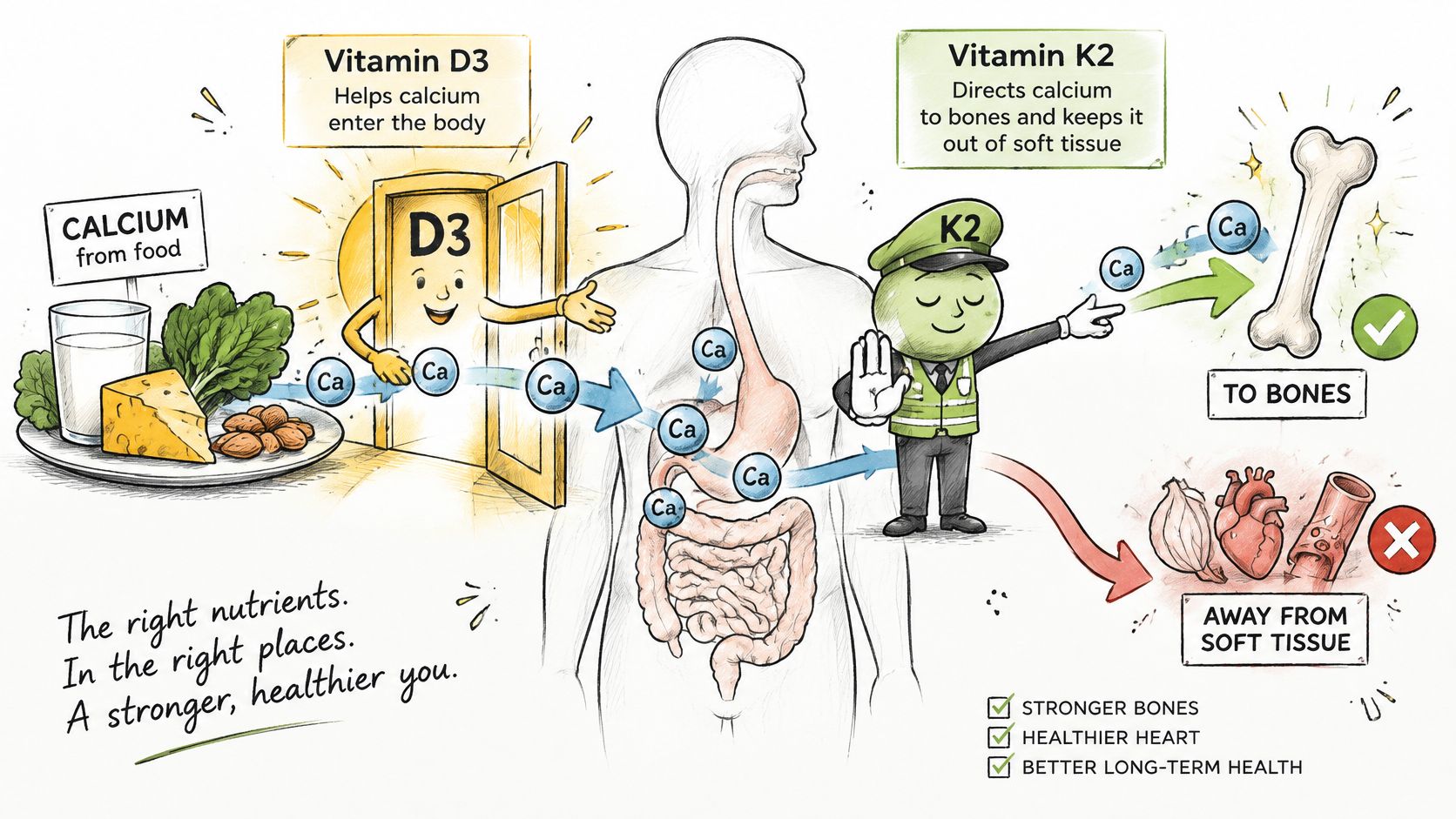
Calcium only becomes useful once it crosses the gut wall. Vitamin D supports that absorption step and helps keep calcium available for normal bone and muscle function. A meal can contain plenty of calcium and still underdeliver if vitamin D status is low.
Your skin makes vitamin D3 when UVB sunlight is strong enough. Food and supplements can also supply it, then the liver and kidneys convert it into forms the body can use.
The UK's winter sun does not provide enough vitamin-D-producing UVB, and diet alone is hard to rely on for the 10 µg daily target; the government's vitamin D deficiency guide sets out why that matters for bone and muscle health. Dietary sources include oily fish, liver and some fortified foods.
From absorption to bone metabolism
Vitamin K's clearest job is activation. It switches on vitamin-K-dependent proteins that take part in blood clotting and calcium handling, so its role reaches beyond bone alone.
Two of those proteins matter for the calcium story. Osteocalcin participates in bone mineralisation. Matrix Gla protein is involved in regulating calcification in soft tissues.
For a practical example, a labelled D3 supplement can make seasonal intake easier to manage because the daily serving is fixed. Whether K2 belongs alongside it depends on diet, medicines and the reason for supplementing; a combined capsule is not proof that extra K2 prevents calcium deposits or makes a high D dose safe.
Before combining products, check every label for vitamin D and vitamin K and add the daily servings together. For broader context, our guide to vitamin D beyond the sunshine vitamin explains the nutrient's wider place in everyday nutrition.
D3 helps the body absorb calcium; K2 helps activate proteins involved in directing its use. Neither replaces the other, and complementary roles do not mean everyone needs both as supplements.
How Much Vitamin D3 the UK Benchmarks Recommend
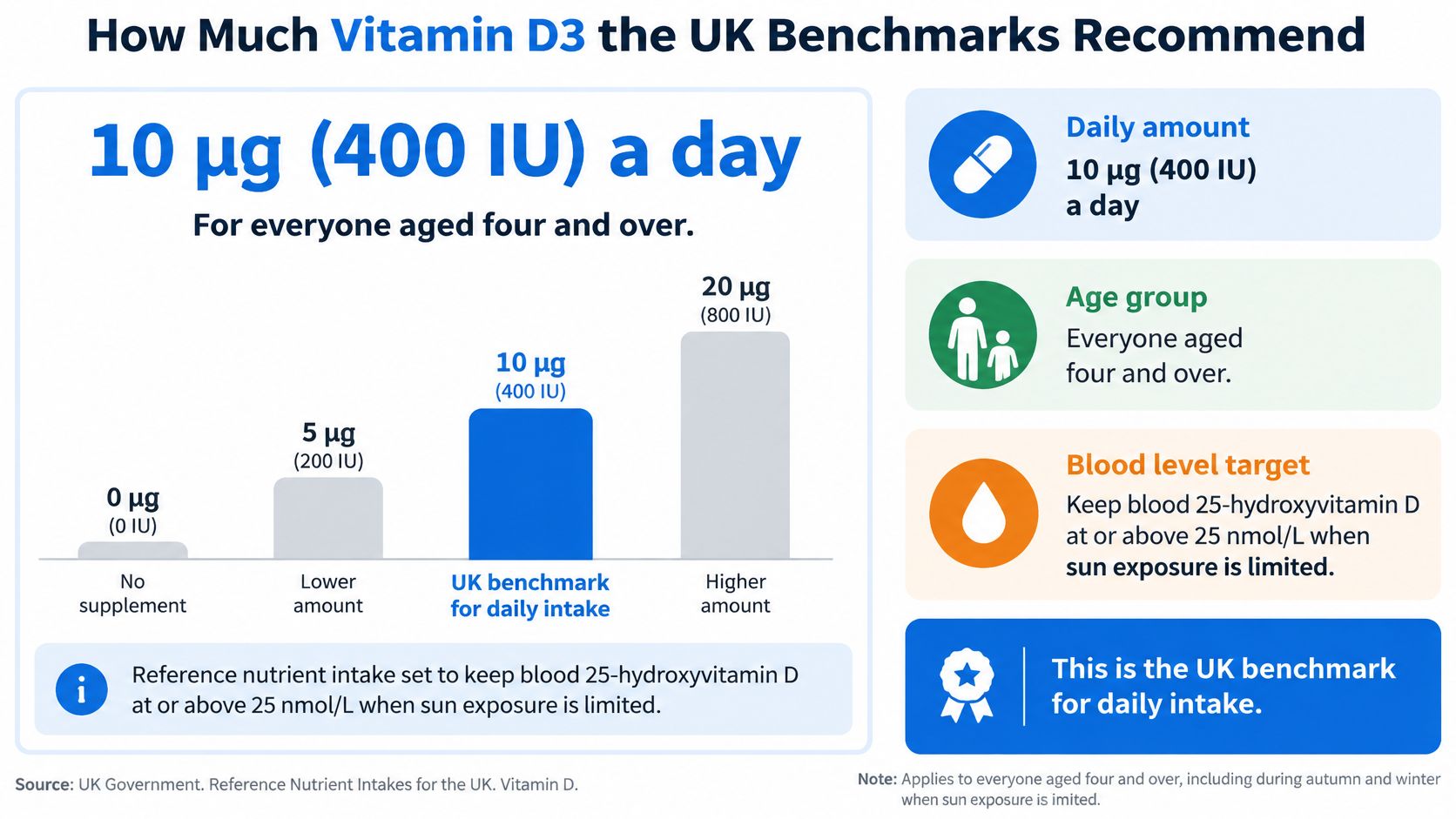
One figure anchors UK vitamin D advice: 10 µg a day. Everything else in the benchmarks below flows from it, including the safety ceiling at the top and the fallback strength in the middle.
UK vitamin D3 benchmarks by group
| Group | Daily D3 benchmark | Basis | Upper limit |
|---|---|---|---|
| Aged 4 and over, autumn and winter | 10 µg (400 IU) | UK reference nutrient intake | 100 µg (4,000 IU) for adults |
| Aged 4 and over, if no 10 µg product is available | Up to 25 µg (1,000 IU) | UK guidance for everyone | 100 µg (4,000 IU) for adults |
| Year-round, low sun exposure or higher-risk groups | 10 µg (400 IU) daily | UK advice for year-round supplementation | 100 µg (4,000 IU) for adults; seek age-specific advice for children |
| Pregnancy and breastfeeding | 10 µg (400 IU) daily | UK government advice | 100 µg (4,000 IU) for adults; discuss higher strengths with a clinician |
| Diagnosed deficiency | Set by a clinician | Treatment, not maintenance | Regimen and monitoring set by clinician |
These benchmarks cover vitamin D in every form, so a label that says "vitamin D3" still answers to the same numbers. The government's vitamin D evidence document explains that the 10 µg (400 IU) reference intake was designed to maintain blood 25-hydroxyvitamin D at or above 25 nmol/L when UVB exposure is minimal, and it places the adult upper level at 100 µg (4,000 IU) per day.
That upper level works like a speed limit. It marks the point where risk begins, so a sensible daily amount sits well below it, and children's ceilings are lower still. Any dose approaching it belongs in a clinician's hands.
For routine seasonal use, choose a label that makes the daily serving unmistakable. People with little sunlight exposure, those who cover most of their skin, and people with darker skin may need supplementation throughout the year. Pregnancy and breastfeeding call for a look at the whole supplement routine, since a multivitamin or combined formula may already contribute to the daily total.
A diagnosed deficiency follows a different path entirely. A low blood result may require a clinician-directed course with its own dose and monitoring, which sits outside the maintenance figures above.
When the exact strength isn't available
The government's lay summary on vitamin D and maternal health says 10 µg daily covers routine winter supplementation, and a product providing up to 25 µg (1,000 IU) is suitable if a lower-strength product can't be found. Check age suitability and serving instructions, particularly for children.
UK labels switch between micrograms and IU, which makes adding up a daily total harder than it should be. For label reading, 1 µg equals 40 IU. The equivalents:
- Routine benchmark: 10 µg = 400 IU.
- Alternative product strength: 25 µg = 1,000 IU.
- Adult upper level: 100 µg = 4,000 IU.
Where Vitamin K2 Comes From and What the Evidence Shows
MK-4 and MK-7 come from different foods and remain in circulation for different lengths of time.
Vitamin K2 forms compared
| Form | Main food sources | Approximate half-life |
|---|---|---|
| MK-4 | Egg yolk, chicken liver, butter, some cheese | Short, measured in hours |
| MK-7 | Natto and other fermented foods | Longer-lasting than MK-4 |
Half-life is the time a substance remains in circulation. MK-7's longer persistence explains its use in once-daily formulas. Persistence still leaves the practical questions open: the right amount for an individual, and whether health outcomes improve.
Food sources need some perspective too. Natto is fermented soya, and it rarely features in UK diets. Eggs, liver and some cheeses can contribute K2, although counting portions gives only a rough impression because the composition varies between foods and products.
What a biological mechanism can show
The British Heart Foundation's expert Q&A on whether you need to take vitamin D explains established advice around vitamin D supplementation. It provides a useful benchmark for separating routine vitamin D guidance from wider claims that every adult should add K2.
Researchers can measure whether a supplement activates proteins involved in calcium handling or changes a bone-turnover marker. Those results show biological activity. They do not by themselves prove fewer fractures, less arterial calcification or fewer cardiovascular events.
The UK guidance in this article sets a vitamin D maintenance benchmark and supplies no K2-specific daily target. Treat online D3-to-K2 ratios as product suggestions; UK guidance gives no matching K2 figure to check them against.
- Start with food: Consider whether your diet includes natto, eggs, liver or some cheese.
- Inspect the label: Identify the K2 form and the amount per daily serving.
- Get medication advice: Check with your prescriber before adding K2, especially during anticoagulant treatment.
For a closer look at how researchers weigh vitamin K findings, see our review of vitamin K and lung-health research.
How to Audit Your Vitamin D and K2 Intake Safely
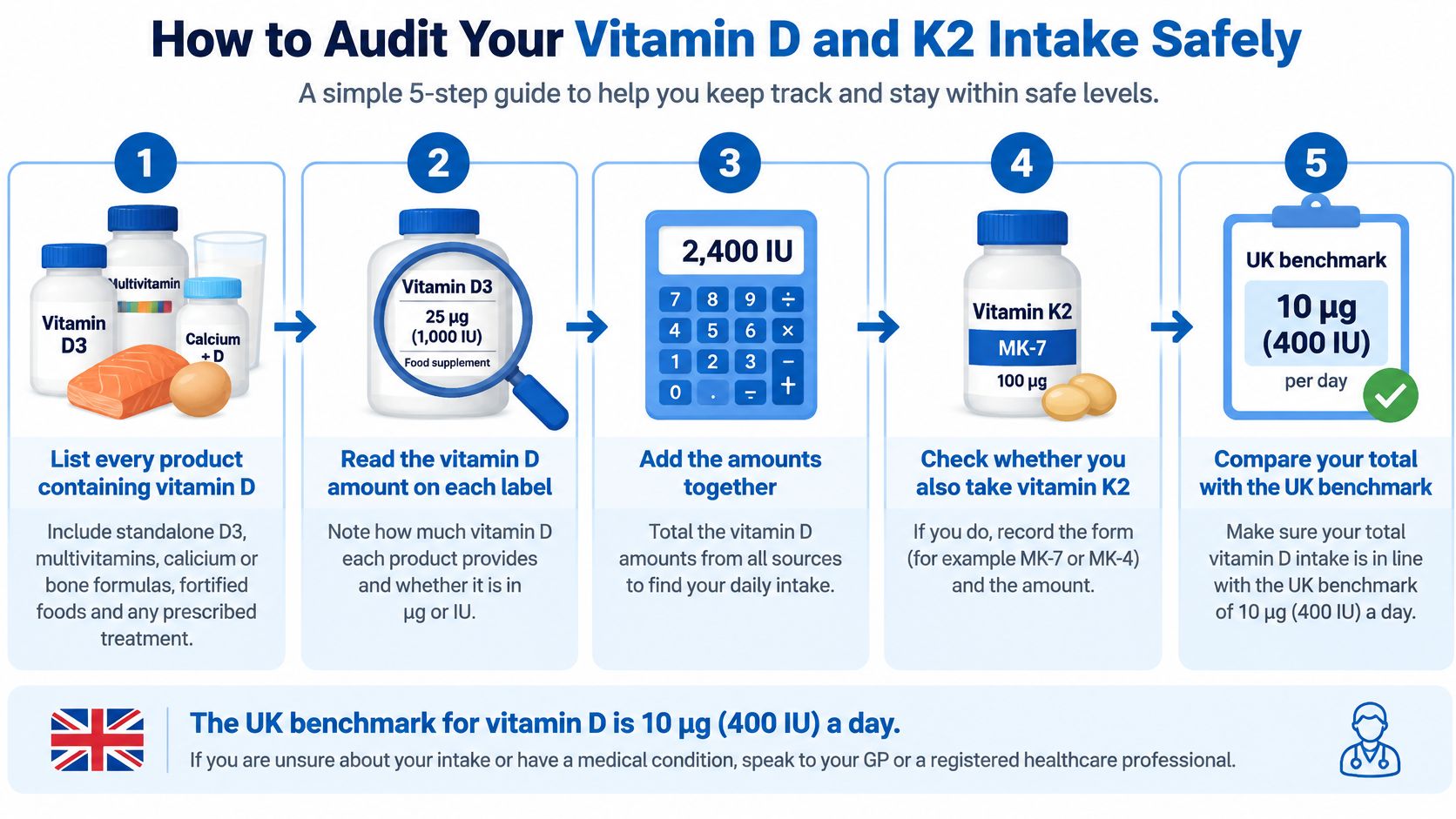
Put every relevant packet on the kitchen table and open a note on your phone. Record the amount taken each day, not just the figure printed prominently on the front.
The government's assessment of excess vitamin D intake identifies an adult upper limit of 100 µg (4,000 IU) daily and warns that excessive intake can cause raised calcium in the blood and urine, with possible kidney and cardiovascular consequences.
Your cupboard audit
List every source. Include standalone D3, multivitamins, calcium or bone formulas, fortified foods and prescribed vitamin D. A product marketed for something else may still contribute.
Read the daily-serving line. Check whether the amount is per tablet, capsule, drop or full recommended serving. For fortified food, use the portion you consume.
Use one unit throughout. Convert IU to micrograms by dividing by forty. Don't add an IU figure directly to a microgram figure.
Add the daily amounts. Keep prescribed intermittent treatment separate and ask your pharmacist how it should fit with other supplements. Don't turn an occasional dose into a self-designed daily schedule.
Compare the total with the maintenance benchmark and adult ceiling. Include food as well as supplements where you can quantify it. Staying below the ceiling doesn't mean a larger-than-needed dose offers extra benefit.
Check for duplication and record K2 separately. A calcium formula plus a D3 drop can duplicate vitamin D without you noticing. Note the K2 form and amount, but don't add it to the vitamin D total.
Flag anything needing professional review. Speak to a GP or pharmacist about high doses, a total exceeding the adult ceiling, pregnancy, breastfeeding, relevant medicines or prescribed treatment. Don't stop prescribed treatment independently.
This visual is a useful reminder to keep the whole routine together.
Safety check: K2 isn't a shield against excessive D3. A combination formula doesn't remove the need to check your total.
If several nutrients overlap, our guide to whether you can take too many vitamins can help you organise the wider review.
Three Shoppers and What Each Should Do
These hypothetical shoppers show how the same label-checking method leads to different decisions. The visual offers a reminder to match supplement choices to the person.

The multivitamin user
A hypothetical 40-year-old takes a multivitamin supplying 10 µg of vitamin D and adds a 2,000 IU D3 drop. In this example, the drop supplies 50 µg.
10 µg + 50 µg = 60 µg daily from supplements.
That's below the adult ceiling, but the extra product isn't generally needed for routine winter maintenance. Ask a pharmacist to review whether the standalone drop is necessary.
The calcium-formula user
A hypothetical 70-year-old takes a calcium tablet containing D3 and K2 alongside a separate high-strength D3 capsule. Without the labels, nobody can safely calculate the total.
Calcium formula's D3 in µg + separate capsule's D3 in µg = daily supplemental vitamin D.
Convert any IU figure before adding, then include other sources. Bring both packets to a pharmacist for a combined-dose review.
The accompanying video provides another format for exploring the topic.
The warfarin user
Another shopper reads that K2 supports calcium handling and wants to add it to their routine. Their priority isn't calculating a vitamin ratio, because vitamin K can interfere with their anticoagulant treatment.
Current vitamin K routine + proposed K2 supplement = a medication-review question.
Contact the anticoagulant clinic before starting K2.
Check Your Total Vitamin D Before You Buy
A useful supplement should make your routine clearer, not harder to manage. Before buying a combined product, check its vitamin D amount per daily serving, convert the units and see whether it duplicates anything in your cupboard.
Our options include Calcium/Magnesium/Vitamin D3 with Vitamin K2 Tablets at £16.95 and Calcium & Vitamin K2 capsules at £11.95. Treat these as labels to compare, not automatic recommendations: read the D3 content where present rather than inferring it from the product category.
High strength needs a separate decision
Vitamin D3 10,000iu Vegicaps provide 250 µg per capsule, two and a half times the adult daily upper limit. They're intended for occasional rather than daily use and shouldn't become a routine supplement without professional advice.
Vitamin D3 20,000iu Vegicaps are vegetarian capsules providing 500 µg of cholecalciferol per capsule, also intended for occasional rather than daily use. Don't design an intermittent regimen yourself.
Bring these details to a pharmacist or clinician:
- Medicines: Include prescribed and non-prescription products.
- Personal circumstances: Mention pregnancy, breastfeeding and bone conditions.
- Existing intake: Bring your vitamin D audit and photographs of labels.
If you're also interpreting a separate low B12 result, Vital iQ Health's guide to next steps after low B12 results offers context for that different clinical question. Don't assume one vitamin's treatment applies to another.
We offer free pre-booked one-to-one consultations with supplement specialists, plus advice by phone and WhatsApp. Our shop at 7 The Arcade, Bedford, is open Monday to Saturday, 9:30 to 17:15, and you can call 01234 348179.
Choose the product that meets your needs and fits your audit, not the one with the most numbers on the label.
Bring your supplement labels to Pumpernickel Health Foods for help comparing vitamin D3 and K2 options and spotting duplicated ingredients. Book a free one-to-one consultation or contact our Bedford team by phone or WhatsApp, so you can choose a manageable routine and identify any questions that need a pharmacist's advice.